Polluted air in Minnesota, past and present
Jul 17, 2026 | 11:14 am ET
Description
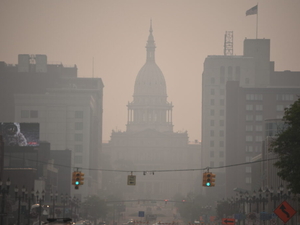
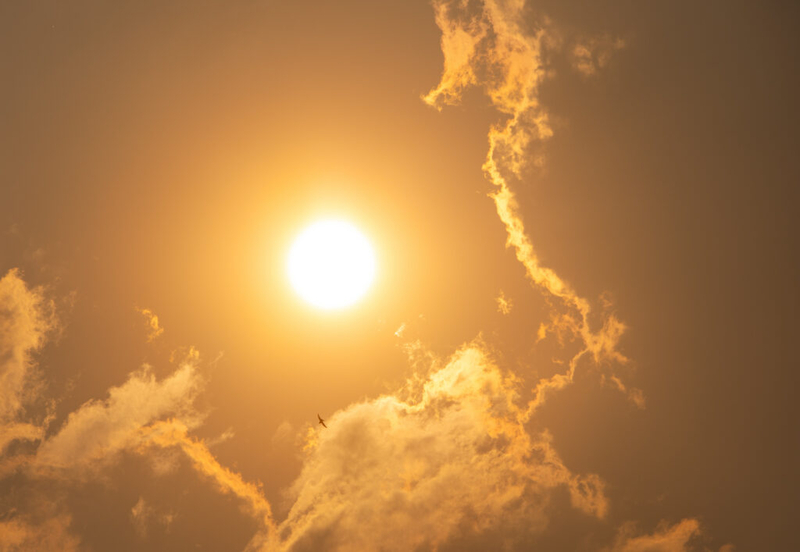
A hot hazy day in Minneapolis, July 15, 2026. Wildfire smoke moved south from fires in northeastern Minnesota and Canada. (Photo by Nicole Neri/Minnesota Reformer)
Smoke from out-of-control wildfires in northern Minnesota and Canada continued to migrate south Thursday, leading to hazardous air quality levels in much of Minnesota. Air quality improved somewhat in the southern and western parts of the state Friday but continued to be hazardous in northeastern Minnesota.
Thursday was the first time on record that the Twin Cities metro area has seen a “hazardous” air quality designation, the Minnesota Pollution Control Agency said.
Minneapolis was the most polluted major city on Earth at some points Thursday, according to Swiss air quality company IQAir, alternating with Chicago and Detroit. The smoke has spread from Ontario and Superior National Forest to the Upper Midwest, across the Great Lakes region and parts of the East Coast.
Friday was also yet another day in a statewide heat wave that began over the weekend. The metro area continues to be under an extreme heat warning until Friday night.
Air quality reached “unhealthy,” “very unhealthy” or “hazardous” levels in most of Minnesota Thursday. At those levels, poor air quality poses risks for everyone, the Minnesota Pollution Control Agency warned. The agency issued an air quality alert for most of the state except southwest Minnesota, in effect until Friday at 11 a.m.
The air quality forecast looks to improve by Saturday except for northeastern Minnesota, with Friday rain on the fires as well as a cold front helping to quell the smoke and pollution. Still, the agency said uncertainty remains high and that smoke could return to western Minnesota.
At hazardous air levels, most people will get irritated eyes, nose and throat; coughing; chest tightness; or shortness of breath. Anyone could experience serious heart and lung effects such as asthma attacks, heart attacks or strokes, the agency said. In unhealthy air levels, the agency recommends that everyone reduce outdoor physical activities; in hazardous air, the agency recommends that everyone avoid outdoor physical activity altogether.
Hot temperatures and poor air quality can aggravate pre-existing health conditions. The agency lists groups who might be more sensitive or exposed to poor air quality, including people with asthma, heart disease, high blood pressure and diabetes, as well children and pregnant women. People who work outside, and those who don’t have air conditioning and open their windows to keep cool, are also at elevated risks. If you have symptoms, call your healthcare provider or 911 in an emergency.
Air quality index, or AQI, is a system for measuring air pollution and categorizing pollution into color-coded risk levels for easy communication. An AQI below 50 corresponds to good air quality; an AQI of 100 triggers alerts that the air is “unhealthy for sensitive groups.” Duluth had AQI levels above 500 this week.
Stricter air quality rules around tailpipe emissions and power generation from both state and federal levels led to improved air quality in the 2010s, with daily fine particle pollution reaching a low in 2017.
In recent years, wildfires have become more extreme, thanks to largely human-caused climate change and, seemingly paradoxically, the historical practice of putting out fires immediately, which leads to fuel buildup. That’s led to more wildfire smoke in Minnesota in recent years, reversing those improvements in air pollution.
In 2021, wildfire smoke first pushed the air quality index level above 200 in parts of the state for the first time, to “very unhealthy” and “hazardous” levels. Canadian wildfires also led to poor air quality in 2023; Minnesota had the worst air quality in the country on June 14, 2023. That year saw nearly 50 air quality alerts, some of which occurred in January.
Wildfire smoke in 2025 eclipsed 2021 and 2023, earning the name “Great Minnesota Smokeout” from the state Department of Natural Resources, which said 2025 was likely the smokiest year in five decades or more in terms of the frequency of bad air quality.
The state did not meet air quality standards in 2025 for fine particles, also known as PM2.5, which refers to particles under 2.5 micrometers in diameter. It’s close to failing the air quality standard for ground-level ozone, a toxic gas that’s formed when sunlight reacts with pollutants from burning fuels or using chemicals. Both kinds of pollution have various sources — vehicles, industrial emissions, winter home heating.
Wildfires create fine particle pollution as well as pollutants that form ozone. In a 2025 report, the Minnesota Pollution Control Agency attributed increased ozone levels and fine particle levels — two measures of dangerous pollutants — to drought conditions. Drought conditions contribute to wildfires, which leads to fine particle pollution, while decreasing cloud cover and precipitation, which leads to more ozone formation.
The report noted that the agency issued its first-ever combined air quality alert for fine particles and ozone from Canadian wildfires in 2023.
On Thursday, the Twin Cities metro area had AQI levels above 300. St. Paul smelled noticeably of smoke.

Saint Paul, MN