Wildfire smoke creates health concerns across Michigan, resulting in closures and cancellations
Jul 17, 2026 | 1:09 pm ET
Description
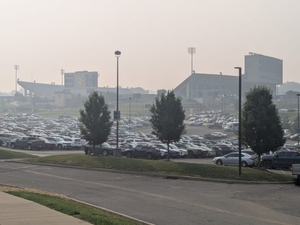
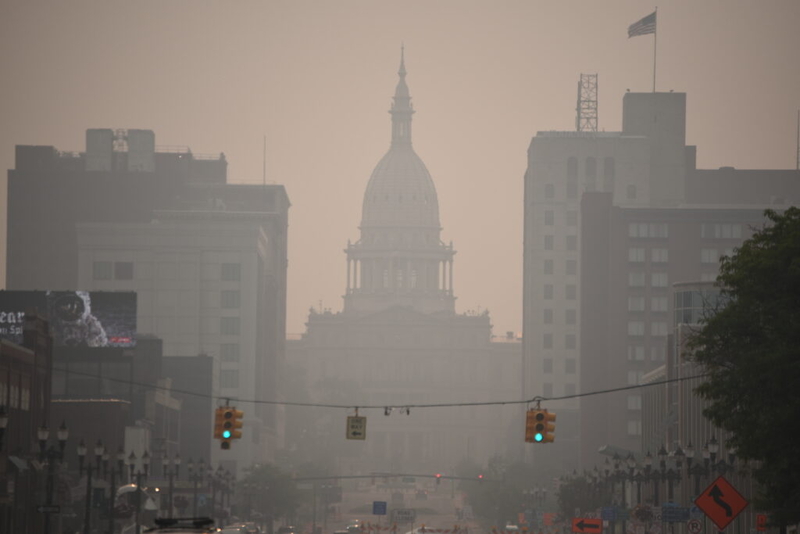
The Michigan State Capitol, visible through wildfire smoke. July 16, 2026. | Photo by Katherine Dailey/Michigan Advance.
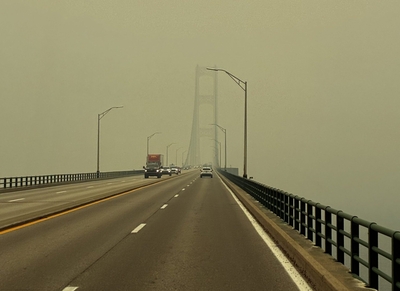
As a sepia-toned haze continues to blanket communities throughout Michigan, some government offices, local businesses and event hosts are closing up shop, as state officials urge residents to limit their time outdoors due to hazardous air quality.
Smoke from Canadian wildfires has worsened air quality across the Great Lakes region, with the Michigan Department of Environment, Great Lakes and Energy maintaining an air quality alert for Friday and Saturday.
Air quality will be in the “Hazardous” range for the Upper Peninsula Friday, and in the “Very Unhealthy” range for the Lower Peninsula, according to EGLE.
The U.S. Interagency Wildland Fire Air Quality Response Program’s Smoke Outlook notes that conditions are expected to improve across the southwest portion of the state as winds push smoke out of the region.
While Grand Rapids can expect to see air quality improvements this evening, and Detroit will see better conditions overnight, the Friday forecast notes that the Upper Peninsula will not see the same benefits.
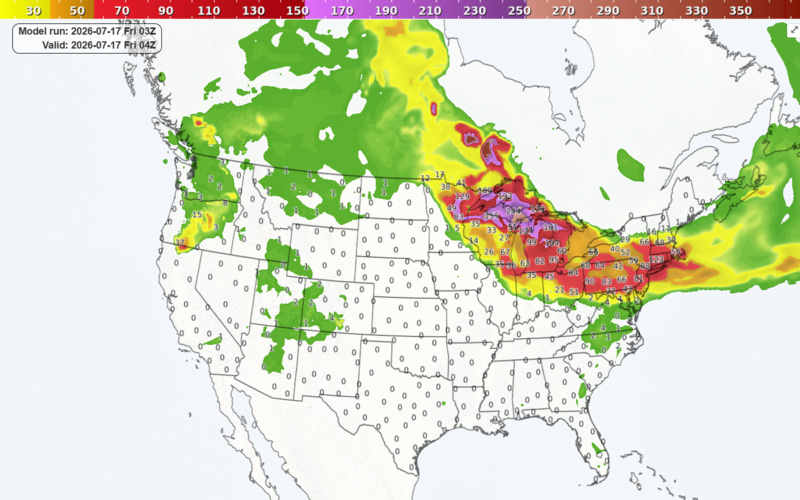
By Saturday, most areas save for the Upper Peninsula can expect to see “moderate” air quality, though winds are expected to shift, bringing smoke back across much of the Great Lakes region Saturday evening into Sunday, according to the Smoke Outlook.
Poor air quality has already disrupted community events and government operations, with the Third Judicial Circuit Court of Michigan, located in Downtown Detroit, closed its in-person operations Thursday, and remaining closed on Friday. The Oakland County Clerk and Register of Deeds also closed down offices Thursday due to the hazardous air quality.
Some outdoor events, like the third annual Rx Kids Baby Parade in Flint, intended to offer resources and raise awareness for maternal and child health, was canceled. The Ann Arbor Art Fair has given its exhibitors the option to operate on a reduced schedule, instead of the scheduled 10 a.m. to 9 p.m. hours.
Officials urge residents to take steps to protect their health
Because of the unhealthy air quality across the state, the Michigan Department of Health and Human Services and local governments are offering recommendations for how individuals can protect their health, including keeping their activity levels low and spending less time outdoors when possible.
Breathing wildfire smoke can cause stinging eyes, coughing, wheezing and shortness of breath, as well as more serious effects like asthma attacks and heart failure. Individuals with heart disease and lung disease, like asthma and chronic obstructive pulmonary disease, are at greater risk of facing negative health effects from wildfire smoke, as are adults 60 and older, children and teenagers, pregnant people and outdoor workers.
While indoors, the Department of Health and Human Services advises residents to close windows and limit opening exterior doors. If their heating, ventilation and air conditioning systems are not equipped with a MERV-13 filter, a high-efficiency air filter rating, or something higher, the Department recommends using portable air cleaners and, if possible, closing the outdoor air intake on air conditioners.
The Department advised those without portable air cleaners to consider making a DIY cleaner, which can be made using a box fan and a MERV-13 filter.
DHHS advised against burning candles, vacuuming without a HEPA filter, smoking, spraying aerosols and using gas stoves more than necessary to avoid making the air quality worse.
It also recommended rescheduling outdoor activities or moving them inside.
For those who must be outside, the department recommends wearing an N95 or P100 respirator masks, noting that it should fit tightly and collapse when breathing in, not letting air in from the sides. Masks should not be used for children younger than 2.
DHHS also advised employers to make accommodations for employees to work inside with proper HVAC systems and high-efficiency air filters, when possible.
People experiencing shortness of breath, persistent or severe coughing, chest pain, dizziness, confusion, changes in consciousness or worsening chronic conditions should seek medical care.
More information is available at the department’s Your Health and Wildfire Smoke webpage.
Lansing, MI