Regional earthquake experts say more coordination, investment needed to prepare for ‘Big One’
Jul 17, 2026 | 9:00 am ET
Description
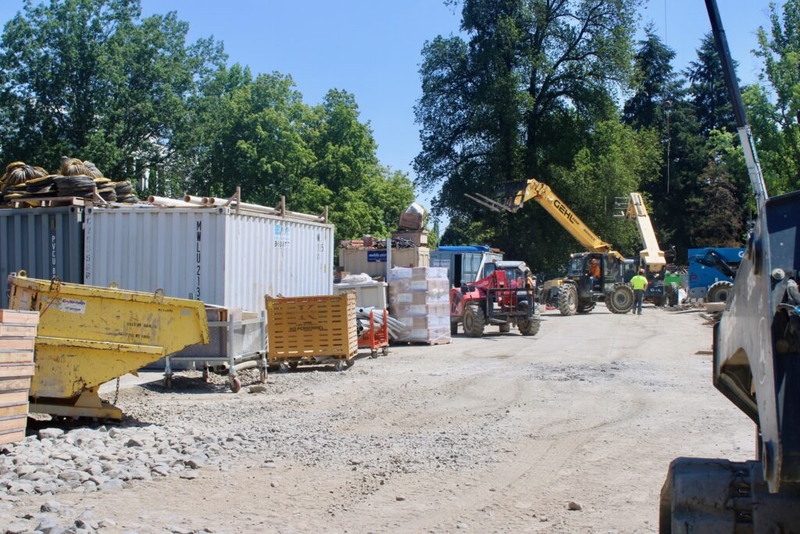
Construction workers and vehicles move around the Capitol in Salem finishing up a years-long, $598 million seismic retrofitting project. Gov. Kotek in 2025 ordered state agencies to begin planning to earthquake-proof large buildings.
(Photo by Julia Shumway/Oregon Capital Chronicle)
PORTLAND — If the “Big One” — the anticipated massive Cascadia Subduction Zone earthquake — hit today, Oregonians west of the Cascades would be luckiest to find themselves at the recently-retrofitted state Capitol in Salem or on the roof of the new terminal at the Portland International Airport.
The comment from Tom Wharton, an engineer at the Port of Portland, drew laughs from an audience Thursday at the 13th annual National Conference on Earthquake Engineering in Portland, but it wasn’t entirely a joke. Jonna Papaefthimiou, state resilience officer in Gov. Tina Kotek’s office, said few of the 4,000 buildings the state owns would survive. Just five would likely remain standing and be immediately usable in the weeks and months after, she said.
The Port of Portland and the governor’s office are among the members of the region-wide multi-agency Cascadia Lifelines Program housed at Oregon State University, operating as a think tank for stakeholders who meet twice annually to discuss preparation for what seismologists project will be a 7.4 or greater magnitude earthquake in the Northwest in the next 50 years.
The Cascadia Subduction Zone quake occurs off the coasts of Oregon, Washington and California every 500 years and was last recorded in 1700. It could cause Northwest coastlines to lower and retreat, spur widespread flooding and landslides and displace millions of people.
Disaster prep advocates face pushback over raising seismic standard for new school construction
The experts discussed progress: Renovations at the Portland airport and state Capitol that made the buildings more likely to withstand earthquakes, a plan to ensure Washington County residents have access to water sourced from beyond Portland’s system and Kotek’s 2025 executive order mandating large state-owned buildings be retrofitted during the next 35 years and new ones be built to a worst-case-scenario earthquake code.
But the experts also discussed policies that they say should be enacted urgently.
If coastal U.S. Route 101 isn’t retrofitted before the Big One hits and shuts down for any extended period following the quake, “then you’ve lost those coastal communities, and you’re not going to get those back,” said Mike Olsen, an Oregon State University civil engineering professor and the director of the Cascadia Lifelines Program.
The highway is also already under frequent threats of coastal landslides and flooding.
“We don’t need to wait for the earthquake to cause a lot of damage to it. It’s already under a lot of pressure,” he said.
Race to retrofit
In coastal areas that will be most heavily impacted, and that are heavily reliant on grid power from the Bonneville Power Administration, policies that promote community microgrids and battery storage will be key to post-quake recovery, said Leon Kempner, a BPA engineer.
BPA controls most of the Northwest electricity distribution grid. In some coastal areas, such as Lincoln City, it is the source of nearly all power.
Kempner said the agency is racing to retrofit the grid to withstand earthquakes, but it didn’t start implementing seismic code into projects until the 1980s, and it lacks resources to move as quickly as needed.
He also suggested that the Oregon and Washington state legislatures should require BPA and all regional utilities to regularly report to state officials on what they are doing to prepare for the Big One to increase awareness, transparency about planning gaps and potential for collaboration.
Wharton, who explained that much of the state would rely on the airport and the port’s four Willamette and Columbia river terminals to receive recovery aid, said the Port of Portland needs nearly $500 million to upgrade a runway that can survive the quake and handle large Federal Emergency Management Agency aircraft, and other aircraft, landing for support or evacuation.
Port officials will meet with Kotek’s office in the next few weeks to discuss some potential budget requests, he and Papaefthimiou said. Some funding could also come from requesting an advance on annual maintenance dollars from the Federal Aviation Administration or grants from FEMA, “as long as FEMA still exists,” Wharton said.
A recent study by the National Institute of Building Sciences found that the, for now, roughly $450 million investment would have a net $7 billion savings benefit for the state as it tries to recover and rebuild after the quake, he said. But none of that matters if roads and bridges are unusable or nonexistent.
Critical corridors
The Oregon Department of Transportation has identified $40 billion worth of bridge deficiencies that, if left unaddressed, leave them vulnerable to the quake, said Yumei Wang, a civil engineering and infrastructure resilience and risk expert from Portland State University.
Olsen and other experts also called for more investment in preparing a disaster response workforce for the state and the region, which would require months of emergency attention and years of rebuilding. Everyone agreed that municipal governments, state leaders, and all regional infrastructure stakeholders need to be more regularly talking and planning together, now.
Mike Britch, an engineering and construction manager at Tualatin Valley Water District, is overseeing a $1.6 billion water infrastructure project to shift the half of Tualatin that relies on water from the Portland Water Bureau to water sourced from the Joint Water Commission that also supplies water to the cities of Hillsboro, Forest Grove and Beaverton.
Part of the project involved building a 2,000 foot “micro tunnel” under the Tualatin River to transport drinking water. Above it, the Roy Rogers Road bridge over the river would not survive the Big One, Britch said, leaving people south of the bridge stranded and unable to get to any area hospitals.
“If I could create a policy and make people do things, I would say I want the state to identify some of these really critical corridors,” he said. “We need some sort of policy to address that.”
- July 30, 202612:08 pmCORRECTION: The Oregon Department of Transportation has identified $40 billion worth of bridge deficiencies, not $40 million as previously reported.
Salem, OR