Trump resurrects debunked Muskegon voter fraud allegations after prior investigations
Jul 17, 2026 | 11:12 am ET
Description
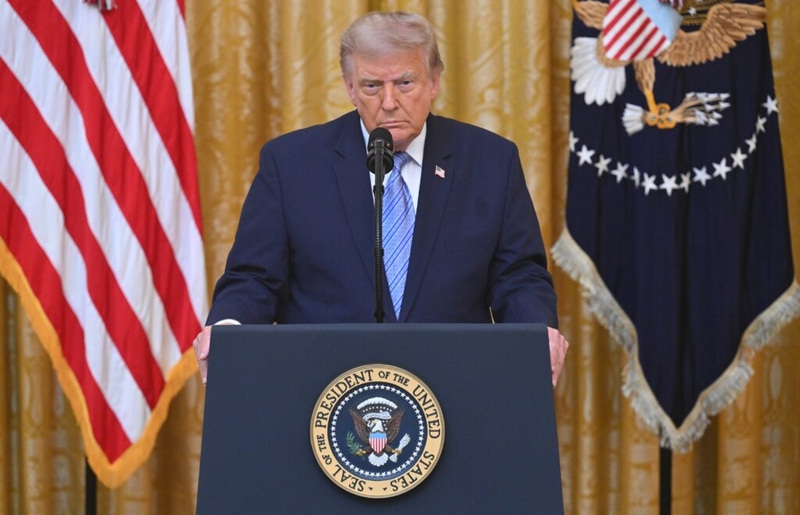
President Donald Trump addresses the nation from the East Room of the White House on July 16, 2026 in Washington, D.C. (Photo by Saul Loeb/Getty Images)
In the middle of President Donald Trump’s primetime speech on Thursday, he pointed to Muskegon to demonstrate what he called “evidence of alleged fraud by a large-scale voter registration operation in Michigan” during the 2020 election cycle.
The allegations, which Trump called “pay, play and cheat,” were investigated by both state-level agencies and the FBI, and local officials have repeatedly confirmed that it did not result in any illegal ballots being sent out or illegal votes being cast.
The allegations surround a number of voter registrations received by the Muskegon City Clerk’s Office in October 2020, which were flagged as fraudulent based on non-existent addresses, invalid telephone numbers or signatures that did not match records. That was referred to and investigated by the Michigan State Police, Muskegon Police Department and Michigan Department of the Attorney General, who then reported it to the FBI office in Detroit.
“Fraudulent voter registration forms had been created, but no fraudulent voter registrations were processed, and no ballots were cast,” Patrick Agema, a Michigan State Police spokesperson, told Michigan Advance, adding that the investigation showed that the fraud was committed by low-level employees who sought to inflate their work output, not as part of an organized effort to compromise the infrastructure of Michigan’s election.
8 Republicans introduce articles of impeachment against Democratic Attorney General Dana Nessel
That echoes Michigan State Police statements from 2023, when the case was a central part of articles of impeachment brought against Attorney General Dana Nessel by far-right members of the state House. The investigation was turned over to the FBI in 2021, meaning they held the ability to decide on prosecutions.
“The Michigan election safeguards worked as intended in this case,” Agema said.
In 2020, just after the irregular registrations were noticed, Muskegon City Clerk Ann Meisch similarly said that none of the registrations in question resulted in any ballots being sent out incorrectly.
The allegations were part of broader claims of “vulnerabilities” in the nation’s electoral system — claims that were swiftly decried by election advocates and Democrats alike.
In Trump’s speech, he alleged that federal law enforcement, under the Biden administration, failed to prosecute anyone involved in the case — though the case was closed after Trump took office for his second term, according to a trove of documents on the case released on the White House website.
“No further investigation is warranted because logical investigation and/or leads have been exhausted, and the investigation to date did not identify a criminal violation or a priority threat to national security,” states a Sept. 25, 2025 memo in which the FBI Detroit, Grand Rapids Resident Agency closed the investigation.
“The FBI agents working on the case believe that crimes were committed, yet the Biden Department of Justice slow-walked the investigation and killed it,” Trump said in his speech, further directing FBI Director Kash Patel to “ensure that the matter is fully investigated” and work with the DOJ to “prosecute those responsible for any crimes.”
Another document released by the White House shows a November 2021 email from an individual whose name is redacted but who is identified as part of the Detroit Field Office for the FBI, in which they express concerns about closing the case.
“Although it doesn’t appear [REDACTED] was paying on a per-registration basis, it is reasonable for the canvassers to believe they would not keep the job if they weren’t somewhat productive, and regardless of what they believed, they still submitted fraudulent voter registration applications,” the email states. “I understand that proving this was done ‘willfully’ would still be difficult, but I wanted to raise my concerns before closing the case.”
The decision not to seek prosecution, the emails state, was agreed upon by the U.S. Attorney’s Office and the FBI, as well as the DOJ’s Public Integrity Section.
A March 2022 email, however, explained that the DOJ’s Public Integrity Section did not concur with a full field investigation into the case in Muskegon “focused purely on the voter registration fraud that has been investigated by State law enforcement officials.” The agency did concur in conducting a preliminary investigation.
Republican state legislators used Trump’s speech as a chance to similarly rehash their own election-related grievances.
State Rep. Rachelle Smit (R-Martin), who chairs the House Election Integrity Committee, said in a press release, “Last night, President Trump said what Michigan Republicans have been saying for years; the damning allegations out of Muskegon surrounding the 2020 election must be thoroughly investigated and, if necessary, prosecuted.”
Smit, who in 2024 sent a letter alongside Rep. Jay DeBoyer to then-FBI Director Christopher Wray requesting a meeting with FBI agents to ensure an investigation into the case in Muskegon was underway, also criticized “the limp and useless tenure of President Biden failed to hash out any of the real and documented concerns in our election systems.”
On the Democratic side, state Sen. Jeremy Moss (D-Bloomfield), chair of the Senate Elections and Ethics Committee, used Trump’s speech to highlight the chamber’s passage of the Michigan Voting Rights Act as necessary in the face of election disinformation.
“When the president talks about elections, it’s because he’s afraid of the outcome, not the process,” Moss wrote in a press release. “He turns to scare tactics when he can’t stand on substance. He seemed to trust the process fine in 2016 and again in 2024, but continues to peddle lies about the election he lost in 2020. Here in Michigan, we’re not buying it. I have worked together with my colleagues to make sure voting is easy, safe, and secure.”
Lansing, MI