A Democratic party divide sharpens into focus in Providence mayoral debate
Jul 17, 2026 | 4:51 pm ET
Description
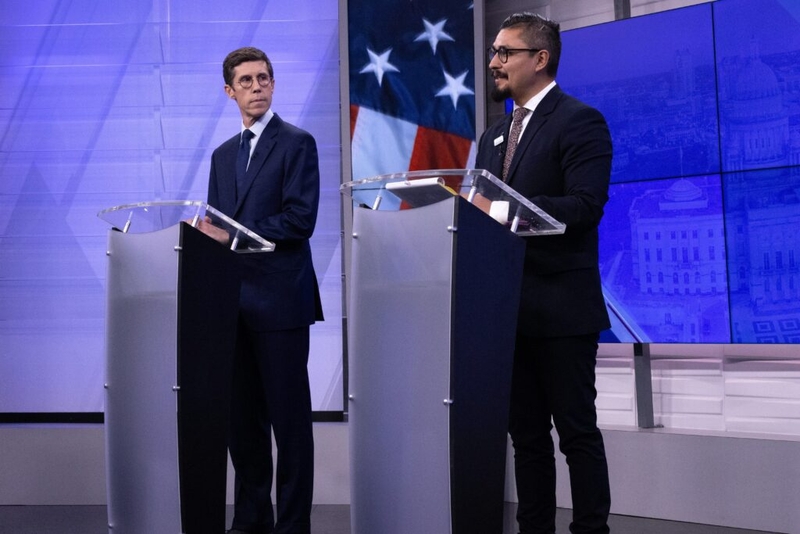
Providence Mayor Brett Smiley, left, and state Rep. David Morales participate in a Democratic mayoral primary debate at WPRI 12 in East Providence on Friday, July 17, 2026. (Photo by James Bartone/WPRI 12)
A monitor inside WPRI’s East Providence studio announced the allotted runtime for Providence Mayor Brett Smiley and his Democratic challenger, state Rep. David Morales: 26 minutes and 45 seconds.
“It’s going to go by quick,” moderator Tim White told each candidate, instructing them to direct their closing statement at the camera “that’s very tall.”
That timespan allowed Smiley and Morales to illustrate, inadvertently or not, a hypothesis floated by moderator Ted Nesi.
“This campaign has become partly a proxy battle among the different factions fighting for control of the Democratic Party,” Nesi suggested.
The full debate taped Friday morning, the first televised matchup between the two candidates, was moderated by Nesi, White and their colleague Alexandra Leslie, and it’s available online on WPRI’s website. It’s also set to air Friday at 6:30 p.m. and Sunday at 10 a.m. on Fox Providence.
Smiley cast Morales as an ideologue lacking experience.
“He is part of a national movement and is not interested in actually solving problems for Providence residents, which is what I’m focused on,” Smiley said, pointing to good schools, safe streets and municipal services like trash pickups as the bread-and-butter of mayoral obligations.
“Most of those things are not ideological,” Smiley added.
Morales portrayed Smiley as a paragon of the status quo upholding a form of governance unresponsive to working-class people.
“It is clear that the status quo is not working, and our neighbors are ready for a fresh new vision centered around prioritizing the needs of working people all across Providence,” Morales said.
A wide gulf seemed to stretch between the two men when it came to policing, immigration enforcement, and public works and education.
Morales said he would like to see ICE abolished. Smiley didn’t go quite as far, but still called the federal agency “lawless.” When the mayor said there was still a need for borders and immigration enforcement, Morales smirked.
Morales had voted in support of the charter school moratorium passed by the General Assembly and signed into law by Gov. Dan McKee last month. Smiley said the moratorium narrows options for families seeking quality education for their students. Morales argued that if neighborhood schools did not fail so often in meeting families’ needs, the demand for charters might lessen.
He is part of a national movement and is not interested in actually solving problems for Providence residents, which is what I’m focused on.
And what about Providence Public Schools? The city finally got its schools back on July 1, nearly seven years after the state Department of Education (RIDE) took control under a turnaround plan to address longstanding problems outlined in a 2019 Johns Hopkins University report. Both men agreed the takeover failed to make its promises into realities. But Smiley could not talk about the takeover without Nesi questioning the mayor’s own role in the saga. Smiley, after all, was chief of staff to then-Gov. Gina Raimondo when the takeover was plotted.
Smiley replied that, within his first few days as mayor in 2023, he understood the urgency to get the state to relinquish its control. Morales countered that, even in the Smiley administration, the city had underfunded the district, leading RIDE to sue the city and a 2024 settlement that left the city on the hook for $15 million in additional school funding. The settlement led Providence to petition the legislature to raise its property tax levy above the state’s usual 4% cap, to as much as 7.5%. (The city ultimately approved a 5.85% increase.)
That settlement, Smiley noted, was something of a mayoral hand-me-down, originating during the tenure of his predecessor, Jorge Elorza, who teamed up with the City Council to sue RIDE in 2021.
“This started well before I took office,” Smiley said. “I settled that lawsuit and increased funding dramatically.”
Still, Morales noted later, “We’ve seen property taxes go up twice over the last few years.”
On that point at least, the men agreed: Both pledged to keep next year’s levy increase within the 4% cap.
Hammering away at housing
Housing in the capital city provoked the most fiery debate between Smiley and Morales.
Smiley defended his April veto of the City Council’s rent stabilization proposal, which would have capped annual rent increases for certain properties at 4%. The solution, Smiley offered, is not a pricing mechanism but a bigger housing supply, plus more immediate assistance through eviction defense, home repair loans and direct aid for tenants who may be in danger of displacement.
One of the tools in Smiley’s housing toolbox — the RENT Fund, which would give up to $3,000 to landlords or other creditors on behalf of tenants facing eviction — was allocated in the city’s fiscal year 2027 budget, but the ordinance which would make it take effect remains pending before a City Council committee.
“It’s being held hostage for political reasons by Mr. Morales’ allies on the Providence City Council because he thinks that it’s going to make me look bad somehow,” Smiley said. “But all it does is hurt people today who might be receiving that assistance.”
Smiley and Providence City Council remain a house divided over rental policy
But some City Councilors have concerns that the program lacks enough safeguards to prevent landlords from accepting the city money and then displacing tenants anyway.
Morales echoed that argument, calling the RENT Fund “essentially a $3,000 check that goes to a landlord without any actual oversight around making sure that a tenant doesn’t find themselves priced out just a few months later.”
Not working with the City Council to “actually pass rent stabilization,” Morales offered, showed Smiley was not serious about shielding working-class people and tenants in Providence from unstable housing arrangements.
Smiley replied that Morales had asked McKee to create a similar rent fund earlier this year, leading to the only instance of overlapping exchange in the debate. Morales said he had endorsed a program “with conditions in place,” rather than an “unvetted program that would be a one-time payment to landlords with no strings attached.”
There are conditions, Smiley shot back. The city has chosen the Community Action Partnership of Providence (CAPP) to manage the still held-up program.
“You’re gonna disparage the CAPP agencies?” Smiley asked.
“What I’m going to disparage is the fact that you did not work directly with the City Council to make sure that the rent relief fund was written in a way that is going to guarantee protections for tenants,” Morales said.

Is the city a laboratory or not?
In a room full of cameras, two videos supplied the fodder for two of the debate’s sharpest barbs.
The first video was Smiley’s debut campaign ad, released last week. It accused Morales of wanting to defund the police. Morales has backed away from such a stance, White said. He asked the mayor if the ad misled voters. Smiley stood by his spot.
“There’s no more important responsibility for a mayor than to keep his or her community safe,” he said. “It’s the thing I think most about.”
Morales saw the ad as a “desperate attack,” and an “absolutely shameful” one at that. Morales’ public safety plan, released this week, doesn’t call for defunding police. He pivoted to promoting local recruitment, stable police and fire staffing, and services for residents experiencing homelessness or mental health issues.
Smiley, skeptical, replied that the plan is mum on illegal guns, ATVs and community policing. It was also redundant, he thought, replicating much of the work he said his administration has already done, such as prioritizing resident applicants for public safety roles.
“The word ‘crime’ only appears once in the entire plan,” Smiley said.
The second video came from a recent, public Morales fundraiser in New York City. A supporter in the video told the crowd in attendance that the Morales campaign aimed to terraform Providence into a “laboratory for municipal socialism,” a description Morales applauded.
It is clear that the status quo is not working, and our neighbors are ready for a fresh new vision centered around prioritizing the needs of working people all across Providence.
Nesi described the crowd in the video as one full of “various Democratic socialists and people in Mayor [Zohran] Mamdani’s orbit.”
What experiments did Morales hope to conduct, Nesi wondered? Morales rejected the premise and didn’t supply the yes or no Nesi wanted, so the newsman reiterated.
“Let me ask you just bluntly: Do you want Providence to be a laboratory for municipal socialism?” Nesi asked.
“I want Providence to be a city that all of our neighbors can afford and feel safe calling home,” Morales said.
“Is that a yes or a no?”
“So I am focused on making sure that our neighbors can —”
Nesi cut Morales off: “‘Yes, a laboratory for municipal socialism.’ ‘No, not a laboratory for municipal socialism.’”
“We will not be a laboratory of any sort,” Morales said. “We’re going to make sure that we are delivering progress.”
Nesi’s rhetoric then pirouetted toward Smiley: A 2025 Gallup poll showed 66% of the Democratic voters polled held a favorable view of socialism, compared to 42% holding a favorable view of capitalism.
“Is Mr. Morales closer to the mainstream of your party right now than your campaign wants to admit?” Nesi asked.
Smiley did not concede the point. He called his opponent “the kind of politician who says one thing behind closed doors when he’s raising money out of state than he does to the people in the community that he’s hoping to serve.”
Nesi’s counter: Doesn’t Morales’ popularity say something about Providence residents’ frustrations?
“What I’m not running is to be a laboratory scientist,” Smiley said. “I’m not trying to conduct an experiment on the people of Providence.”
Morales tapped his fingers as the mayor went on to cite pricier groceries, gas and housing as evidence that “Providence voters are clearly struggling.”
When it was time for closing remarks, Smiley and Morales took turns staring into the tall camera.
Smiley riffed on time: “The election presents a very clear choice — a choice between continuing our progress in Providence, and going backwards.”
Morales’ parting words, meanwhile, concerned space.
“This election poses a simple question,” Morales said. “Whose side is City Hall on?”
The Democratic primary is scheduled for Sept. 9. Early voting begins Aug. 20.
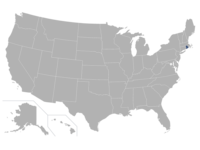
Providence, RI