After gasline tax bill, pipeline corporation plans to ask Alaskans for a few billion dollars
Jul 15, 2026 | 9:45 am ET
Description
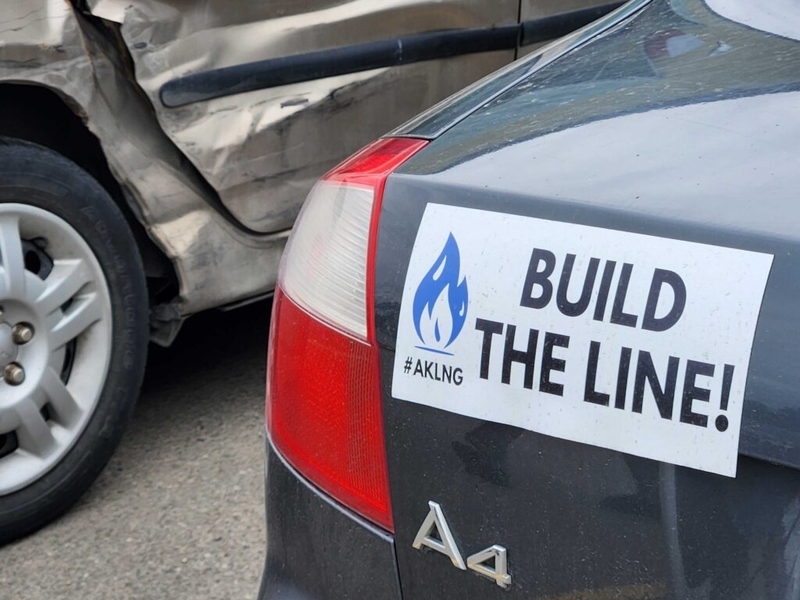
A bumper sticker on a car parked in Midtown Anchorage on June 29, 2026, expresses support for the Glenfarne-Alaska Gasline Development Corp. plan for natural gas pipeline tax concessions. (Photo by Yereth Rosen/Alaska Beacon)
A few months from now, if developers of the proposed trans-Alaska natural gas pipeline move forward with the project, they will ask Alaskans for something between a few hundred million and a billion and a half dollars.
The request is optional, but if the state doesn’t chip in, Alaska’s 25% ownership of the pipeline will dwindle to a smaller fraction, and any profits will similarly shrink.
Two other requests for cash could come as soon as next year, to first fund a gas treatment plant on the North Slope and then a natural gas export facility on the Kenai Peninsula.
As state lawmakers debate a multibillion-dollar tax break for the pipeline project this week, a confidential memo and legislative testimony show the break won’t be the last financial request from Alaskans.
Confidential document guided Alaska senators working on natural gas pipeline tax break
Keeping the state’s 25% ownership of the Alaska LNG project will cost at least $4 billion, according to estimates from the Alaska Department of Revenue.
If the state spends that money, and if the project is built and sells gas as planned, the department estimates the state will earn more than $21 billion through 2062, almost five times its initial investment.
But there’s a risk: if the pipeline project costs more than expected, the state of Alaska will be asked to pay more.
“We have reserved the option for the state of Alaska to elect to invest or not,” Frank Richards, president of the Alaska Gasline Development Corp., told the Senate Finance Committee on June 4. “The project will proceed forward without the state investment, but we wanted to give the state that opportunity should it elect to, eyes wide open.”
A potential investment for the state
Last year, the Gasline Development Corporation, a state-owned company charged with building the gas pipeline project, sold the lead role in the project to Glenfarne, a private multinational developer.
According to a confidential memo analyzing the deal, Glenfarne agreed to pay $10 million and fund the project’s development until the “Final Investment Decision,” the point at which investors start to put down money and contracts go out for construction.
Glenfarne has 75% ownership of 8 Star Alaska, the parent company of the pipeline project. The state — through AGDC — has 25% ownership. AGDC’s ownership share stays the same regardless of how many new investors come into the project.
But ownership of 8 Star Alaska may not mean much.
The Alaska LNG project includes three separate “subprojects” — a gas treatment plant on the North Slope, the pipeline itself and an export terminal on the Kenai Peninsula.
Each of those subprojects is its own subsidiary company, and not all of the subproject profits will go back to 8 Star Alaska.
“The real value is down in the three subsidiaries of 8 Star,” said Sen. Cathy Giessel, R-Anchorage, in a July 2 podcast interview.
Right now, each subsidiary is subject to the same 75-25 ownership split as 8 Star, but that changes at FID, when other investors put in their money.
At that point, said Matt Kissinger, AGDC’s commercial director, there will be enough money to build each subproject, but the state will have the opportunity to push out other investors and preserve its 25% ownership.
“All the investors will be in; they’ll all be committed, and then we’ll have 180 days for the state to decide to back them out of some of their commitment,” he said.
According to a draft analysis of last year’s Glenfarne-AGDC deal, AGDC has “the right to invest in up to 25%, but not less than 5%, of each sub-project at FID.”
The 5% minimum — if AGDC takes any share at all — was negotiated with Glenfarne, Kissinger said, because if the state is going to push out another investor, it needs to do so for a meaningful amount.
Part or all of the 25% buy-in could be taken by AGDC. The state could buy in directly, or another state-owned corporation like the Alaska Industrial Development and Export Authority, Alaska Railroad or the Alaska Permanent Fund Corp. could do so.
If the state and public corporations don’t reach the 25% maximum, then Alaska residents, Alaska Native corporations and other in-state companies would have a chance to take some or all of the remainder.
On June 25, the AGDC board voted unanimously to approve the creation of a subsidiary that will allow individual Alaskans to invest in the project through AGDC.
“No more funds are required by the State of Alaska to invest for this project to proceed forward, it’s just that we have the option to, and if Alaskans want the opportunity to invest, that’s the structure that we’re going to set up for them,” Richards told the board.
AGDC and Glenfarne expect the pipeline subproject to reach FID this year. The gas treatment plant and the export facility FIDs are expected no sooner than 2027.
Department of Revenue estimates a $4.4 billion cost
Keeping the state’s share of the project at 25% is likely to be expensive. Glenfarne estimated last month that building the pipeline alone will cost as much as $16.9 billion.
In an example scenario AGDC presented to legislators last month, the company suggested developers could take out loans for 70% of that cost.
The Alaska Department of Revenue is independently using that percentage for its baseline predictions, too.
The developers could cover the remaining 30% by selling part of the pipeline subsidiary.
If the state wants to keep 25% ownership of the whole project, that would mean buying 25% of that 30%.
Using some assumptions, “that would result in $4.4 billion in nominal terms that would be required to invest in the project,” said Dan Stickel, the Department of Revenue’s chief economist, on May 21.
The profits could be huge, the department estimates. A 25% equity share could be worth $21.3 billion through 2063.
That’s on top of the tens of billions of dollars in production taxes, property taxes, royalties and fees that the state would receive regardless of whether or not it takes an additional ownership share.
What happens if Alaska doesn’t buy in?
“That (25% ownership) will definitely be diluted. That’s the mechanism that was designed,” Kissinger told state lawmakers.
AGDC’s scenario, presented to legislators on June 4, suggested 8 Star Alaska would keep 35% of the pipeline subsidiary. AGDC would have a quarter of that 35%, or 8.75% of any profits after debts are paid.
If 8 Star Alaska keeps less than that 35%, then the state’s quarter would shrink correspondingly.
While investing in the project increases the potential profits, there’s also a risk, said Sen. Bert Stedman, R-Sitka, on June 16. If the project costs more than expected, the state and other investors would have to pay more money to keep their share of the project.
“If the state wishes to take that risk, and if the state wishes to be a paying member of the project … you would be paying 25% of any of the investment dollars coming in to maintain that,” Kissinger said on June 3.
Where would Alaska get the money?
Current state law allows AGDC to borrow money without legislative approval.
“Right now, under the current statutes, AGDC has extremely broad bonding authority. We can raise revenue bonds — provided there is no recourse back to the state — without any further approvals,” Kissinger said on June 26.
The current version of the gasline tax break being considered by state lawmakers would limit AGDC’s borrowing power.
Legislators would have to meet within 90 days — possibly in special session — to approve any bonds.
The Alaska Department of Revenue would be required to analyze the investment and make a recommendation to legislators.
Another funding possibility is that the state could offer things instead of money in order to pay for its share of the project.
Earlier this year, the state of Alaska changed its regulations, allowing the state to give away gravel to public-backed construction projects.
“What we’re hoping to do is to utilize state materials, state assets, to be able to provide to the project in lieu of cash,” Richards told the House Finance Committee on May 27. “The gravel that will be used for access road and pipe bedding and pipe backfill and pipe storage yards and camp facilities represents about 20 million cubic yards of material, so that has a value of roughly $60 million and if we are able to then utilize that value and gain equity, then that would be a non-cash option that we would like to exercise for the state.”
In an interview on Tuesday, Richards said the state could also offer the land that the pipeline will use. Instead of paying something like $9 million per year in rent to the Department of Natural Resources, the state could simply deed the land to the pipeline operator and receive a share of the pipeline subsidiary in return.
Lawmakers could also appropriate money directly from the state treasury to AGDC in order to fund the project.
Rep. Andy Josephson, D-Anchorage, said on May 21 that in order to come up with the money for the 25% investment, the state’s independent financial adviser recommended overdrawing the earnings reserve of the Alaska Permanent Fund.
“I know that’s sacrilege to talk about, and it’ll be left for the next Legislature … but $4 billion is something this state could probably borrow or find, I guess,” he said.
“This is such a significant decision for what I call the re-electeds,” said Josephson, who is retiring and not running for re-election. “If they don’t do it, they could be chastised for decades and remembered for not doing it, but if the project has significant cost overruns, they could be chastised for that.”
“I would agree, it’s a very significant decision,” Stickel said.
Speaking June 19 on the floor of the state Senate, Sen. Jesse Kiehl, D-Juneau, said he is terrified of what might happen if the state invests and there is a cost overrun that requires more money to complete the project.
“Does it go bankrupt, and we just leave it? Nobody in this room is that naive. There’s one deep pocket around this project. There’s one entity that’s had a 50 year dream of building the pipe. There’s one place you can go for billions and billions of dollars,” he said.
Left unsaid was the name of the Alaska Permanent Fund.
Editor’s note: The headline has been updated after initial publication.
Juneau