Candidates for the Kansas education board’s most rural district share their views on funding, DEI
Jul 15, 2026 | 1:32 pm ET
Description
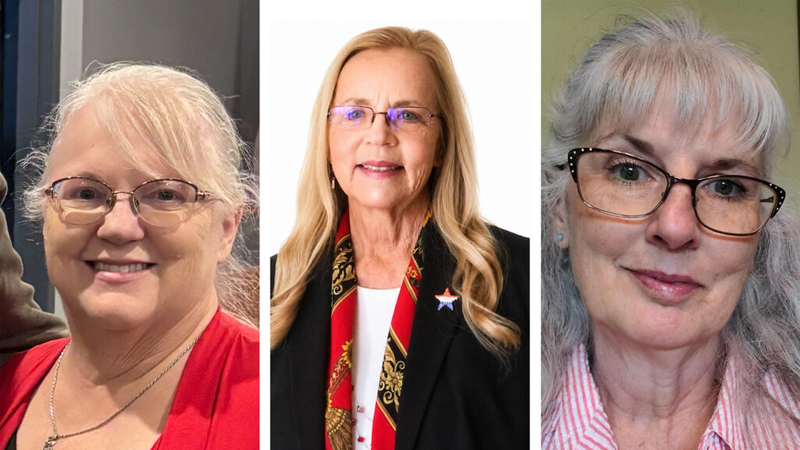
State Board of Education candidates for the western Kansas district, from left, Kelly Ancar, Jean Clifford and Lorie Wood share their views on funding and diversity, equity and inclusion initiatives. (Composite from photos courtesy of the candidates)
TOPEKA — The three candidates running for the State Board of Education to represent the district covering most of western Kansas disagree on funding strategies and diversity, equity and inclusion.
Republicans Jean Clifford and Kelly Ancar and Democrat Lorie Wood hope to represent the 5th District on the state board, which oversees K-12 public schools.
Clifford and Ancar will oppose each other on the Aug. 4 primary ballot. Wood will face the winner in the November general election.
Five of 10 education board seats are up for election every two years. This year, none of the five Republican incumbents chose to seek reelection. Because three of the five members whose terms won’t end until 2028 are Democrats, this election could flip the board’s GOP majority.
The candidates
Clifford, a retired Air Force attorney and longtime resident of Garden City, served a four-year term on the state board from 2019-2023 and also has served on her local school board.
She said her six children, who attended public and private schools, inspired her to earn a master’s degree in special education. She highlighted her range of experience.
“I have the background to put these things in perspective,” she said, “and to work with the other organizations and elected bodies that are also interested in schools.”

Republican Kelly Ancar, a registered nurse from Hays, grew up in rural Kansas and owns Amazing Grace Homecare, which provides at-home assistance, primarily to seniors. She graduated from Fort Hays State University, where she later taught nursing.
She said teaching alerted her to literacy deficiency in Kansas, something she hopes to change.
“I had students in college that I had to refer for reading remediation, which was shocking to me,” she said.

Democrat Lorie Wood of Dresden, a city in rural Decatur County in northwest Kansas, is a retired K-12 and University of Colorado Boulder teacher whose experience spans 30 years in multiple states and countries.
Wood, a former registered Republican and, more recently, a former unaffiliated voter, organized the Decatur County Democratic Party in 2025. Serving as the chair led her to launch her first campaign.
“I kept getting frustrated about what I was seeing,” she said. “Every recommendation is to get involved locally.”
Funding
The state funding formula expires in June 2027, and the Education Funding Task Force is forming a new plan.
Clifford said the state’s underfunding of special education forces districts to cut general education resources to maintain necessary programs. The state has not met its obligation to fund 92% of special education costs since 2010.
Frank Harwood, the Kansas State Department of Education deputy commissioner, said the state shorted schools by $226 million for special education in the current fiscal year.
“Most of the special education funding that goes to the early learners is really a great investment,” she said.
In May, four Kansas school districts announced plans to sue the state for inadequate special education funding.
Wood said schools in western Kansas especially lack resources because rural areas generate less property tax revenue than highly populated ones.
“Our schools out here are trying to do more with less money, and it’s not working,” she said. “Some of the superintendents are even bus drivers.”
Ancar said she believes the state does fully fund special education. She said accountability and compliance will solve resource problems.
“It’s not about whether or not they should fund,” she said, “it’s about whether or not every recipient of those funds is able to answer and be accountable for where every one of those dollars went.”
As a former regulatory consultant for healthcare facilities, Ancar said many schools fail to comply with federal regulations. She cited the U.S. Department of Education’s threat to pull funding from four eastern Kansas school districts for their gender-inclusive policies as an example.
“Compliance is always the cheaper way to go,” she said.
Diversity, equity and inclusion
State lawmakers banned DEI practices in all areas of Kansas government, including public schools, in 2025.
Ancar said schools should comply.
“It is there still in some of the curriculum and embedded in the culture and in the classroom,” she said. “We should leave all of those sorts of moral developments and upbringing and those sorts of issues to parents.”
Clifford said schools in the 5th District are compliant but still inclusive.
“DEI has been used as a catchphrase for a lot of things that are really not going on in schools,” she said. “In the schools that I have visited, every student was valued.”
Wood said schools should not avoid inclusive programs. She said as someone who uses a wheelchair, inclusivity in Kansas schools needs to improve.
“Some of the schools that I’ve been to don’t even have accessibility,” she said. “If we are avoiding that issue, we can’t be inclusive to people who are physically disabled.”
Topeka, KS