Ohio Republican attorney general candidate appears to advocate ending parts of Medicaid
Jul 15, 2026 | 4:00 am ET
Description
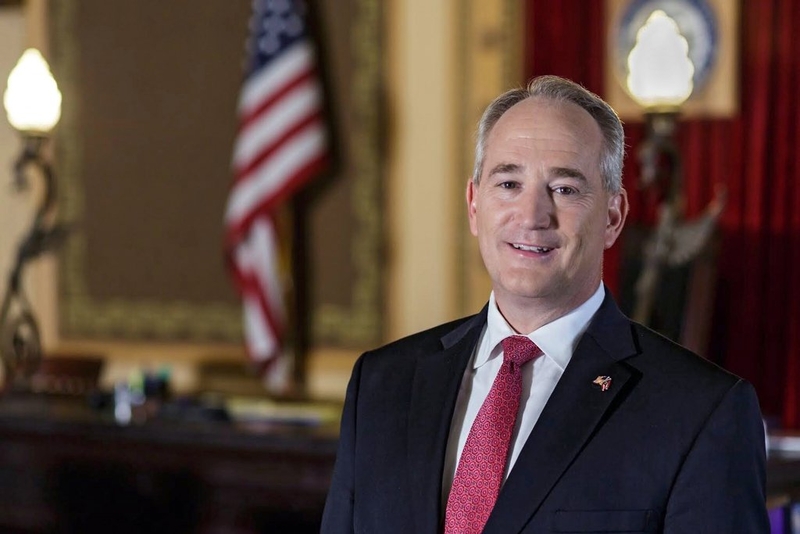
Ohio Auditor of State Keith Faber. Official photo.
In two recent media appearances, Ohio Auditor Keith Faber made statements that sounded supportive of ending at least some parts of Ohio Medicaid.
Faber’s campaign did not clarify his comments when asked about them, only saying that Faber supports the lawful use of Medicaid dollars and doesn’t support the unlawful use of them.
The federal-and-state-funded health program for the poor covers more than 3 million Ohioans and costs upwards of $40 billion a year.
It was created alongside Medicare in 1965 as part of President Lyndon Johnson’s Great Society.
In April, President Donald Trump said it was “not possible” for the federal government to fund Medicaid, Medicare, and childcare. Trump was asking for $1.5 trillion in additional military spending to fund his war with Iran when he made the statement.
That was after he signed a bill last summer with massive tax cuts heavily favoring the wealthy and almost $1 trillion in cuts to Medicaid over 10 years.
With the brunt of those cuts scheduled to kick Jan. 1, Trump’s top lieutenants have been highlighting provider fraud in the program without saying much about the healthcare conglomerates that have been accused of overcharging state Medicaid programs by huge amounts.
In a June 4 appearance in Ohio, acting U.S. Attorney General Todd Blanche said that Medicaid provider fraud was a “crisis” that “crippled our taxpayer programs and robbed the American purse for too long.” But KFF, the nonpartisan healthcare research organization, said there’s no reliable measure of provider fraud.
John Kulewicz, the Democratic nominee for Ohio attorney general, said there’s a simple reason why Republicans are playing up provider fraud so much these days.
“I think they want to get rid of Medicaid,” he said in an interview.
Kulewicz pointed to two May 5 media appearances by Faber, his Republican opponent.
Faber appeared on the Bruce Hooley Show on Salem Media, a self-described “Christian and conservative media company.”
“We’re spending tens of billions of dollars a year on Medicaid every single year in Ohio, so a very small percentage loss is a huge dollar amount,” Faber said at the 2:37 mark. “And the scammers figure out how to take advantage and you’re seeing it throughout the system.”
He added, “It goes back to this question: Why are we having government programs doing so many things for so many people and expecting people not to lie, cheat, and steal…? I tend to be a small-government conservative. I think you get rid of some of these unnecessary programs and we’re all going to be better off.”
Faber’s office and campaign were asked if he was advocating to completely end Medicaid in Ohio or some part of it. And, did Faber believe millions of Ohioans should lose healthcare because of lax fraud enforcement — a function for which Ohio Republicans have been responsible since 2011?
In an email, Faber campaign advisor Matt Dole didn’t respond to those specific questions, saying instead, “Keith Faber supports the lawful use of Medicaid dollars as a safety net for those Ohioans who need it. He opposes the unlawful use of Medicaid and has a record as Auditor of State fighting fraud and waste. There is no conflict between these positions.”
Faber and other Republicans have particularly been calling attention to reports of fraud from programs under federal waivers that allow Ohio Medicaid to pay for in-home care for low-income residents.
Among alleged abuses, state Attorney General Andy Wilson on June 23 announced Ohio indictments as part of the Trump administration’s “2026 National Health Care Fraud Takedown.”
The operation had “led to criminal charges against 455 defendants nationwide for their alleged participation in healthcare fraud and opioid abuse schemes totaling more than $6.5 billion,” Wilson’s office said.
The statement didn’t specify how much of that was attributable to Medicaid funded home-care programs.
The statement said that, as part of the national “takedown,” five people in the Buckeye State were accused of defrauding Medicaid home-health programs of $127,000.
In one case, a Cincinnati woman admitted billing Medicaid $110,000 for 16-hour-a-day care, but only providing services between the time she left her day job and midnight, Wilson’s office said.
In another, an Elyria woman said $1,500 in fraudulent billing “stemmed from personal difficulties and expressed a willingness to repay the money,” the statement said.
The biggest fraud allegation was unrelated to home health. A Westerville doctor was accused of improperly billing $200,000 for child behavioral health services that weren’t rendered, Wilson’s office said.
On a May 5 appearance on Cincinnati’s WLW radio, Faber declared his skepticism of home-care waivers.
“The problem is that it’s very difficult to catch the abuse because grandma’s never going to rat out granddaughter or daughter who’s supposed to be taking care of her, but she’s sitting there playing on her cell phone all day,” Faber said at the 1:16:18 mark of the “Sunday Nights With Bill Cunningham” show.
“So that’s the problem you get into and, candidly, why the legislature probably needs to get out of that waiver and get back to the… eliminate these programs.”
Faber’s office and campaign were asked to provide a documented instance in which someone in Ohio neglected a family member in such a scenario. None was provided.
Cunningham, a conservative fixture on Cincinnati radio, asked Faber, “Is this mainly focused on immigrant communities like the Somalies?”
Faber again questioned whether the home-care waivers should exist.
“Certainly regular Americans,” Faber replied. “You’re seeing it all over the place. But we know there is a very large utilization of these programs inside various immigrant populations including the Somali population. But it’s being abused all over the place and the question is, why do we have that program?”
Columbus, OH