SC restaurants must say if shrimp came from US or foreign waters under new law
Jul 13, 2026 | 5:00 am ET
Description
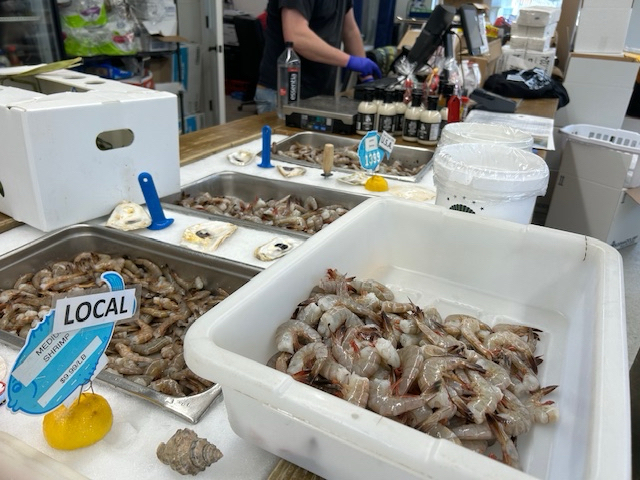
A new law will require restaurants disclose when shrimp is foreign versus local, such as the shrimp pictured at Mt. Pleasant Seafood market in Mount Pleasant, S.C. (Photo courtesy of SeaD Consulting)
COLUMBIA — Beginning in October, restaurants in South Carolina will have to tell diners whether the shrimp they’re eating came from a different country.
A law legislators finalized last month requires restaurants that get their shrimp from anywhere other than U.S.-controlled waters to clarify that on their menus.
If restaurants serve any imported shrimp, their menus and signs must read: “Some items served at this establishment contain foreign imported shrimp. Ask for more information.”
Senators approve requiring shrimp advertised as local to come from SC’s shores
To give restaurateurs time to get signs printed and menus changed, the law takes effect Oct. 28, exactly 120 days after Gov. Henry McMaster signed it.
After that, eateries caught passing off imported shrimp as domestic will initially receive a three-day warning, then a fine of between $100 and $5,000 for each day spent without a sign.
People often travel to South Carolina’s coast for the fresh seafood, said Bobby Simons, co-owner of Acme Lowcountry Kitchen. They should know whether they’re actually eating shrimp caught there, he told the SC Daily Gazette.
“I think it’s a shame to travel all the way to Charleston to eat something from China,” Simons said.
A 2025 study commissioned by the Southern Shrimp Alliance, an organization of shrimpers from eight states, found that just four of 44 Lowcountry restaurants selected for a survey served shrimp caught in the U.S. Advertisements at 25 of those claimed the shrimp was local, even though the study’s testing determined the crustaceans came from another country.
“Consumers want the fresh taste and crisp bite unique to the shrimp species that live off the U.S. coast,” said Blake Price, executive director of the Southern Shrimp Alliance, which also has members in Alabama, Florida, Georgia, Louisiana, Mississippi, North Carolina, and Texas.
“This law gives South Carolina’s commercial shrimping fleet — multigenerational, working-waterfront businesses that depend on customers’ trust in what’s on the menu — a foothold to build on,” Price said in a statement.
The ensuing outrage, dubbed “shrimpgate,” led to finger-pointing among locals — sometimes literally: A day before the bill was signed into law, Simons made a Facebook post using an image from the viral 22-second pointing stare from professional basketball player Sophie Cunningham, as the Indiana Fever guard wordlessly defended teammate Caitlin Clark.
“When you catch someone selling ‘local’ shrimp but you know they are really foreign and imported…,” the Acme Lowcountry Kitchen post read.
Acme was one of the four restaurants in the survey serving domestic shrimp. Most of the restaurant’s crustaceans come from a market in McClellanville, Simons said.
The law doesn’t require restaurants to specify where off the United States’ shores their shrimp was caught, just that it came from somewhere in state or U.S. waters. So, the shrimp served in some places might still come from somewhere other than South Carolina.
The Senate’s version of the bill would have gotten more granular, requiring eateries to say whether their shrimp came off the coast of the Palmetto State. But the final version of the bill followed the House’s recommendation of sticking to foreign versus domestic.
Some worried about getting too specific, Sen. Sean Bennett, a member of the negotiating committee, said in introducing the compromise. If a restaurant had to change suppliers on short notice, trying to swap out signs and menus to reflect the switch could cause chaos, he said.
In an effort to at least encourage restaurants to buy American-caught shrimp, legislators agreed to the vaguer version of the bill, with the understanding they’d come back to the specifics in a future session, he said.
“We finally, hopefully, landed this plane, at least for the time being,” the Summerville Republican said.
The law is a good move forward, Simons said.
“The most important thing is, for us at Acme, to support our local shrimpers,” he said. “But you take it one step further, and it’s very important to support any U.S. shrimper.”
Simons’ bigger concern is whether the law is actually enforced, he added.
Violations under a similar law, the Country of Origin Labeling Act, or COOL Act, are rarely punished, legislators said previously. Besides, that 21-year-old law applies to grocery stores and warehouse clubs but exempts places that provide ready-to-eat meals, such as restaurants. Having a state version will give the Department of Agriculture the authority to enforce the rule at restaurants, legislators said.
Simons sometimes worries a sudden influx of demand for locally sourced shrimp from restaurants that previously imported might cause a shortage for his own restaurant, he said.
His concern is only speculative until he sees how many restaurants the law encourages to start buying locally. And while the potential for increased competition might cause Simons some temporary strife, he’d rather that than see shrimpers with no buyers for their catches, he said.
“That’s great for the shrimpers,” Simons said. “But then I would be like, ‘Oh my goodness, what do I do now?’”
Columbia