Challenge over SC law banning 8 concepts on race from classrooms can continue, appeals court says
Jul 07, 2026 | 4:40 pm ET
Description
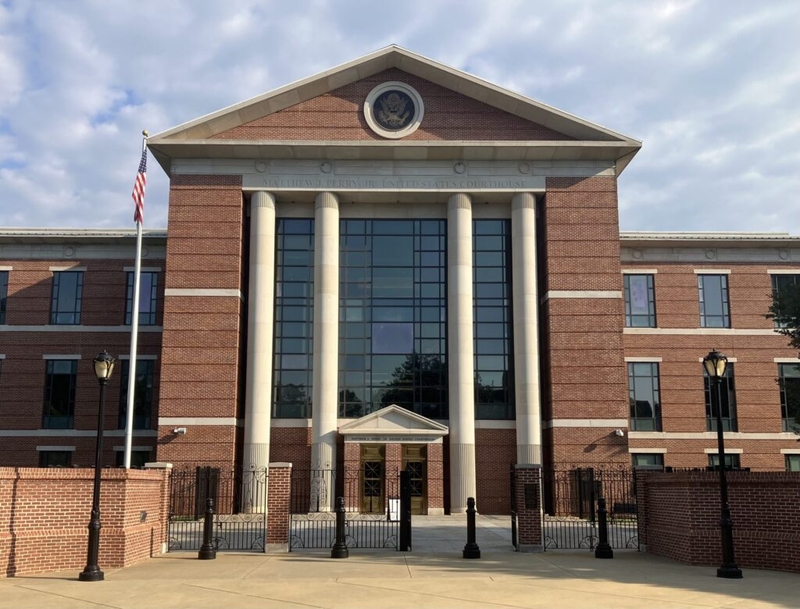
A lawsuit challenging state law's prohibition on teaching certain concepts in K-12 public schools will return to the courtroom of a U.S. district judge here at the Matthew J. Perry Jr. Courthouse in Columbia, South Carolina, after an appeals court ruled the challenge can continue. (File photo by Abraham Kenmore/SC Daily Gazette)
COLUMBIA — A group of students, educators and an author can challenge a state law banning certain race-based lessons, a federal appeals court said Tuesday, reversing a lower court’s decision.
The challenge, filed in January 2025, never got to arguments on the law itself, ending instead last September when U.S. District Judge Sherri Lydon decided those who signed on didn’t meet the standards to sue. Tuesday’s decision will allow the group’s challenge to move forward.
The ruling also gives the group, which includes the state NAACP, another chance to argue the state should stop enforcing the law while the case continues.
SC law banning 8 concepts on race from classrooms can remain in place, judge says
“This decision is a critical victory for South Carolina students, educators, and families who deserve access to truthful, inclusive education,” Charles McLaurin, an attorney working on the case for the NAACP Legal Defense Fund, said in an email.
The Department of Education pointed out the case is not yet settled, since the appeals court simply allowed the challenge to continue but made no decisions about which side was in the right legally.
“There has not yet been any ruling on the merits of the case, and the Department’s legal positions and defenses are still pending before the district court to be decided,” spokeswoman Christy Cox said in an email. “We remain confident that the Department’s actions are consistent with the law.”
State law and failed legislation
The law, included as part of the state budget since 2021, prohibits schools from teaching eight concepts about race and history, including that one race is better than another, that people are responsible for past atrocities because of their race, and that traits such as a hard work ethic are oppressive and racist.
Districts that violate the law risk losing state funding. Such budget clauses are technically one-year laws, but they remain in state budgets indefinitely unless removed or superseded by another law.
The concept on the list cited as most troublesome deals with students’ feelings of guilt due to their race. Teachers don’t know what lessons may get them in trouble based on students’ feelings, McLaurin said in court last year.
In 2023, legislators of both parties agreed that line could stifle instruction.
That’s why it was excluded from legislation that sought to clean up the law, while creating a uniform complaint process.
As passed by the Senate, the bill also specifically protected “historically accurate” discussions of slavery, Reconstruction, the Jim Crow era, segregation, racial lynchings and any “historical oppression of a particular group of people based on race, sex, ethnicity, class, nationality, religion, or geographic region.”
But opponents, many of whom didn’t realize the legislation would clean up what was already state law, packed hearings, arguing the concept ban would create fear among teachers and censor lessons. They succeeded in killing the bill. It died with the end of the 2024 session, which left the prohibitions intact and without clarification for teachers on what’s allowed.
The lawsuit
The lawsuit filed seven months later argues the budget clause led to harmful, far-reaching effects for students.
The students claimed the law caused the Department of Education to omit a class on Black history from the state’s 2024-25 roster of Advanced Placement courses, while author Ibram Kendi argued it meant the removal of one of his books from school classrooms and libraries. A librarian and a teacher claimed the law forced them to change their lesson plans or risk being fired.
Those effects violated the group’s First Amendment rights to information, as well as the Constitution’s 14th Amendment’s guarantee of due process and equal protection, the lawsuit read.
The appeals court agreed that two of the four students suing, none of whom are named in the filings, couldn’t remain part of the lawsuit. One student graduated high school after its filing, and the other never actually enrolled in the African American Studies class before its discontinuation.
Since the other two students made moves to enroll in the Advanced Placement course, they had the right to sue, wrote appeals Judge Steve Agee, who penned the opinion for the three-person panel.
Students, teachers call on SC education agency to add AP African American Studies to state list
Attorneys for the Department of Education said the law didn’t lead to the removal of the AP course or the removal of Kendi’s book, “Stamped: Racism, Antiracism, and You.”
Lyon agreed in her dismissal of the case, saying the removal of the clause from the state budget wouldn’t solve the issues the students or Kendi raised.
A June 2024 department memo cited an upcoming review of the state’s social studies curriculum as one of the reasons the state wouldn’t continue offering AP African American Studies, which the College Board tested as a pilot program starting in 2022 and launched as a new course for the 2024-25 school year. Board members in Lexington County School District 3 officially removed Kendi’s book from library shelves because of “inaccuracies and lack of objectivity,” according to court filings.
In both cases, however, officials also mentioned the law as a concern, which made the challenge valid, the appeals court decided. The state’s memo also mentioned the budget clause as a reason for removing the course, and school district board members expressed similar concerns in emails included in court filings.
The lawsuit will return to Lydon, who will decide how the case moves forward.
“We look forward to continuing this case in district court and fighting for every student’s right to have honest and accurate portrayals of their history taught in their classrooms,” McLaurin said in an email.

Columbia