University of Iowa professor awarded for work on foundational statistics tool
Jul 03, 2026 | 12:00 pm ET
Description
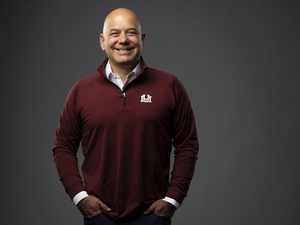
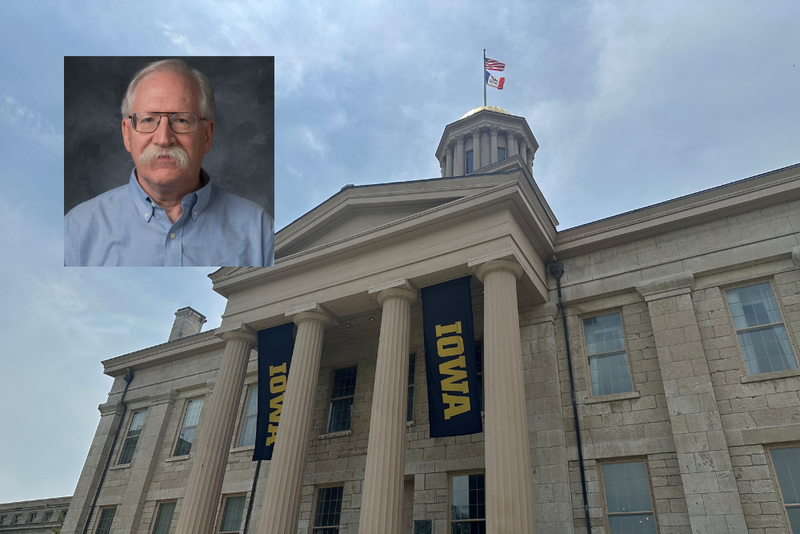
Luke Tierney has retired from the University of Iowa, but not before earning an international statistics award for his work. (Photo by Brooklyn Draisey/Iowa Capital Dispatch and portrait courtesy of University of Iowa)
A University of Iowa professor is celebrating his retirement with an international statistics innovation award, and he has no plans to slow down his decades of work on a statistical computation system used by millions around the world.
Luke Tierney held the position of Ralph E. Wareham Professor of Mathematical Sciences until July 1 and now has emeritus status. He and four others have been named laureates of the Rousseeuw Prize for Statistics, which comes with a $1 million award, for their work on the R Project. The project developed and maintains the computer language R, described as “the open-source language that has become the common foundation of modern statistical computing,” according to a press release announcing the award.
Tierney said he’s not sure yet what he plans to do with his portion of the prize, beyond supporting his and others’ maintenance and innovation of R. “Primarily, I hope to put it back into supporting work on the R Project,” he said.
Awarded by King Baudouin Foundation — the “largest public utility foundation in Belgium,” according to its website — the Rousseeuw Prize for Statistics has been awarded three times since 2022. The prize defines statistics as “the science and technology of obtaining useful information from data, taking its variability into account.”
In the world of data tools, Tierney said “S” as a framework came before R and was created by a telephone company to handle “a wide variety of different data situations,” including quality control and fraud detection. S started seeing use from university graduate programs but wasn’t sold in that area, he said, so New Zealand researchers Ross Ihaka and Robert Gentleman used it to create R, a new engine.
Tierney, who was working on other computing tools for statistics and data visualization at the time, met the pair at a conference around 1996, beginning a relationship that would lead Tierney to his current work on R.
“They decided to open source the project and bring a group in, and I was one of the people they brought in,” Tierney said. “There were about seven of us initially, and now it’s 19, I think.”
It’s been 30 years since Tierney was first brought into the R Core Team, and for as long as the last decade, his research has focused almost entirely on the language. Much of his work relates to maintenance of the project — fixing bugs and adapting to changes in hardware while trying to keep “R itself” stable to keep code written 20 years ago working when possible.
Tierney used R in his teaching for courses on “computationally intensive statistics” and data visualizations, he said, exposing students to a language utilized in industries from pharmaceuticals to media and more.
“It’s used by a lot of people who need to work with data and get data ready to analyze, and create visualizations,” Tierney said.
While Tierney and other R Core Team members innovate through adaptation, he said the majority of new ideas and innovations come from the packages people create using the core system.
As many as 24,000 open-source packages exist today, Tierney said, created using R. His and other team members’ work is generally unpaid, with core work supported by donations from individuals and corporations. The program has been able to support one paid position.
“When people write Ph.D. theses on statistics, they typically develop a new idea and then make it available in software more often than not as an R package, and so that’s where new things come out,” he said.
Tierney expects to work on R “for as many years as (he) can,” he said, but he and others who have been part of the project for a long time have the goal of bringing new people in to keep things going after they step away.
Finding people with the right skills for the job isn’t a problem, but Tierney said the relative lack of flexibility university researchers have compared to his time starting out with R makes it hard for those who would be interested to make the time available to help out.
“We’re actually having some more success in the last two or three years than we have in the previous 10, I think, in finding new young people, so I’m hopeful,” Tierney said.
Des Moines, IA