Abdul El-Sayed had a big week of U.S. Senate primary endorsement leaps and stumbles
Jul 02, 2026 | 7:11 pm ET
Description
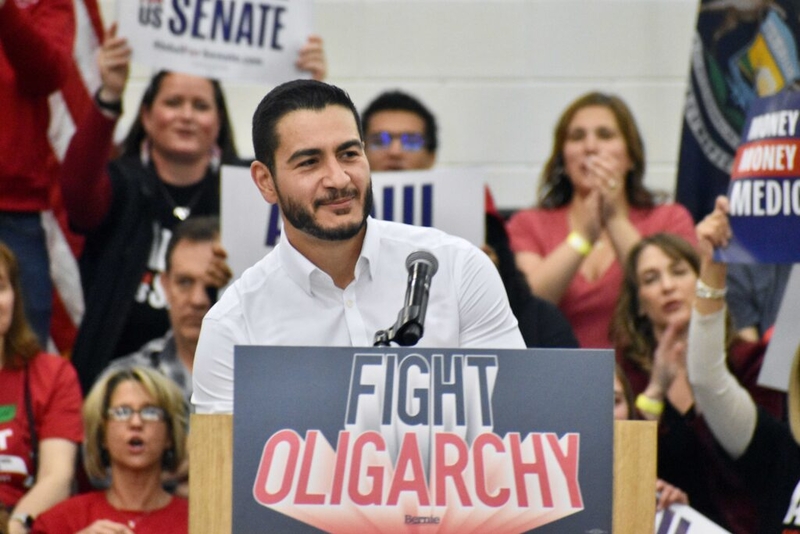
Michigan Democratic U.S. Senate candidate Abdul El-Sayed speaks during a rally with U.S. Sen. Bernie Sanders (D-Vermont) at Mumford High School in Detroit, Mich. May 3, 2026 | Photo by Ben Solis/Michigan Advance
Abdul El-Sayed’s campaign for Michigan’s open U.S. Senate seat gained endorsements this week from the national Indivisible organization and U.S. Rep. Alexandria Ocasio-Cortez of New York, even as it faced questions about a statewide Indivisible endorsement process, corrected an erroneous clergy endorsement and continued to fend off Republican attacks aimed at his progressive platform.
The former public health official is competing against U.S. Rep. Haley Stevens of Birmingham and state Sen. Mallory McMorrow of Royal Oak in the Democratic primary.
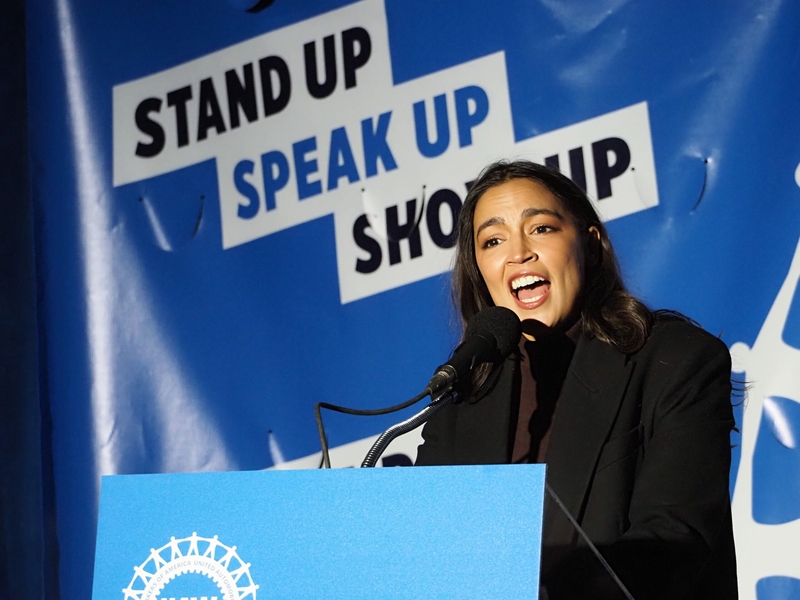
Ocasio-Cortez, a congresswoman from New York and an important leader in the progressive movement, decided to throw her weight behind El-Sayed on Thursday.
“After watching this campaign unfold for well over a year, it has become clear that Abdul El-Sayed is the strongest candidate to keep this seat in November,” Ocasio-Cortez said in a statement circulated by the campaign. “He is building a winning coalition by putting forward an agenda that speaks directly to working people. He is not afraid to take on the greed making life unaffordable across Michigan because he’s never taken a dime in corporate donations.”
Ocasio-Cortez went on to say that “when he gets to Washington, he will work to get big money out of politics and to guarantee healthcare as a human right to all Americans.”
“I am proud to endorse Abdul El-Sayed to be Michigan’s next senator,” Ocasio-Cortez added.
The nod was among the more significant endorsements El-Sayed has received in the 2026 primary hunt, which have also included support from U.S. Sen. Bernie Sanders, the Vermont independent, and the powerful United Auto Workers union.
Stabenow warns of foul play with NRSC spending against El-Sayed and not Stevens
Last week, the National Republican Senatorial Committee launched a digital ad that called El-Sayed “too radical for Michigan,” citing not only his calls to implement Medicare for All, but also his stance on abolishing U.S. Immigration and Customs Enforcement and his springtime campaign event with controversial leftist influencer Hasan Piker.
The NRSC has aired ads boosting the lone Republican candidate in the race, former U.S. Rep. Mike Rogers of White Lake, with plenty of attack lines against El-Sayed, but also Stevens and McMorrow earlier in the race.
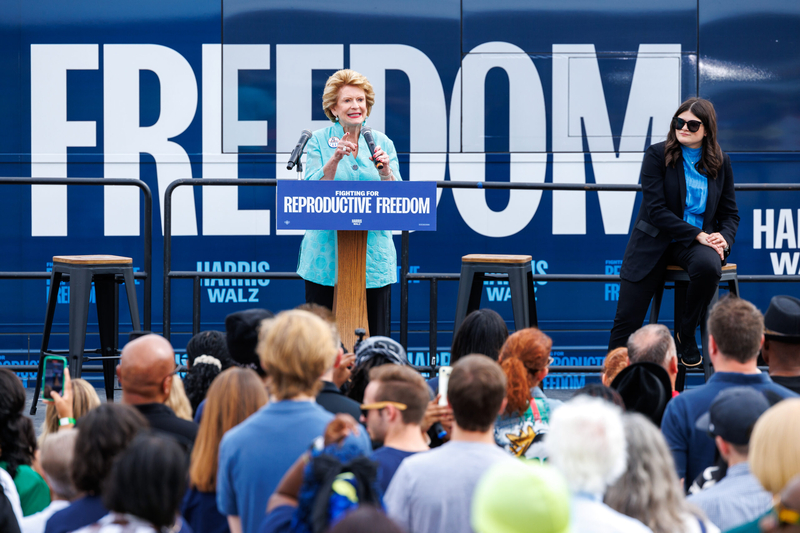
Former Michigan Democratic U.S. Senator Debbie Stabenow, who has endorsed Stevens, argued otherwise in an interview with the Advance.
Stabenow said she believes likely independent voters in Michigan still view Stevens as being the best candidate to beat Rogers in the general election, while Republicans view El-Sayed’s core campaign planks as the easiest to defeat. She said that was why they were spending against El-Sayed and launching ads boosting his campaign platforms.
“This is a strategy that’s been used in other places around the country to get involved in a primary. If this were a general election ad, I think it would be negative for Abdul, and they probably would have much tougher ones coming,” Stabenow said. “But this is the primary, and so they’re focused on reminding people, and reminding essentially Abdul’s voters who love Bernie Sanders, that he’s supported by Bernie Sanders … that he’s the farthest to the left in the primary, and so they are emphasizing that.”
Indivisible becomes divided over a nod for El-Sayed
On Tuesday, Indivisible, a national grassroots political operation that helps local groups defend democratic principles, also endorsed El-Sayed. The national branch said it did so after the State Wide Indivisible Michigan, or SWIM, organization also took a vote of its local chapters to endorse him.
However, several members of Michigan’s local Indivisible branches raised concerns about the transparency of the process, telling the Advance that while individual branches were able to make their own decisions on endorsements, it was some members’ understanding that State Wide Indivisible Michigan was not going to make an endorsement in the U.S. Senate race.
The surfacing of the internal split within a progressive group like Indivisible is seen by some as an indicator of how divisive the Democratic primary race has become.
Debbie Rosenman, leader of Fighting 9 Indivisible in Ferndale, said many chapters had opposed a statewide endorsement because precisely they believed it would be divisive. She said an initial vote failed to reach the 60% supermajority required to move forward.
Rosenman said State Wide Indivisible Michigan later held another vote and survey of member chapters, eventually backing El-Sayed. She questioned whether tie votes from some chapters were counted and said the statewide organization has not publicly explained how votes were tallied, arguing that the lack of transparency conflicted with national Indivisible guidelines.
National Indivisible later asked Michigan chapters in a separate yes-or-no survey whether it should endorse El-Sayed, which it ultimately did.
Rosenman said that was a disservice to Stevens and McMorrow, who are still very much in the race.
SWIM’s core team disputed Rosenman’s account, saying it spent months educating members, holding candidate forums and polling chapter leaders before launching a formal endorsement process. The group said communication problems stemming from rapid growth contributed to misunderstandings.
“We began with many months of discussions and digging into resources to help groups learn about the candidates. We started with a test poll last November which showed most leaders were still uncertain and wanted more information,” State Wide Indivisible Michigan wrote. “We discussed the race at length in leader meetings, brought in political team experts from national, followed our partner organizations’ work on candidate forums and interviews, made those available to our members, and held our own candidate forum in early April.”
A two-step poll was issued in April of this year. The first was a question of whether SWIM should endorse. The team said that vote did pass with a supermajority vote. The second was a poll asking which candidate leaders preferred, but there were irregularities in the voting process, SWIM said, that led to no preferred candidate being chosen.
“The results of that needed a lot of discussion. There were similar complaints full of misinformation, and we held a debriefing meeting for leaders to air their concerns,” the core team said. “SWIM listened, leaders seemed satisfied, and we said we would try again closer to the primary because the majority of leaders’ wishes (which is what drives action from SWIM) were not being heard. SWIM developed a clear process document for the steps leading up to an endorsement and shared it with leaders for feedback.”
SWIM tried again. Another first brush vote showed that the leaders wanted to endorse. A second poll vote landed on El-Sayed with a clear supermajority of 80%, SWIM said.
“During this poll is when the complaints started, not before,” SWIM told the Advance. “As far as national, there were complaints about their poll being ‘unfair’ because they only had one candidate. The explanation that is being completely missed is that national did not issue a preferred candidate poll. The decision to endorse El-Sayed by SWIM had already been made by the members in Michigan.”
Pastor says campaign mistakenly listed his endorsement
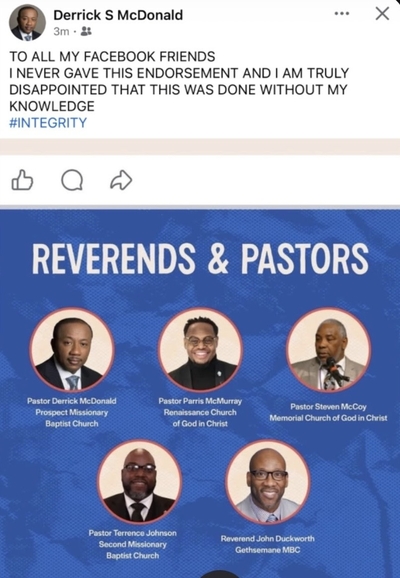
As endorsements continued, the campaign announced nods from pastors, but one of them was added to the list in error.
A post featuring those spiritual leaders on Facebook included Pastor Derrick McDonald of Pontiac.
McDonald later posted on his own Facebook account decrying his inclusion when he did not endorse El-Sayed.
“To all my Facebook friends. I never gave this endorsement and I am truly disappointed that this was done without my knowledge,” McDonald wrote.
The initial post from the El-Sayed camp was deleted some time after and replaced with a new reverend and pastors endorsement list, this time without McDonald.
An El-Sayed spokesperson said that the McDonald endorsement was a miscommunication.
Lansing, MI