Scrapped Air Products project could signal stiffer headwinds for CO2 storage
Jul 02, 2026 | 5:00 am ET
Description
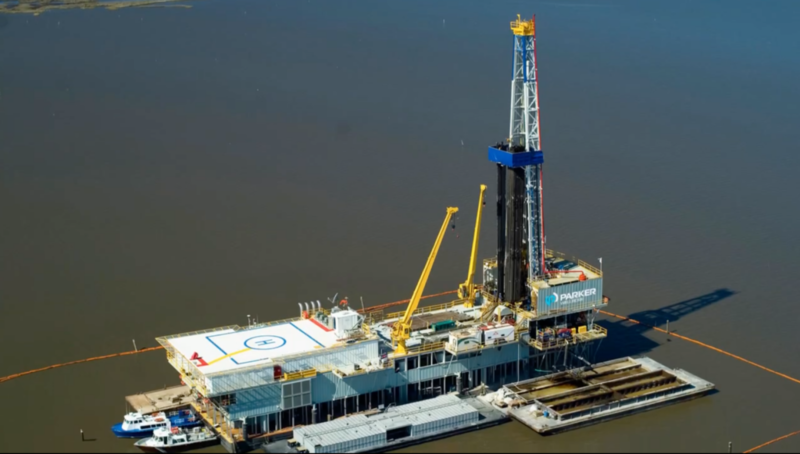
A drilling rig similar to this one was used in Lake Maurepas as a test well for Air Products' carbon storage project. (Image courtesy of Air Products)
Political hostility and public distrust are likely to blame for the recent cancellation of the massive Air Products & Chemicals Clean Energy Complex in Louisiana, according to industry analysts who see potential ripple effects for the petrochemical industry.
Air Products announced Tuesday it has canceled the hydrogen manufacturing facility it had planned in Ascension Parish and an accompanying carbon capture project to transport and store carbon dioxide from the site under Lake Maurepas. All told, the company had plans to invest $8 billion in Louisiana.
Since it was announced in 2021, the project faced increasing political headwinds, including the loss of clean energy tax incentives at the federal level and public resistance against carbon sequestration and industrial expansion at the local level, Baton Rouge-based economist David Dismukes said.
“I’m not super surprised,” Dismukes said in a phone interview. “It became such a hot button political issue.”
In Tuesday’s announcement, Air Products said it will record a $2.2 billion after-tax loss for the third quarter largely related to its decision to terminate the Louisiana Clean Energy Complex.
“I think that speaks volumes about the project, too, that you’re willing to walk away from $2 billion,” Dismukes said.
At the federal level, President Donald Trump’s hostility toward clean energy has prompted other companies to abandon similar projects. Exxon Mobil folded the low-carbon hydrogen plant it planned in Baytown, Texas, last year once the $332 million the Biden administration put behind the project was pulled.
The Air Products proposal in Louisiana called for $8 billion in total investments, including roughly 170 permanent jobs at its Ascension site once it became operational. The company also planned other related facilities and spending to limit air pollution from its so-called blue hydrogen facility, one that uses fossil fuel to generate the gas and captures the CO2 it produces.
It was that carbon sequestration component that was widely opposed in communities around Lake Maurepas, where injection wells would have been used to pump greenhouse gases about a mile below the lakebed. Both Democratic and Republican state lawmakers brought forward bills to block CO2 pipelines and storage, though pro oil-and-gas legislators stopped these and similar measures from advancing.
After unveiling its Louisiana plans, Air Products went on the offensive at the State Capitol in 2023, hiring 25 lobbyists to fend off unfriendly legislation, and largely succeeded. The first and only policy speed bump for carbon capture and sequestration in Louisiana has been a moratorium on new permits Gov. Jeff Landry put in place last October. His freeze did not apply to ongoing projects, with more than 30 proposed in the state.
But according to economist Loren Scott, the Air Products cancellation could have ripple effects across the state’s economy. Environmental groups will likely be emboldened to oppose other carbon sequestration projects in the state, he said.
Central Louisiana residents, leaders sue state over carbon capture land grabs
Businesses don’t do well with political uncertainty, Scott added. He sees Landry as having largely played both sides on the carbon storage debate, enacting corporate-friendly taxes and policies while also issuing a permit moratorium.
“If he wants to save these projects, the governor is gonna have to come off the fence,” Scott said.
Public distrust of carbon sequestration may be less about the technology and more about how and where it’s used, he said. A carbon storage project in Caldwell Parish has faced little public opposition because the company is injecting the gas directly below its own facility on its own land, he said.
That could be a lesson for the rest of the industry; people don’t like to see CO2 injected under public lands or lakes, Scott said.
Another impact of Air Products folding its plans is the $17 million in research grants the company promised Southeastern Louisiana University for its scientists to monitor Lake Maurepas for industrial pollution. The school will have to look for other sources of funding to continue the work.
“The Center [for Environmental Research] was established with initial funding from Air Products, and the loss of those funds will require a refocus of its abilities and priorities. However, it remains a cornerstone of our university’s research infrastructure,” SLU spokesman Mike Rivault said in an email. “Southeastern will seek additional funding for the Center and will continue to serve as an authoritative, transparent and indispensable resource for understanding the regional environment and its complex ecosystems.”
Environmental groups have celebrated the Air Products announcement, saying the best thing for Lake Maurepas is to keep it free of industrial activity.
Marylee Orr, director of the Louisiana Environmental Action Network, welcomed the news when reached by phone Wednesday.
“Some positive unintended consequences of the Trump administration’s doubling down on oil and gas is the cancellation of projects like this that were considered part of a renewable energy sector that is no longer in favor,” Orr said. “It’s great news for Louisiana communities that would have borne the burden of the pollution and risks from these so-called ‘clean’ industries.”
Baton Rouge, LA