After years of effort, Chesapeake Bay-specific menhaden population study gets funding
Jul 01, 2026 | 5:26 am ET
Description
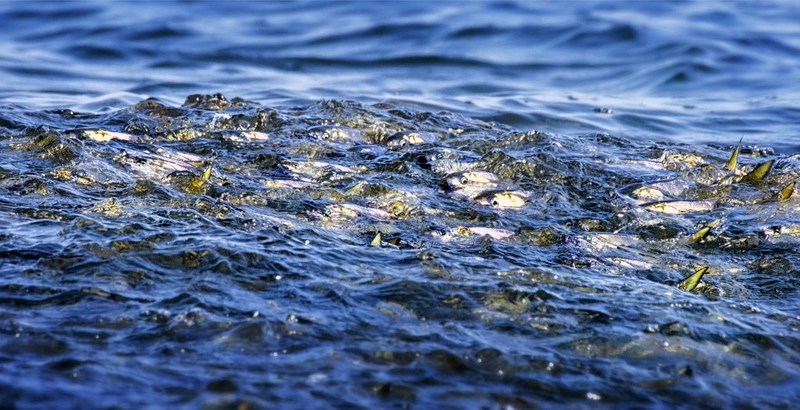
A provision in the two-year budget that lawmakers finalized June 29 will fund a state study on menhaden, small forage fish in the Chesapeake Bay. (Photo by Vicki Jauron, Babylon and Beyond Photography via Getty Images)
With new state dollars granted by the General Assembly by way of a budget amendment from Gov. Abigail Spanberger, scientists and lawmakers plan to examine the menhaden population inside the Chesapeake Bay, the culmination of years of legislative efforts.
The data will be essential to determine whether updated conservation standards and catch limits for the small forage fish should be established. Menhaden sustains several species and fuels the only industrial reduction fishing operation in the Bay.
With $2 million allotted over the biennium, researchers at the Virginia Institute of Marine Science and the Virginia Marine Resources Commission will conduct a study on the menhaden population within the Bay to help regulators manage a “scientifically defensible and ecologically meaningful” cap of how much fisheries can catch, according to the budget language.
Conservation groups have been raising alarm over the potential decrease of menhaden in the Bay for years.
The Chesapeake Bay Foundation said striped bass and osprey populations have suffered because they don’t have enough menhaden to eat. Multiple bills to add the funding in the state budget have failed to pass, including one pitched earlier this year.
“Unfortunately, many questions remain about the health of the Bay’s menhaden population and the iconic species such as osprey that depend upon it,” said Will Poston, CBF’s forage campaign manager. “This is precisely why independent science on menhaden in the Bay is so important.”
Ocean Harvesters, which contracts with Omega Protein, is the only reduction fishery allowed to fish within the Bay in Virginia waters. The company has vehemently denied that their operations are depleting the menhaden within the Bay.
The Reedville-based corporation has already adhered to a Bay-specific yearly catch cap of 51,000 metric tons. Maryland has banned reduction fishing – which is when the fish are caught to be ground up into oil. This limits where Ocean Harvesters can catch menhaden in the Bay.
The company has pushed back against further regulations of their Bay catch limits and argued the catch limits and time period quotas offered up by various groups are arbitrary and not based on science.
“We look forward to continuing to work with the Virginia Institute of Marine Science in collaboration with the Virginia Marine Resources Commission to develop a scientific study of the Bay’s Atlantic menhaden population,” Monty Deihl, Ocean Harvesters CEO said in a statement.
The budget language lays out what the study should consider: seasonal abundance, movement rates, impacts of menhaden predator consumption, spatial and temporal patterns of commercial fishing in the Bay and the possibility of localized depletion of menhaden populations.
The measure allows for this research to utilize the industry-backed Science Center for Marine Fisheries funded study’s recommendations on the Bay’s menhaden population.
Researchers may also pull from the 2023 VIMS report that laid out a roadmap for this study.
The Atlantic States Marine Fisheries Commission Menhaden Management Board voted to reduce the quota caps for the entire East Coast by 20% last October, citing concerns about striped bass populations, on which many species and fishermen rely.
More recently, the management board considered additional restrictions for Ocean Harvesters’ work within the Bay.
Some of the options included reducing the Bay cap and implementing time period quotas to help menhaden populations work their way up the Bay towards Maryland, where pound net fishermen have cited lacking yields for years.
However, the board put off their decision on these changes until later this year.
Even with the Senate agreeing to all of the governor’s amendments, there was still heated debate on the floor ahead of the vote, reflecting the persistent challenges the subject has presented through multiple legislative sessions.
Sen. Richard Stuart, R-King George, whose district includes the Reedville fishery, said that he believes there is no evidence that the fishery is overfishing menhaden – and that past legislation looking to shut down the fishery or reduce its work is unfair.
“It concerns me from the perspective of 260 families that rely on this. They are very good jobs … in the area. There are another 200 or 300 indirect jobs,” Stuart said.
Sen. Scott Surovell, D-Fairfax, said his constituents in parts of the Potomac River have been increasingly concerned about osprey populations. The debate over menhaden has lingered the entire time he has served in the General Assembly.
“We have these fish experts at VIMS, (who) are hopefully going to get some information about it. I just know that there’s been some concern for the last 17 years,” Surovell said. “We haven’t done anything.”
Progress on the study will be presented to multiple legislative, administrative and regulatory agencies by Oct. 1 for the next two years.
The Virginia Department of Workforce Development, along with other groups, will report on possible impacts on workers if there are reductions in catch allowances for the entire coast and within the Bay.
Richmond, VA