Maine delegation celebrates long-awaited Camp Ellis coastal restoration project
Jun 30, 2026 | 2:25 pm ET
Description
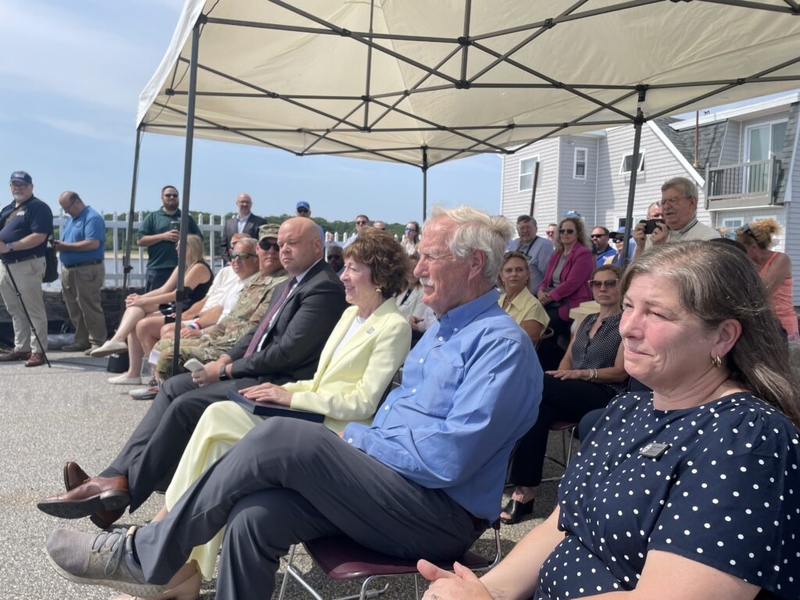
Adam Telle, assistant secretary of the Army of Civil Works, U.S. Senators Susan Collins and Angus King, and Saco Mayor Jodi MacPhail at an event marking the start of the U.S. Army Corps of Engineers' Camp Ellis shore damage mitigation project on July 30, 2026 in Saco, Maine. (Photo by Lauren McCauley/ Maine Morning Star)
More than 150 years after the federal government built a navigational jetty in Saco, work is underway to remedy the severe coastal erosion the jetty unleashed.
The U.S. Army Corps of Engineers on Tuesday marked the start of construction for a $45 million shore damage mitigation project at Camp Ellis Beach in Saco.
“To call this a long-awaited moment really misses the mark,” U.S. Sen. Susan Collins told the crowd assembled at the base of the pier, a backhoe off in the distance. “This is a long championed victory won by a resolute determined community that refused to give up.”
From 1828 through 1968, the federal government built and expanded jetties on the north and south sides of the mouth of the Saco River to make it easier for commercial ships to navigate.
But the jetties altered the pattern of currents and sand deposits, causing severe erosion in Saco, particularly at Camp Ellis, which is the base of the northern jetty.
“The extent of the erosion is truly shocking,” Collins said. “Thirty-eight homes have been washed into the sea during the last century. During that time, the shoreline receded by 400 feet, and roads have been lost.”
Some funding was allocated to address the issue in 2007, but the expected cost grew over the years, prompting Collins and U.S. Rep. Chellie Pingree to push for additional support.
“For generations, residents of Camp Ellis have been forced to confront the impacts of severe shoreline erosion, homes have been lost, property has been severely damaged, many families have been left wondering and worrying about what the future would hold,” Pingree said in a letter, read by field representative Pam Trinward on Tuesday. Pingree could not attend the event because she had to fly to Washington, D.C. for votes in the U.S. House of Representatives.
The U.S. Army Corps of Engineers will now begin work on a 750-foot spur jetty, which will stretch out off of the existing jetty, to reduce the wave energy that reaches Camp Ellis beach.
The first phase of construction is expected to be completed in August 2027, and the project will bring 300,000 cubic yards of sand to restore the beach.
“This means everything,” said Saco Mayor Jodi MacPhail. “This is a day that many residents, community members thought would never come, because it has been a 50, 60 year battle.”
And the restoration of Camp Ellis will be a boost to all of Saco, MacPhail said.
“This is really going to open up a lot of doors for the area, as far as touristry, hopefully some economic development that we can bring in and kind of bring it back to a work, play, live environment,” MacPhail told Maine Morning Star.
In addition to the ongoing erosion, the area saw severe damage after a storm in 2007, and after the back-to-back storms in January 2024.
“We hope we never see a storm like January of 2024 but I’m afraid that may be in our future,” said U.S. Sen. Angus King. “We don’t know when. This week, we’re seeing extraordinary weather across the country that’s going to be hitting us in a few days, and so we just have to be ready.”
The three members of Maine’s congressional delegation emphasized the important role local advocates played in getting the project to the finish line.
“I expect a lot of you who are here are those who put in the work, who put in the perseverance, who went to the meetings, who went to the council meetings, who hounded us in Washington,” King said. “Because the perseverance is what really brought us to this day.”
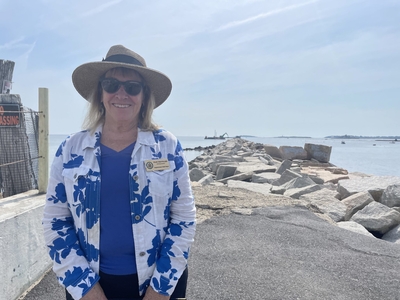
Trinward, who said Pingree assigned her to oversee the Camp Ellis restoration project 14 years ago, said it is a big step forward, but there is still more work to be done.
“The state can help, and we need the state to help,” Trinward said, speaking more broadly about coastal erosion. “There needs to be more money for dunes and growth above, to hold the sands.”
She compared the area to the coast of Wales, which has similar geography as coastal Maine. But in Wales the coast has been protected from development, and hasn’t seen the same erosion.
“But we don’t have the luxury of being able to do that, because we have property, people living in houses, so years later, you figure out that, oh, maybe we shouldn’t have done that,” Trinward said. “So now you just have to do the best you can.”
Trinward said it was important for the federal government to step in, because the challenge is too big for an individual community to handle alone.
Her sentiment was echoed by Collins, who said she feels that a problem created by the federal government in the construction of the jetties, calls for a federal remedy.
“This project will help protect property and restore the beachfront,” Collins said. “Securing the funding to prevent such a catastrophe has been a lengthy process in Washington, but throughout here in Saco, particularly here in Camp Ellis, leaders and residents have also been steadfast in pursuing solutions.”
Maine Morning Star Editor Lauren McCauley contributed reporting to this story.
Augusta, ME