These new laws are taking effect in Iowa July 1
Jun 30, 2026 | 4:32 pm ET
Description
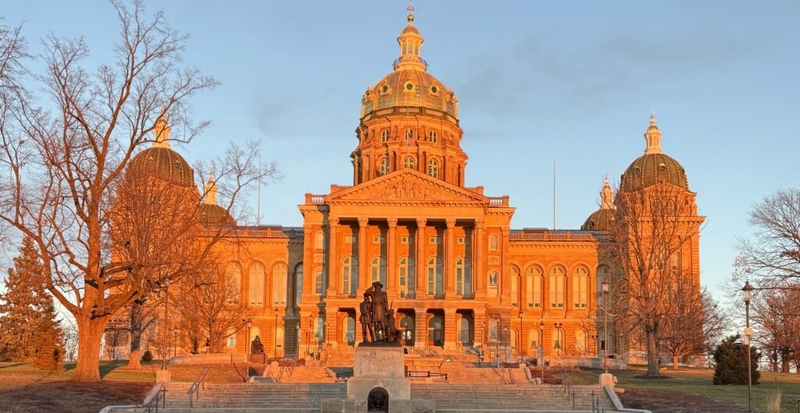
The Iowa Capitol during golden hour on Dec. 20, 2025. (Photo by Cami Koons/Iowa Capital Dispatch)
Many of the laws advanced during the 2026 legislative session take effect Wednesday, including measures restricting access to abortion-inducing medication, increasing the speed limit on two-lane highways and limiting future governors’ powers during public health and disaster emergencies.
July 1, the beginning of the state’s fiscal year, is the default date for new laws to be enacted, unless otherwise specified.
Several measures passed this session went into effect immediately, including laws banning public entities from hosting warrant resolution clinics and shifting some K-12 funding from public to charter schools to follow students. Other new laws have a different start date specified. For example, the 5-cent tax on vapes and alternative nicotine products will go into effect Jan. 1, 2027.
Here’s a look at some of Iowa’s new laws that take effect Wednesday:
Abortion medication: Iowans will need to obtain prescriptions for abortion-inducing medications like mifepristone and misoprostol through in-person appointments beginning Wednesday. This restriction, under House File 2563, will mean patients can no longer obtain these medications through telehealth and mail-order prescription services.
Proponents of the measure said physicians will be able to better identify instances of abuse by requiring in-person appointments, as well as stop “black market” abortion medications from coming into the state. Democrats and health advocates said that characterization of telehealth and mail-order prescriptions was inaccurate, as the medicine still comes from licensed medical providers. Some Republicans also said the in-person requirement will allow for more stringent enforcement of the state’s six-week abortion ban, which bans abortions after cardiac activity is detectable in an embryo.
The measure additionally clarifies the definition of “abortion” to exempt medical treatments related to miscarriages and ectopic pregnancies.
E-Verify, SAVE and other citizenship checks: Though many of the citizenship and work status verification steps codified through Senate File 2218 were already being enforced through by an executive order from Gov. Kim Reynolds in 2025, the law will make these changes permanent. State government entities and state licensing boards are required to use the federal Systematic Alien Verification for Entitlements (SAVE) database and E-Verify system to verify citizenship and legal status of people seeking state employment and professional and occupational licenses. The governor’s executive order enacting this new requirement and the law that followed came out of the immigration arrest of former Des Moines Public Schools superintendent Ian Roberts, who was granted a license to serve as superintendent in July 2023 by Iowa Board of Educational Examiners.
The new law also directs the BOEE to have applicants for new and renewing educator licenses provide the board proof of their legal U.S. work authorization, and to verify their continued work eligibility every five years to remain licensed. There are several other immigration-related provisions in the law, such as making the act of providing a false Social Security number a crime, and requiring Iowans registering to vote to swear they are a U.S. citizen under penalty of perjury.
Affirmative action, police training: Iowa state and local entities, including the state departments of Education and Administration, Board of Regents and school districts, will no longer be required to enact or report on Affirmative Action plans under House File 2711.
Additionally, the new law removes certain training requirements for police officers that were approved in a 2020 police oversight law. Law enforcement agencies in Iowa will no longer be required to hold annual bias prevention trainings, and the Iowa Law Enforcement Academy will no longer have racial and cultural awareness training requirements. Police will still be trained on deescalation techniques.
‘Tough on crime’ laws: House Republicans laid out a priority of targeting “repeat offenders” at the beginning of the 2026 session — and two measures aimed at targeting this group will take effect Wednesday.
House File 2542 adds a minimum seven years in prison on top of their base sentence when a person is convicted of their third felony. This additional sentence cannot be deferred or suspended.
The governor also signed into law Senate File 2399, which deals pretrial bonds and bond amounts. Moving forward, judges will need to provide written justification if they set bail lower than the uniform bail schedule, and would need to provide written justification for any pretrial release for people charged for crimes such as a forcible felony or intimidation with a dangerous weapon. “Promise to appear” releases are also banned for people charged with simple or misdemeanor charges related to violence or drugs, though earlier releases can still occur for other misdemeanor charges and when a person needs medical attention.
The new law will also allow for inflation adjustments for bond scheduling. This provision will not go into effect immediately — the law gives the judicial council until July 1, 2027, to submit an updated bond schedule to review by the Iowa Supreme Court.
Age verification: Websites and social media platforms in which one-third or more of the content hosted is pornographic will have to implement “reasonable” age verification steps under House File 864.
The law, modeled after a similar measure in Texas upheld by the U.S. Supreme Court, requires these websites to verify users’ ages using government-issued identification, financial documents or other similar documents.
Animal torture: Animal torture, defined as when a person “intentionally, willfully, and maliciously mutilates, burns, poisons, drowns, starves or causes intensive or prolonged pain or death to a companion animal, or provides anything of value to another person to do the same,” will be charged as a Class D felony under House File 2348. If an individual was previously convicted of animal abuse, neglect, torture, or other crimes related to misconduct involving animals, that charge would be raised to a Class C felony.
Iowa is the final, 50th state in the nation to make animal torture a first offense felony.
Speed limits: As of Wednesday, two-lane state highways will have a speed limit of 60 miles per hour — higher than the 55 miles per hour limit previously in place. Senate File 378 does not change speed limits for other types of roads: residential and school zones will remain at lower speed limits, and interstate speed limit will remain at 70 miles per hour.
Childcare assistance: Iowa’s Child Care Assistance (CCA) program has been available to parents who are childcare workers, regardless of income, since 2023 through a pilot program. Under House File 2514, this assistance program has become permanently available to people in the childcare industry who work at least 32 hours per week.
Governor’s powers: Reynolds, who is not seeking another term in office in 2026, limited future governors’ ability to enact restrictions in situations similar to the COVID-19 pandemic with the signing of House File 2694. The law states a governor cannot restrict private businesses’ operations during public health disasters or order places of worship to close, though the governor can still make recommendations in these emergency situations.
The law also requires lawmakers approve any changes to election laws and regulations in the future, even when the Legislature is not in session. Democrats have criticized the measure as an attempt by Republicans, who hold a trifecta of control at the Iowa Capital, to restrict the powers of a future Democratic governor.
HPV vaccine: Parental consent is necessary for almost all vaccinations, as well as most medical care, under Iowa law. But there’s a carveout in Iowa law for care related to prevention, diagnosis or treatment of sexually transmitted diseases or infection, allowing minors to consent without permission from their guardians or parents.
Senate File 304 strikes this exemption for minors’ ability to consent to vaccinations without approval from their guardian. The measure will specifically prevent minors from independently consenting to receive the Human Papillomavirus (HPV) vaccine and the hepatitis B vaccine. During debate on the proposal, Democrats and health advocates said this prevents Iowans under age 18 from taking precautions against cancer, as HPV vaccines are linked with lower instances of cervical cancer when a person is vaccinated before age 17.
Local identification cards: Local governments can no longer issue community ID cards under House File 2296. The new law specifically impacts impact Johnson County’s community ID program, identification cards which cannot be used to drive, access cash benefits or vote. The law will not restrict counties from issuing official state driver’s licenses and non-operator ID cards. Cities or counties can also still issue IDs for local government employees or elected officials related to their job duties, and identification devices for people with disabilities.
Des Moines, IA