Trump administration revives controversial Moose-Wilson Road project with eye on recreational path
Jun 30, 2026 | 6:23 am ET
Description
Photo courtesy of WyoFile
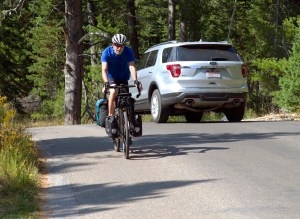
Winding through dense forests and wetlands in the southwest corner of Grand Teton National Park, the 7.1-mile Moose-Wilson Road offers incredible wildlife viewing opportunities as moose, bears and other critters forage nearby.
The road is narrow and heavily trafficked, which prompted the National Park Service to launch a management plan last decade. What ensued was a multi-year process with heavy public engagement that identified four alternatives to shape the corridor’s management.
In 2016, the park service identified an option that generally restricted development within the corridor to the existing footprint. Notably left out of that preferred alternative was a proposal to build a multi-use pathway, separated from the road, for bicycles and pedestrians.
Now, the park service is revisiting the pathway proposal. Last week, the agency released a draft “programmatic agreement” that identifies additional scoping work related to construction of a multi-use pathway, realignment of a 1.8-mile segment of the Moose-Wilson Road and restoration of that segment. The park service is accepting public comment on the proposal through July 9 — 15 days from the draft’s release.
The pivot is the result of a 2025 executive order signed by President Donald Trump that emphasizes recreation, according to the park service. “This aligns with implementation of the [executive order], which calls for improving visitor services, enhancing access, and reviewing policies that may unnecessarily restrict recreation in national parks,” the agency stated this spring when it announced plans to revisit the pathway decision.
According to the new draft document, recreational opportunities, newly stipulated by Trump’s executive order, were not considered during the previous scoping process.
Conservation groups are skeptical, however, saying the process did what it was designed to the first time around.
The order opens “the door to future development, a disrupted visitor experience, and habitat fragmentation” in the corridor, the National Parks Conservation Association said in a statement. “Given the comprehensive environmental, scientific, and community inputs that support the selected action, the National Parks Conservation Association is deeply disappointed by a new Department of Interior-led directive to re-open and reevaluate the 2016” decision.
Years in the making
Like neighbor Yellowstone, Grand Teton National Park has grappled with managing increasing crowds in recent years. The park’s annual recreation visits surpassed 3 million in 2015, and between 2015 and 2021, that count grew by 23%. The park has embarked on several initiatives aimed at understanding and addressing the impacts of growing visitation.
The National Park Service kicked off the Moose-Wilson planning process in 2013 by soliciting public comments in a year-long scoping period. In outreach materials, the agency said it sought to ascertain everything from the road’s purpose for visitors to the desired conditions of the corridor’s fundamental resources.
The road is the main artery running through what’s known as the Moose-Wilson corridor — a swath of roughly 10,300 acres with exceptional wildlife habitat that also provides access to destinations like the Death Canyon trailhead, Laurance S. Rockefeller Preserve and Murie Ranch historic district.
A mix of aspens, chokecherries, willows and conifers in forests and pristine riparian zones draw many species — which can create “wildlife jams” as slowing or stopping vehicles clog the road. Along with growing visitation, some local residents rely on the road as a shortcut between Teton Village and Jackson Hole Airport or Wyoming Route 390 and destinations in the park and beyond.

In 2016, the park service estimated that roughly 400,000 visitors traveled the corridor annually.
“The volume of traffic on the road, combined with the various purposes for which people travel the road, is resulting in congestion and conflicts among users,” the park service stated in a planning document.
Given those realities, a great deal of management plan discussion and comment focused on traffic management strategies. Ideas ranging from seasonal closures to reservation systems and one-way road traffic were contemplated. Another was construction of a multi-use pathway separate from the road. According to park service reports, public comment ran the gamut.
Those in support said it would be safer for users and result in fewer vehicles overall and a more serene experience. “A pathway will encourage users to park and use non-motorized transportation, thus, decreasing congestion on the roadway,” one commenter said. “Currently, pedestrians or cyclist (sic) must traverse the existing narrow road which is very dangerous. In addition, a pathway segment would tie Moose and [Teton] Village together. This would complete a world class pathway system loop.”
Others, however, called it an inappropriate project that would unduly affect sensitive wildlife habitat and increase the potential for human-wildlife conflict.
“Those of us who enjoy bicycling have recently benefitted by the addition of dozens of miles of pathways in Teton County, many in the Park, and in areas that have superb vistas and which are much safer and less disruptive to animals than a path would be in the Moose-Wilson corridor,” another commenter said.
The pathway was under one of four alternatives proposed for the management plan, but the park service ultimately opted for a different one, Alternative C. The alternative also directed park officials to manage traffic during peak periods, using timed entry techniques, and to lower the speed limit on the road, which isn’t open to RVs or trailers, to 20 miles per hour.

The agency released its environmental assessment on the draft management plan in 2016. A so-called record of decision, which typically represents a final step in the process, was signed in 2017 during Trump’s first term.
“The emphasis of the selected action is to balance preservation and public use and enjoyment by exemplifying conservation legacies within the corridor,” the decision states.
Why now?
In March, a page on the National Park Service’s relatively obscure Planning, Environment and Public Comment (PEPC) site was updated with an announcement.
“The National Park Service is revisiting the 2016 Environmental Impact Statement and Record of Decision for the Moose-Wilson Road project,” it read. The action, according to the announcement, stemmed from the 2025 Making America Beautiful Again executive order.
Along with increasing entry fees for foreign tourists and improving affordability for United States residents, the order’s stated goals included “expanding opportunities to enjoy America’s splendid national treasures.”

The order directed the secretary of the interior to review all of the department’s recreational access rules and “take steps to rescind any that unnecessarily restrict recreation in national parks.”
In this case, “Specifically, the NPS is re-evaluating the selected action to incorporate a separated multi-use pathway extending the length of the corridor and realign a segment of road, with a parallel pathway, between Sawmill Ponds and Death Canyon Road,” the March announcement said.
Last week, it released the draft programmatic agreement.
This type of document provides consultation procedures that streamline the standard four-step process under the National Historic Preservation Act, according to the park service. They allow federal agencies to implement a program by negotiating an agreement between the agency, appropriate state or tribal historic preservation offices and the Advisory Council on Historic Preservation.
The draft agreement, which lists Grand Teton National Park and Wyoming historic preservation officer as parties, is evidence the park has accounted for the impacts of the undertaking on historic properties, it states.
The corridor holds significance as a hub for Indigenous peoples, evidenced by recent discoveries of obsidian relics. The park has already consulted with numerous tribes, the agreement states, including Wyoming’s Eastern Shoshone and Northern Arapaho.
Cheyenne, WY