New Mexico Gov. Lujan Grisham calls for restitution amid allegations that feds let fentanyl into NM
Jun 29, 2026 | 3:00 pm ET
Description
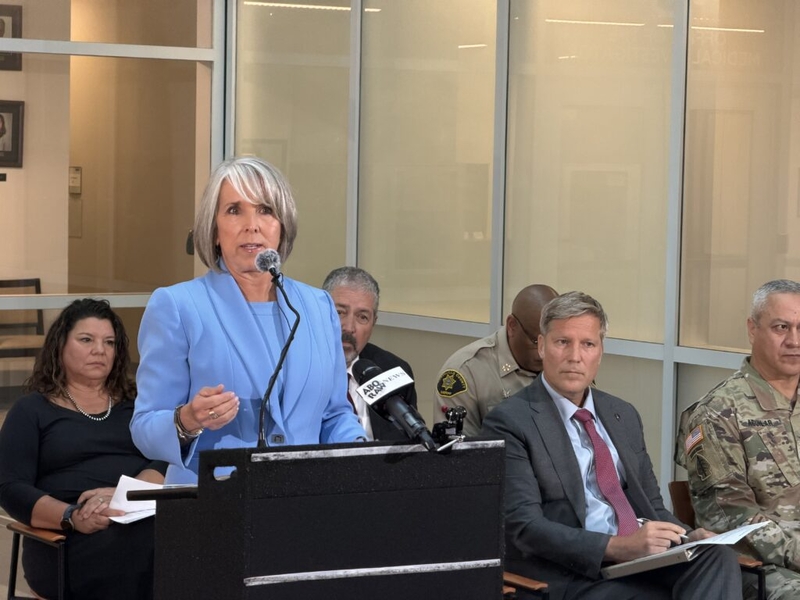
New Mexico Gov. Michelle Lujan Grisham spoke alongside (left to right) state Department of Health Secretary Gina DeBlassie, Bernalillo County District Attorney Sam Bregman, Bernalillo County Sheriff John Allen, Albuquerque Mayor Tim Keller and New Mexico National Guard Adjutant General Miguel Aguilar on June 29, 2026, to demand the federal government be held to account over allegations that U.S. Drug Enforcement Administration officials let copious amounts of fentanyl flow into the state. (Joshua Bowling/Source NM)
New Mexico Gov. Michelle Lujan Grisham spoke alongside local, state and law enforcement officials Monday to announce that they plan to pursue restitution from the federal government over allegations that U.S. Drug Enforcement Administration officials knowingly let fentanyl shipments into New Mexico.
Mayors, district attorneys and sheriffs from across New Mexico joined Lujan Grisham in condemning the federal government’s alleged actions, which were detailed in a whistleblower complaint first reported by the Albuquerque Journal and the Associated Press. In one instance, a whistleblower alleged that agents stood by while 1.8 million fentanyl pills were trafficked in hopes of catching higher-ranking dealers and suppliers down the line.
Since those allegations were made public earlier this month, state leaders have demanded answers from the federal government. New Mexico Attorney General Raúl Torrez in a letter to Lujan Grisham last week said he was opening a “thorough and aggressive investigation.”
Lujan Grisham at a Monday news conference said she was working to schedule a meeting at the White House over the matter and said she believed the state could seek “hundreds of millions” to more than $1 billion in civil damages.
She said this was the third time — following the COVID-19 pandemic and the federal prescribed burn that led to the Hermits Peak-Calf Canyon Fire — that she has had to mitigate the adverse effects that stemmed from federal inaction.
“This is a stunning failure by the federal government,” Lujan Grisham said, adding that she has not received confirmation from the federal government that the DEA has stopped this practice. “They should be accountable for what happened in our state.”
She said northern New Mexico has seen an increase in arrests and “stunning results” after she mobilized the National Guard to Española last year over the town’s outsized rate of fentanyl deaths.
“Imagine if it wasn’t an uphill battle,” she said.
Indeed, overdose deaths in New Mexico have risen in recent years while they’ve fallen nationally. State leaders have spent nearly $844 million since 2022 to rebuild the state’s behavioral health system — an investment that has largely been focused on fighting addiction and overdoses, Lujan Grisham said.
New Mexico House Speaker Javier Martínez (D-Albuquerque) joined Lujan Grisham to condemn the federal government’s alleged actions and said that as someone whose district includes portions of Albuquerque that struggle the most with addiction and overdoses, he was alarmed that the federal government would permit such operations.
“The fact that people lost their moms or dads or children to the scourge of fentanyl right under the nose of the federal government is devastating,” he said. “They talk about the bigger fish. Where are the bigger fish? I don’t think they caught the little fish, either.”
Martínez made similar remarks last week alongside U.S. Rep. Melanie Stansbury (D-N.M.) when she announced the state’s congressional delegation also is seeking an investigation and a briefing by the DEA.
The alleged fentanyl tracking occurred during multiple presidential administrations, according to the whistleblower complaint. Martínez drew parallels between Albuquerque’s current situation and the Ronald Reagan-era crack epidemic in Los Angeles.
“I don’t care who it was; Biden, Trump, whatever. This is a systemic failure,” he said.
Albuquerque Mayor Tim Keller, who has overseen the city’s recent efforts to divert non-violent 911 calls for addiction and behavioral health, said the revelations in the whistleblower complaint are particularly painful because they came at a time when city, county and state leaders were all coordinating and “working the hardest” to address addiction and trafficking.
“Make no mistake. This is literally the federal government using us in some sort of uninformed, undisciplined experiment that is literally killing our people,” he said. “This is absolute betrayal by our federal government in our time of need.”
State health officials were equally blunt in their assessment. New Mexico officials have invested in behavioral health and life-saving medications like Narcan, but they said they feel now like they have been playing against a stacked deck for years.
“No state can be expected to outfund or outwork a crisis that the federal government is enabling,” state Department of Health Secretary Gina DeBlassie said at the Monday news conference.
Santa Fe, NM