Hey neighbor! How Minnesota can use recent adversity to burnish its brand.
Jun 29, 2026 | 7:00 am ET
Description
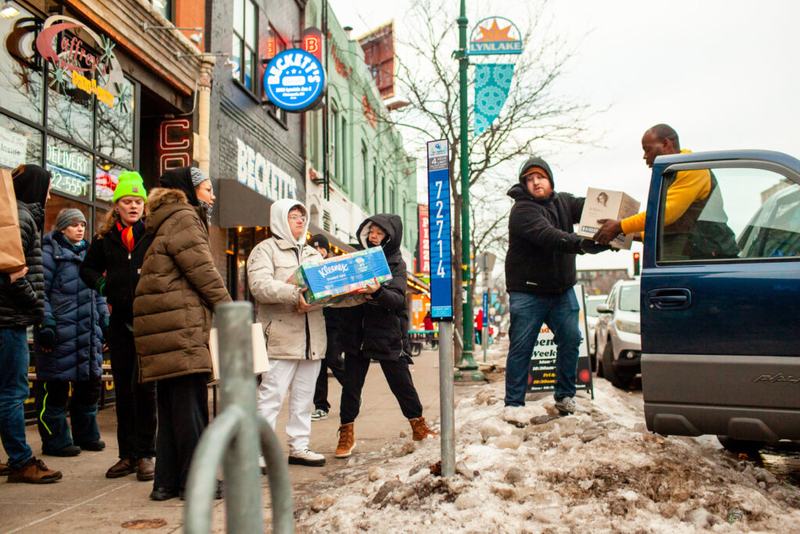
Community members form a bucket bridge as they give donations to a person distributing them at Smitten Kitten, an adult store that was a hub for donations to be distributed to people who were sheltering in place out of fear of ICE Thursday, Jan. 15, 2026. (Photo by Nicole Neri/Minnesota Reformer)
At the start of the year I was asked an intriguing question. How much damage has been done to Minnesota’s once pristine brand, and how might we rebuild it?
The unflattering news stories had been relentless. Allegedly large-scale fraud. Cracks appearing in our celebrated quality of life.
Gov. Tim Walz, who’d already been on a losing national ticket, read the political tea leaves and announced he was ending his campaign for re-election.
We were invaded by thousands of masked and combat-ready federal agents, terrorizing our neighborhoods and, by early January, already killing one Minnesotan in cold blood.
The state is still reeling from the human and economic damage done at the beginning 2026. At that time, I would have told you the toll on Minnesota’s reputation looked equally devastating.
It turns out the answer to that question has proven more nuanced and fascinating.
People tend to view reputational trouble in crisis terms. It’s also an opportunity to talk about your brand in new ways, and at a moment when the mass public is paying attention. The one thing that rarely works is to try and argue your way out of what is often a mess of your own making. It leaves you sounding defensive and unlikeable.
The better strategy is to replace the toxic narrative with one that is more positive and enduring.
In our case, we’re now known in many quarters around the country as a generous place where neighbors courageously stand up for each other. We can run with that.
Watching all the news buffeting Minnesota, I was reminded of a talk I used to give to business groups around the country, re-counting how the ad agency I worked for helped Harley-Davidson come back from the brink of oblivion and grow into one of the world’s strongest brands.
When we started working with Harley, the venerable motorcycle maker had just about run out of road. A leading cycle magazine at the time wrote, “Some of the hardware on Harleys looked as if it were hammered out of iron ore by rock-wielding natives along the shore of the Milwaukee River.”
Our first advice was to be patient and deliberate. Get the product fixed, and they had begun investing in that. Then start small, doing the work of rebuilding trust by getting people on the new bikes for a test ride. We knew things were turning around when the president of the Oakland Hell’s Angels raved publicly about how the new Harleys “don’t beat you to death anymore and your kidneys are still intact.”
In January I put together a framework for how a similar approach might work in Minnesota, intended to run in this space as a call-to-action to repair the state’s beaten-up brand. Then the Trump administration’s immigration crackdown surged wildly out of control. It became clear that would monopolize the public attention span for some time.
Now that the tear gas has dissipated (mostly) and the streets are quieter, I’m surprised at how closely my original framework mirrored the way events have played out. That’s not because I was prescient. It’s what good communications logic ought to do. It does give me a measure of real-world confidence in the strategy.
I suggested three possible narratives.
The first encouraged us to look inward and engage Minnesotans with a simple message: Don’t hate on Minnesota, it hurts all Minnesotans. Think of it as the best kind of patriotism, but for Minnesota. Be honest, certainly. Fix what needs fixing. But we also need to have one another’s backs if we want to protect the home we all share and keep the good life we’ve built out of the crosshairs of those who seek political gain by attacking us.
This is the only one of the three narratives I’ve yet to see emerge, but a small-scale messaging campaign could change that. It’s a simple truth that’s easy to repeat out loud or on social media. It evokes the powerful emotion of rallying together in the face of an outside attack. Divisiveness is and will remain a challenge, but working to get as many people as possible on a “Minnesota Nice” side of the divide is a story in itself. While the glare of the spotlight remains on us, it can also lead to stories of what still works here. The natural beauty and parks. The diverse theater and food culture. The way we put kids and seniors first. That’s how the long, careful work of a turnaround begins.
We got some help recently when the New York Times editorial page cited the State of the Nation Project, whose bipartisan experts declared that Minnesota has the highest quality of life in the nation. This is something we tell ourselves all the time. We just have to get the word out, albeit skillfully.
My second narrative was to do what Minnesota has always done: Lead with smart public policy. Go big by challenging the 2026 legislative session to come up with a smarter, more efficient, more fraud-proof way to deliver human services. Give it a good handle: The New Minnesota Model.
Walz proposed a large-scale reorganization of Minnesota’s human services this year, but it’s his final year, and the Legislature didn’t engage with the idea much. The Legislature passed a bill creating an independent Office of the Inspector General, but that is more backward looking than forward.
A start, if a halting one. The opportunity remains. In many ways the effort is the message, and I would push that advantage. There are smart ideas out there. A positive high-profile debate about this puts a good spotlight on Minnesota. If performative politicians would rather tear the effort down, then my first narrative — call it Minnesota patriotism — may be useful in calling them out. As a sidenote, success would be catalyzed by the sort of bipartisan collaboration often associated with gubernatorial candidate Amy Klobuchar. It would be interesting to see the idea find its way to the center of her campaign.
My third narrative has become even more compelling after Operation Metro Surge. In my old Harley speech, I talked about how we went on to build a brand that stood for freedom. In January, bubbling up under the chaotic surface of what the Department of Homeland Security called its “largest DHS operation ever,” I saw a similar symbolic opportunity. The administration’s story of rooting out fraud and deporting “the worst of the worst” was crumbling in the face of the wanton violence of ICE agents and an emerging counternarrative of courage and civic virtue, as Minnesotans stood together with plastic whistles and smartphone videos to protect their neighbors.
The state was once again at the center of a grassroots movement echoing around the nation. With the killing of Renee Good and Alex Pretti, Minnesotans were once again the public face of that movement. And, just handful of city blocks from and five years after George Floyd was killed.
So: Just as we think of New England as the birthplace American democracy, we can describe Minnesota as the birthplace of a new patriotism. One that symbolizes the sort of authentic, human revitalization we all hope for in America.
In the end, ICE got beat by Minnesota. The world watched the story unfold. Read an opinion piece or listen to a conversation about people standing up to injustice, lawlessness and corruption, and sooner or later it comes around to, “We have the example of Minnesota.”
For better or worse, Minnesota’s response to the ICE surge is an indelible part of our brand. I’d say, for the better. The tactics of civil resistance that proved so effective here — noisy yet peaceful, decentralized yet in their own way highly organized, intensely local yet visible all around the world — are attributes worth owning.
The political arguments fade over time, even ones as currently divisive as immigration. The powerful emotional constructs — courage, truth, justice, standing up for neighbors, a new American patriotism — can live on in Minnesota’s brand if we’re smart about using narratives like the ones I’ve sketched out here.
As always, the hard work is in the details and execution. Minnesota has one of the nation’s best creative communities and a deep bench of smart business leaders.
My final suggestion is to challenge them to create a task force to study Minnesota’s brand health more deeply, then use the narratives and language above as a starting place to present a revitalized Minnesota brand to a world in need of a bright north star.

Saint Paul, MN