RIDOT picks the company that will restart Rhode Island’s truck tolls
Jun 29, 2026 | 5:30 am ET
Description
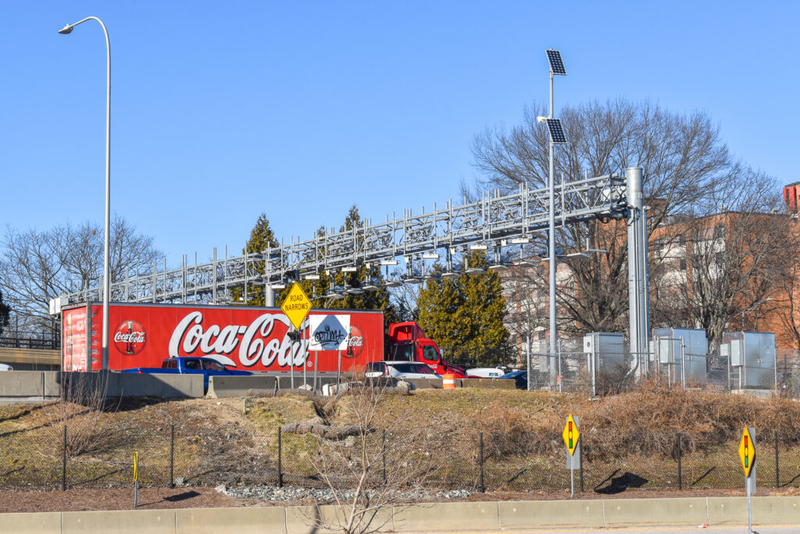
A Coca-Cola truck passes under an offline tolling granary on Interstate 195 in Providence in March 2025. (Photo by Christopher Shea/Rhode Island Current)
The long-awaited return of truck tolls is still on track for 2027, albeit a little later than the Rhode Island Department of Transportation (RIDOT) had promised.
The transportation department on Friday awarded a tentative $944,000 contract with Canadian-based Quarterhill to create a new back office system that will manage toll transactions on tractor trailers traveling over the state’s highways. It was one of nine entities to respond by the state’s March 27 bidding deadline. The others were Bridge Atlantic, LLC; Emovis USA, Inc; Kapsch TrafficCom USA, Inc; Legnetix, Inc; Neology, Inc; SWC Group; ViaPlus, LLC; and Vitronic Machine Vision, Inc.
Electronic Transaction Consultants, LLC, doing business as Quarterhill, indicated in its technical proposal that the new billing system would go online no later than May 2027. But it is possible tolls won’t go online until July, confirmed RIDOT spokesperson Charles St. Martin.
“The contractor has a two-month period of certification following this to ensure system accuracy,” he said in an email to Rhode Island Current.”
Interim RIDOT Director Robert Rocchio told lawmakers in March he expected the truck tolls to be operational by the first quarter of 2027. But that timeline depends on how long it would take to replace the dormant equipment installed in phases on state highways in 2018 under then Gov. Gina Raimondo’s RhodeWorks program, and select a new toll collection contractor.
“As previously reported, after sitting dormant for years due to ongoing litigation, the toll infrastructure requires upgrades which will result in a one-time cost of $19 million,” St. Martin said. “That work is ongoing.”
Rhode Island’s tolling system went live in June 2018 with each of its 13 highway gantries charging an average toll of $3. A truck paid a toll only once in each direction, could not pay more than $40 per day, and could not pay more than $20 for making a single “through trip” from Connecticut to Massachusetts.
The American Trucking Associations argued in its lawsuit, filed shortly after the program went online, that the tolling system discriminated against interstate trucking companies and impeded the flow of interstate commerce.
The system collected nearly $104 million in revenue before being shut down in 2022 after then-U.S. District Judge William E. Smith sided with the American Trucking Association and ruled the program’s $20 per day cap was unconstitutional.
The state appealed the ruling that November. In December 2024, the federal appellate court in Boston found Rhode Island could charge trucks — but only if it eliminated a $20 per day cap.
The transportation department plans to cut the average rate for tolls at all gantry locations by 25%, St. Martin said.
Before it was shut down by the courts, the toll system was collecting around $40 million per year. St. Martin said revenue should remain the same even after the rate changes.
The state’s fiscal 2027 budget set to take effect July 1 had assumed $20 million in estimated toll revenue would cover the costs associated with updating the gantries and software. But the late spring activation means the transportation department will have to dip into different revenue streams.
St. Martin said available carryforward funds in FY27 will be used to pay for the one-time gantry infrastructure upgrades and activation of the billing system.
“When tolling resumes, future toll revenue will replenish those carryforward funds,” he said.

Providence, RI