New Orleans, local groups see biggest cuts from Gov. Landry’s budget vetoes
Jun 26, 2026 | 5:00 am ET
Description
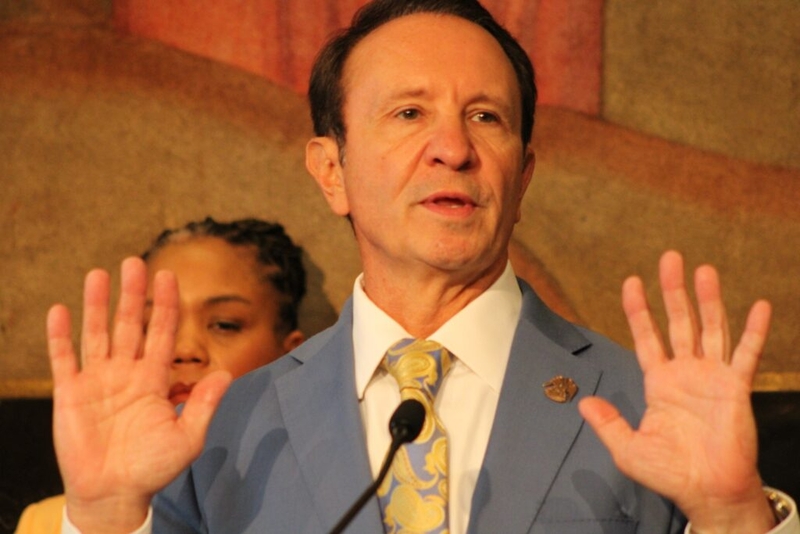
Gov. Jeff Landry speaks to reporters at State Capitol news conference Thursday, June 25, 2026. (Photo by Greg LaRose/Louisiana Illuminator)
Projects planned for New Orleans and groups that serve Black communities throughout the state saw some of the biggest cuts from Gov. Jeff Landry’s veto pen, based on a review of his line-item revisions to the state spending plan made public this week.
The governor has framed the reductions as fulfilling his promise to ensure the best use of public money, but lawmakers who had state spending pulled from their districts see Landry’s vetoes as retribution for voting against legislation he supported.
The changes were posted online Wednesday, just hours after Landry got the legislative votes he needed for his plan to take $168 million in state money for public school operations and use it for teacher and school support pay stipends.
Through his spokesperson, the governor said Thursday he has told lawmakers since taking office in early 2024 that funding for non-governmental organizations — often charities and church-based organizations that provide services such as education and medical care — would receive intense scrutiny.
“That’s exactly what we did this year,” Landry said. “If you look at the descriptions of what we struck out, it’s overwhelmingly NGO funding, which is in line with my desire to be the best stewards of taxpayer dollars.”
One of the larger concentrations of cuts involved organizations and projects in Algiers, which Rep. Delisha Boyd represents. She did not vote on the governor’s stipend funding request, citing a court order that has stopped Landry from moving forward with his plan, but she said her choice would have been “no” if she did.
“Most of these programs are for helping elderly people and children,” said Boyd, a Democrat who’s held her House seat since 2022.
Several of the groups are funded through the Algiers Development District, a legislature-created entity that had approximately $600,000 pulled from the state government’s operating budget. Another $150,000 was cut from the Algiers Economic Development Foundation, and Landry also struck a $1 million allocation for Behrman Stadium, the only high school football venue in Algiers that’s long needed upgrades.
Boyd met Thursday with other members of the Legislative Black Caucus, who she said noted that a bulk of the governor’s cuts targeted their districts.
The deletions included $1.75 million from the state’s capital outlay budget for four solar-powered resiliency hubs to provide neighborhoods with access to air conditioning and device charging during extended power outages. Civic groups have built close to 20 similar facilities around the state, largely relying on government funds for the work.
The construction budget originally included funding for local churches to build resiliency hubs in Caddo and Calcasieu parishes, and another was slated for a housing group in New Orleans.
That fourth resiliency center was planned for the district Sen. Royce Duplessis, D-New Orleans, represents. He was the lone Senate member who voted against the governor’s teacher stipend proposal. In a statement, he highlighted funding for other New Orleans projects that Landry eliminated with his veto power.
“These were not political projects. They were investments in children, healthcare, housing stability, workforce development and public well-being,” Duplessis said. “When government chooses to deny resources to communities because of political disagreements, that is not leadership.”
The items Duplessis listed include $6.5 million for a Volunteers of American healthcare facility, and $1.7 million for an early learning center. But nearly all of those dollars are designated as Priority 2 and wouldn’t have been awarded next year anyway. They are included in the budget to place them in the queue for future state funding.
Some budget items the governor rejected had Priority 5 status, placing them at the starting line for state funding. His vetoes effectively remove them entirely from the wait list.
A $1 million allocation to build a new New Orleans City Hall that Landry struck from the state construction budget was a Priority 5 item. The city has struggled for decades to formulate and fund a plan to replace its main governmental building, which turns 70 years old next year.
An official cost to erect a new city hall has never been put forward, but estimates have placed the amount well north of $200 million.
“The city of New Orleans has been in a tough financial spot,” the governor said. “The state has come in to help, but that must also come with fiscal restraint. My goal is to work with the city to prioritize spending on government services and to not be too hasty with new projects they may not be able to afford.”
Other notable vetoes from Landry included:
- $18 million in the capital outlay budget for A Good Deed Foundation’s grocery-store centered development in North Baton Rouge, with $16.2 million designated as Priority 5;
- $3 million for Habitat NOLA’s Rising Oaks development in Terrytown, with $2.5 million in Priority 5 funding and $500,000 as Priority 2;
- $2 million capital outlay funding (Priority 5) for Project 70805 Inc. to redevelop a former hardware store in North Baton Rouge into a food business incubator;
- $2 million in the state operating budget for the Ellis Marsalis Center for Music in New Orleans, a community center providing services to children and musicians in the Upper 9th Ward neighborhood ;
- $1 million for the Orleans Parish Sheriff’s Office in the state operating budget;
- $1 million for the North Lake Charles Economic Development District in the supplemental appropriations budget; and
- $500,000 in the operating budget for the J.S. Clark Leadership Academy in Opelousas.
Baton Rouge, LA