States face more budget pressures amid rising costs, slow growth
Jun 08, 2026 | 1:32 pm ET
Description
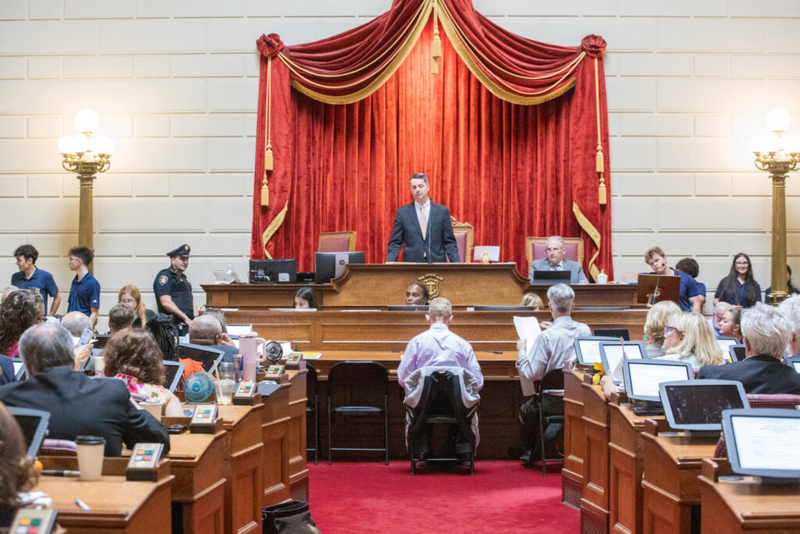
The Rhode Island House of Representatives debates the fiscal year 2027 state budget in Providence on Friday. A new survey of state budget officers found many states face ongoing budget pressures. (Photo by Alexander Castro/Rhode Island Current)
The most recent budgets proposed by governors across the country reflect ongoing financial pressures for states as they expect modest revenue growth, rising prices and federal policy changes.
Most governors recommended state budgets for fiscal year 2027 that would essentially keep spending flat from the general funds that pay for most state services. That’s according to the Fiscal Survey of States by the National Association of State Budget Officers. (Forty-six states will begin the 2027 fiscal year in July.)
The survey of budget leaders found nearly half the states were implementing some form of spending cuts to balance the books.
In their budget plans, 14 states said they would eliminate vacant positions, four reported hiring freezes and eight reported changed retirement benefits to reduce costs. Four states reported layoffs and cuts in employee benefits.
“While budgets are tightening, states overall remain in a strong fiscal position due to steps taken in recent years to manage spending carefully and build reserves,” Alexis Sturm, director of the Illinois Governor’s Office of Management and Budget and current president of the National Association of State Budget Officers, or NASBO, said in a news release.
The survey found that most states planned to increase the size of their rainy day funds: 25 states project those reserves to grow in fiscal 2027, 10 expect theirs to decrease and 11 states expect no change in dollars unadjusted for inflation. Four states did not report.
But researchers at The Pew Charitable Trusts earlier this year found that the power of those reserve funds is weakening as states confront rising costs. Pew researchers concluded that the median state in 2025 could fund its operations on reserve funds for 47.8 days — down from a record 54.5 days in fiscal 2024.
States pay for most spending from three primary tax revenues: sales and use taxes, personal income taxes and corporate income taxes. In the recent survey, 29 states reported tax revenues were coming in higher than forecasted for fiscal year 2026. Nine states reported collections were on target, while 11 said their revenues were below expectations. One state did not report on revenue collections and NASBO noted the revenue numbers may change following the April tax season.
In their budgets, governors proposed a mix of tax increases and decreases for the upcoming fiscal year that NASBO says will collectively have a near-zero net impact on general fund revenues.
With federal stimulus dollars and strong consumer demand, states recorded record revenue growth in fiscal years 2021 and 2022. But NASBO expects more modest growth for state revenues in the coming years with a slower national economy, the impact of state tax cuts and changes in federal tax policy.
“States are continuing to navigate a tighter fiscal environment than they experienced earlier this decade,” Shelby Kerns, executive director of NASBO, said in a statement. “While revenues in most states are meeting or exceeding forecasts, growth remains modest and many states are seeing ongoing spending demands outpace recurring revenue growth in the out-years.”
Stateline reporter Kevin Hardy can be reached at [email protected].