Oregon’s wildlife areas: Managed for livestock?
Jun 08, 2026 | 11:32 am ET
Description
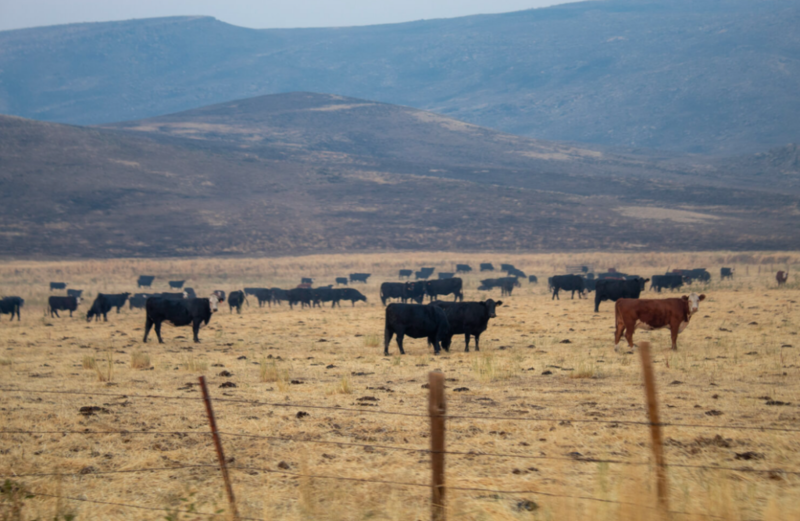
Cattle who were separated from their calves stand in front of burnt hills near Emmett, Idaho. (Photo by Mia Maldonado/Idaho Capital Sun)
Every time an Oregon hunter buys a license, pays for a tag or purchases a box of ammunition, a small portion of that money goes into the Pittman-Robertson Wildlife Restoration Fund. Since its inception in 1937, the sole purpose of that fund is to protect and improve habitat for wild game animals.
In Oregon, those dollars have helped purchase and maintain twenty Wildlife Management Areas — roughly 200,000 acres of public land set aside specifically for fish and wildlife. These lands were paid for by Oregonians, and they were created for one reason: to benefit wildlife.
So why are cattle grazing on more than half of them?
On areas including White River, Wenaha, Elkhorn, Phillip W. Schneider, and others, private ranchers hold grazing agreements that allow their cattle onto Oregon Department of Fish and Wildlife Wildlife Areas. When you ask managers why, the answer you consistently get is something called “forage conditioning” — the idea that when cattle eat the grass down in spring, it somehow grows back in a way that is more nutritious for elk and deer. Leave the grass alone, the argument goes, and it becomes “wolfy” and unpalatable. Graze it with cattle, they say, and you are actually doing ungulates a favor.
However, when you look carefully at the actual science behind this claim, the evidence is surprisingly thin — and in Oregon’s dry landscape, it doesn’t hold up at all.
The justification for forage conditioning in the Pacific Northwest rests heavily on a single study from 1975. That study reported that after cattle were reintroduced to a northeastern Oregon wildlife area, elk numbers eventually increased, and managers concluded the cattle were improving the grass.
That study has been cited over and over again for 50 years as proof that grazing benefits wildlife. But here is the problem: the researchers changed many things at the same time that they introduced livestock to the lands — they built new water sources, put up new fences, conducted burns, and closed the area to vehicle traffic.
Forage quality was never measured with laboratory analysis, and there was no comparison site to rule out the possibility that the elk simply responded to all those other improvements. By modern scientific standards, the study proves very little about cattle and forage quality specifically and yet, it’s the basis of current management.
Since then, studies that have used more careful methods and actually measured grass nutrition in the laboratory paint a much less convincing picture. A few studies found small improvements in protein content on grazed plots. But nearly every one of those studies also found that cattle removed enormous amounts of total grass — sometimes cutting available forage in half or more.
The studies showing the biggest forage quality improvements were almost all conducted during unusually wet years, in wetter places than most of eastern Oregon. When researchers ran the same kind of experiment in a dry, semi-arid landscape similar to most of Oregon’s wildlife areas, they found that spring cattle grazing did not improve the nutritional value of deer diets enough to make up for all the grass that was gone. In plain terms: Elk and deer had less to eat overall, and it was no more nutritious than before.
This makes sense once you understand how Oregon’s landscape actually works. In wetter climates, when you graze grass down in spring, rain drives new growth back up through the summer. That fresh regrowth is more nutritious, and grazing animals benefit. But in eastern Oregon, once the spring moisture is gone, it is usually gone for the year. The grasses finish growing and go dormant for the season. When cattle eat them down in spring, save for an usually wet summer/fall, there is nothing left to drive regrowth. The whole theory depends on rainfall that Oregon’s semi-arid wildlife areas do not reliably have.
In addition, research has shown consistently that elk and deer avoid areas where cattle are present, getting pushed off their best feeding grounds and into steeper, drier, less productive terrain — exactly when they need good nutrition the most. Female elk and deer have the highest energetic demands when they are lactating to support newborn fawns and calves. A brand new study out of Oregon State University builds on this research showing cattle act as competitors, not facilitators, to elk — with elk consistently avoiding cattle across the growing season.
Oregon’s mule deer are in trouble. Populations have been falling for years across the West, and ODFW’s own biologists have acknowledged that cattle competition is likely part of the problem. Meanwhile, the management plans justifying cattle on these wildlife areas keep pointing to that same 50-year-old study, while conducting no real monitoring to check whether the supposed benefits are actually happening on the ground.
Oregonians paid for these lands and we deserve an honest answer to a simple question: are these areas being managed for elk and deer, or for cattle?
The ODFW Commission should immediately task staff with re-evaluating their management plans and take steps to eliminate cattle from our Wildlife Management Areas to provide more opportunities for hunters and allow these lands to heal from decades of harmful livestock grazing. The best available science has evolved since 1975 and management should change accordingly.
Salem, OR