Bills to remove housing barriers in commercial zones, on dead-end roads move to Ayotte
Jun 08, 2026 | 4:55 am ET
Description
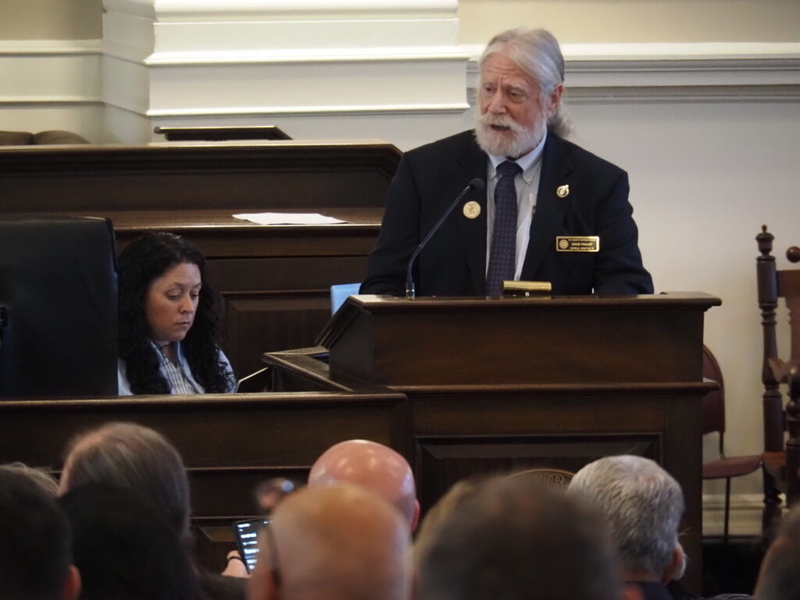
Rep. David Fracht, an Enfield Democrat, said SB 564 could lead to overdevelopment. (Photo by Ethan DeWitt/New Hampshire Bulletin)
The New Hampshire House and Senate sent three bills to Gov. Kelly Ayotte intended to enable more housing construction, overcoming opposition from the New Hampshire Municipal Association and others.
In a series of votes on the last standard session day of the year Thursday, the House and Senate approved final versions of House Bill 1010, House Bill 1588, and Senate Bill 564, which address housing developments in commercial zones, parking requirements, and development on dead-end roads.
The bills now head to Ayotte’s desk and face strong prospects: Ayotte signed and celebrated a slate of bills in 2025 meant to spur housing, in large part by overriding perceived restrictive municipal zoning.
But they also overcame opposition from some who said they eroded needed guardrails for cities and towns, and could lead to safety issues and overcrowding in commercial areas.
“New Hampshire needs more affordable housing, but we also need smart growth, responsible planning, and local decision-making,” said Rep. David Preece, a Manchester Democrat, speaking against the bills. “Housing and local control are not mutually exclusive.”
HB 1010 and HB 1588 are tandem bills meant to update last year’s transformational statute for housing in commercial zones.
That law, House Bill 631, is not set to take effect until July 1, about a year after it was signed. It requires municipalities to allow multi-family residential developments on commercially zoned land, as long as there are adequate roads, water, and sewage, and no issues with the site “incompatible with residential use,” such as air, noise, odor, or transportation impacts.
Both HB 1010 and HB 1588, if signed by Ayotte, would update HB 631 just one minute after it takes effect next month.
HB 1588 would tighten the law. It would clarify that the developers could build housing that passed the requirements “by right” in commercial zones — a stronger legal status. It would also limit the types of restrictions municipalities could place on that development to frontage, setbacks, and height requirements, excluding other factors such as density.
And if a developer sued after being improperly denied a permit by a municipality, the developer could seek attorneys fees from the city or town, the bill states.
“It addresses the ambiguity in the existing law that will result in taxpayer‑funded lawsuits, and also grants municipalities greater local control by clarifying that municipalities can do site review,” said Rep. Joe Alexander, a Goffstown Republican and the chairman of the House Housing Committee, in a speech on the House floor.
HB 1010, in contrast, would give municipalities tools to potentially limit certain developments. The bill would allow municipalities to carry out studies to determine whether the water, sewage, and traffic infrastructure was adequate before approving. If the road design did not support the volume of traffic expected, for instance, the proposal could be denied.
Traffic studies could include any increase in vehicles on the roads, the availability of sidewalks, and other pedestrian safety measures. The bill would allow cities and towns to require developers to obtain approvals from the owner of a public water system and the owner of a public sewer before proceeding.
Together, the two bills are meant to clarify the intent and scope of last year’s commercial zoning bill, Alexander said.
“The only thing that we’re going to run into is that municipalities may be open to more lawsuits if we fail to clarify what we mean by these laws,” he said.
HB 1588 also includes an unrelated provision that would allow cities and towns to create “special assessment districts,” where municipalities can take out bonds to pay for infrastructure upgrades and then levy fees on the developments that would benefit from the upgrades to pay off the bonds.
But opponents, such as the Municipal Association, warned HB 1588 would tie the hands of municipalities with reasonable concerns. In a handout given to lawmakers ahead of the vote, the association called the bill “one of the most anti-local control bills of the session.”
Preece agreed. “This bill goes further by overriding local zoning protections and by exposing municipalities to costly litigation, forcing taxpayers to pay attorneys when disputes arise,” he said. “This is not a housing policy, it is a mandate that shifts the risk and the cost onto local communities.”
SB 564 would address restrictions on dead-end roads. It would prevent cities and towns from imposing a maximum road length for new housing development, as long as that new development adheres with the state fire code.
It stops municipalities from capping the number of homes on a dead end road, unless the cap is necessary to comply with the fire code or guidelines from the National Fire Protection Association.
And it requires cities and towns to allow utilities such as septic systems and electric distribution infrastructure to be installed in buffer areas, open spaces, as long as they aren’t wetlands or protected shore lands.
Again, opponents cited concerns of overdevelopment if the bill becomes law.
“Let’s take a look at what could be built on 100 housing lots,” said Rep. David Fracht, an Enfield Democrat. “One hundred single-family homes? Certainly. One hundred duplexes or triplexes? Why not? How about 100 apartment buildings with an unlimited number of dwelling units? This bill places no cap on the number of dwelling units that can be built on these long dead-end roads.”
Alexander argued the bill would bring needed development while respecting safety concerns.
“This bill now clarifies and provides statutory requirements for local jurisdictions to follow relative to the state fire code,” he said.

Concord, NH