AFL-CIO president aims to unionize 2 million workers in 5 years
Jun 07, 2026 | 10:11 pm ET
Description
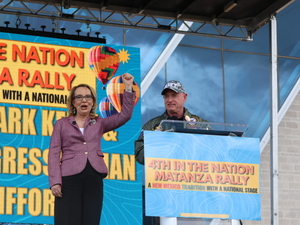
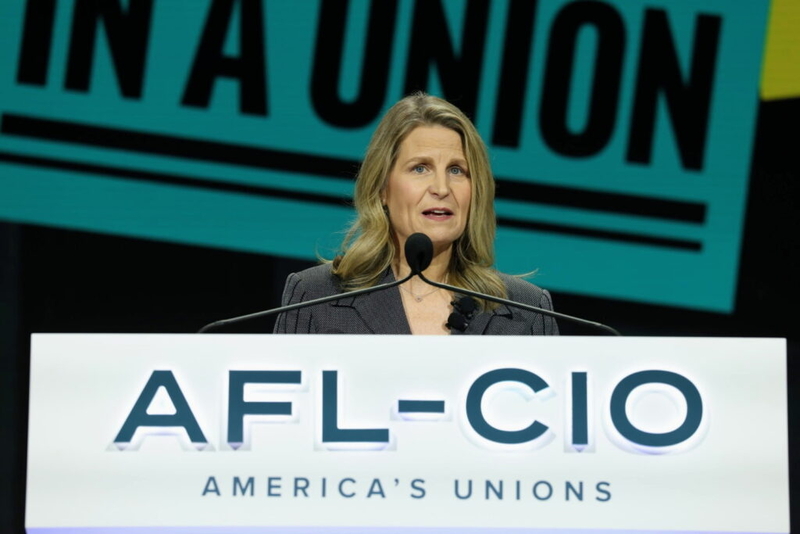
AFL-CIO President Liz Shuler addresses hundreds of union representatives at the labor federation's national convention in downtown Minneapolis on Jun. 7, 2026. (Photo courtesy AFL-CIO)
MINNEAPOLIS — Moments after being reelected by representatives for dozens of unions Sunday, AFL-CIO President Liz Shuler made an ambitious pledge to unionize at least 2 million workers over the next 5 years.
Meeting that target requires pushing through longstanding headwinds in federal labor law that make organizing a union an expensive and arduous slog, while also confronting new assaults from the Trump administration.
Shuler says union organizers have proved it’s possible. In 2022, she set a goal to organize 1 million workers in a decade, which unions did in just three years, adding bus factory workers in Alabama, doctors in Minnesota and 27,000 educators in Virginia.
“We have shown people all over this country there is a way to fight back, and it’s called the labor movement,” Shuler said. “And now it’s time to use that power to build an economy that actually works for working people.”
To get there, Shuler said the labor movement would turn out an additional 2 million voters to the polls this November along with 50,000 “trained election protectors.”
Shuler was addressing a crowd of hundreds of union members on the first day of the labor federation’s national convention in downtown Minneapolis. The convention, which happens every four years, brings together representatives from 65 unions covering all sectors of the American economy, from Hollywood actors to Pittsburgh steelworkers.
Minnesota’s status as the convention host took on new resonance following the incursion of some 3,000 federal immigration agents into the state for Operation Metro Surge earlier this year.
The immigration crackdown resulted in thousands of arrests, including of union workers, as well as the deaths of two American citizens, Renee Good and Alex Pretti. Pretti, who worked as a nurse at the Minneapolis VA, was a member of the American Federation of Government Employees Local 3669.
Unions played an important role in the resistance to ICE, including by organizing a general strike and protest in January that drew tens of thousands of people into the streets of Minneapolis in negative 30 degree windchill.
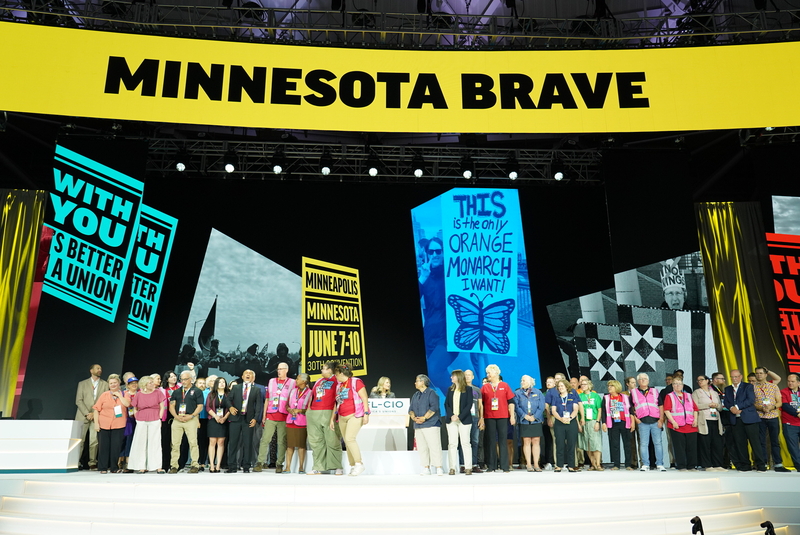
The AFL-CIO awarded the Minnesota labor movement with the George Meany-Lane Kirkland Human Rights Award. Union members from Minnesota marched onto the stage of the convention hall, and the crowd gave a standing ovation and recognized their efforts standing up to ICE.
“When Operation Metro surge descended on Minnesota, our labor movement stepped up like never before,” Minnesota AFL-CIO President Bernie Burnham said in a recorded video.
She said unions funded legal defense for unlawfully detained workers; rank-and-file members alerted support networks to ICE raids; and, union marshals helped keep the peace during tense demonstrations.
“(The Trump administration) thought that if they could get away with this terror in Minnesota, they could get away with it anywhere, but they mistook kindness for weakness. They invaded a winter people in winter, and our solidarity froze them in their tracks,” she said.
After electing a national president, secretary treasurer and 55 vice presidents, union representatives over the next three days will debate the labor movement’s political agenda, develop strategies to grow their ranks and discuss how to confront the threat of artificial intelligence to the labor market.
Shuler ran unopposed for a second full term. Shuler became the first woman president of the AFL-CIO in 2021 after serving as the secretary-treasurer. She began her career in Portland, Ore. as an organizer for the International Brotherhood of Electrical Workers Local 125, of which her father was a longtime member.
Secretary-Treasurer Fred Redmond was also unopposed in his reelection bid. Redmond became the highest-ranking Black officer in the labor federation’s history when he was elected secretary-treasurer in 2021. He rose through the ranks of the United Steelworkers after joining the union as a rank-and-file member in 1973 when he was hired at Reynolds Metals Co. in Chicago.
Their reelection comes at a difficult moment for the American labor movement.
Shuler boasted that union membership hit a 16-year high in 2025, but the percentage of American workers who are union members continues to hover around the lowest levels on record. Just 10% of American workers are members of unions today compared to 20% in 1983 — the first year comparable data is available — despite unions enjoying the highest public-approval ratings in decades.
The Trump administration launched an unprecedented attack on public sector unions through its so-called Department of Government Efficiency, firing workers en masse and shredding the collective bargaining rights of 1 million federal employees.
Trump also hobbled the National Labor Relations Board, which oversees private-sector labor disputes, by firing a board member for the first time in the board’s 90-year history. The firing of Gwynne Wilcox left the board without a quorum for months, leading to a pile-up of hundreds of cases, to the advantage of management over labor, which has little other recourse for redress.
The Republican-controlled Congress has put the labor movement back in a defensive position and again delayed highly sought-after legislation making it easier to form a union.
And yet, there is some glimmer of hope for unions. A small group of Republicans have joined Democrats to try to force a vote in the U.S. House on a policy long sought by unions, which would set a deadline for companies to agree to a first labor contract governing wages and working conditions after workers vote to unionize. Companies, who have far more resources than new unions, often seek to wear down the union with protracted delays.
Trump’s return to the White House has also healed labor divisions in the way only a common enemy can.
The Service Employees International Union, which represents 2 million workers, rejoined the AFL-CIO on the eve of Trump’s inauguration after breaking away in 2005 in an ugly divorce over competing visions for the labor movement.
SEIU President April Verrett seconded Shuler’s nomination for president, in an important symbol of the union’s homecoming to the convention for the first time in two decades.
“The question before labor is no longer how we protect the best version of the old world. The question is whether we are willing to build a new one,” Verrett said. “And when I think about the leader this moment requires, I think about my friend Liz Shuler.”

Saint Paul, MN