Game, Fish and Parks doesn’t disclose employee’s landowner status in lake refuge repeal
Jun 07, 2026 | 11:00 am ET
Description
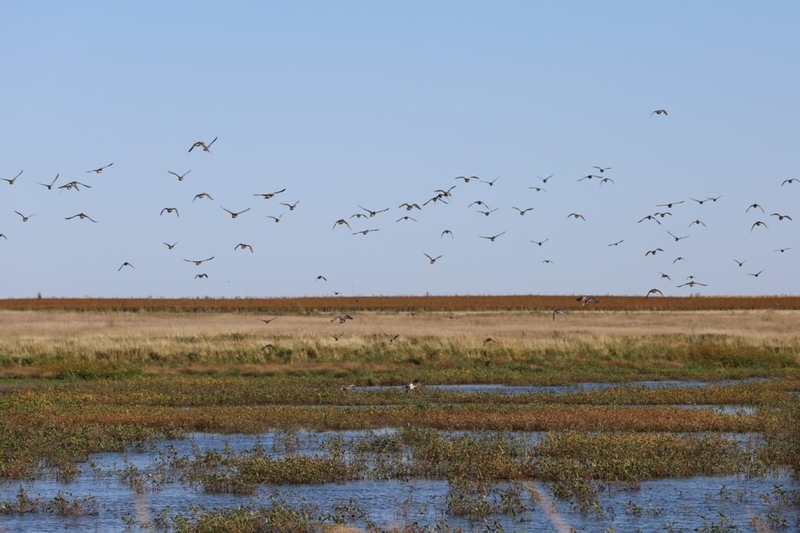
Ducks fly off of a northern South Dakota wetland on September 27, 2024. (Joshua Haiar/South Dakota Searchlight)
Listen to an audio version of this story by reporter Meghan O’Brien. For broadcasters: See below for a downloadable version with a script.
When officials with South Dakota’s Game, Fish and Parks Department sought to repeal a lake’s waterfowl refuge status, they said it was what the surrounding landowners wanted.
They didn’t say one of the landowners works for their agency.
Kraig Haase is a Watertown regional supervisor of conservation officers for Game, Fish and Parks. He co-owns 15 acres of land at the northwest end of Lake Albert, according to records maintained by the Grant County Equalization Office.
In April, a committee of state lawmakers finalized a decision to repeal the lake’s status as a waterfowl refuge. The decision will allow hunting of ducks, geese and other waterfowl at the lake just east of Milbank, which is one of multiple lakes with the same name in the state.
The location of Lake Albert in Grant County, South Dakota, which will no longer be designated as a state waterfowl refuge.
“Every single landowner around” Lake Albert wanted to remove the refuge status, Director of Wildlife Tom Kirschenmann, of Game, Fish and Parks, told the legislative committee. The department had previously brought the request on the landowners’ behalf to the Game, Fish and Parks Commission, a group of eight governor-appointed members.
The commission endorsed the request unanimously in March.
“In particular,” Kirschenmann told the legislative committee, “because it was the landowners themselves coming forward to bring that particular change.”
Searchlight later learned that Haase is one of the landowners. That was not disclosed to the commission, according to Chairwoman Stephanie Rissler.
“Should we have had any red flags brought to us by other landowners or other users, that would have been an opportunity for the commission to potentially take a deeper dive at the issue, but that didn’t happen,” she said in a Searchlight interview. “I don’t have any concerns with it at this time.”
Haase wasn’t the conservation officer who worked with the landowners through the process, according to Jacquie Ermer, a regional wildlife supervisor with Game, Fish and Parks.
“I guess we were looking at that he was a landowner like anybody else, and so he was part of the process with the landowners,” she told Searchlight. “I guess nobody asked us, to my knowledge, ‘Who are each of the landowners? What do they all do?’ Nobody asked that to my knowledge.”
Haase made similar comments to Searchlight.
“I’m just another landowner in the process,” Haase said. “It wasn’t significant who I worked for.”
He doesn’t remember anyone asking to come on his land to hunt geese or ducks, and doesn’t think neighboring landowners would monetize waterfowl hunting.
All of Haase’s land is enrolled in the state’s Controlled Hunting Access Program. That means Game, Fish and Parks leases the land and allows the public to hunt there. Landowners are paid based on the number of hunters that use the land. Haase’s land is only enrolled in the program for turkey hunting.
Refuge was 46 years old
The Lake Albert Waterfowl Refuge site is about 840 acres, including the lake itself and the land surrounding it.
In 1980, the property owners surrounding the lake agreed to have it designated as a waterfowl refuge, according to Ermer. That meant hunters could not shoot geese, ducks and other waterfowl on the lake or surrounding land, although they could still shoot deer, pheasants and other game.
“We were trying to establish Canada geese. It seems weird to even be thinking about that, with the goose population nowadays,” Ermer told commissioners. “This was started as a trial to see if we can get geese to use it to rest there, and then also to create a better hunting opportunity.”
Nick Harrington, the communications director for the Game, Fish and Parks agency, emailed a statement: “Kraig Haase received the same communication and discussion as all the surrounding landowners, which all of them were in favor of this change.”
State waterfowl refuge status removed from northeastern South Dakota lake
Haase was treated as a private citizen during the process, Harrington said, and the commission didn’t disclose any of the landowners’ names, nor did any landowner attend meetings to speak in favor of the change.
Haase’s status as a conservation officer for the department “was kind of a non-issue,” Harrington said.
After the commission endorsed the repeal of the refuge designation, the legislative Rules Review Committee voted 3-2 for a rules package that included the status change.
Sen. Jim Mehlhaff, R-Pierre, who voted in favor of the rules package, told Searchlight that he wasn’t aware of Haase’s land ownership.
“But that would not have had an impact on how I voted,” Mehlhaff said. “If you’re going to argue that removing it is a conflict, having it there in the first place could be viewed as a conflict as well, which I don’t view as a conflict at all. It’s a landowner who happens to be a state employee.”
Rep. Erik Muckey, D-Sioux Falls, voted no on the package. He told Searchlight that he voted no because “there are much bigger concerns here in terms of process as to how we balance property rights, as well as conservation efforts in the state, that is not an easy thing for us to make decisions on just on one singular rules package.”
He said the situation doesn’t constitute a conflict of interest.
“Whether or not that information was presented to me, I still have the same comments,” Muckey said. “I think that there’s broader conversation to be had about how this fits into a broader system of property ownership and conservation conversations that still need to happen.”
Landowner reflects on original purpose
Joyce Hartsoch has lived on the lake’s west shore for 50 years, and the land has been in the family for generations. Her great grandfather homesteaded there, she said.
One of her neighbors is Haase. He’s listed on a deed for 15 acres along with his brother, Kent Haase.
She said a desire to restrict hunting motivated landowners to seek the refuge status decades ago, because hunters were recklessly driving through her family’s 200-plus acres at the time.
“People just thought they could come up our driveway and go out along the lake and hunt,” Hartsoch said. “It was kind of risky to have people running through here all the time without even asking permission. So, when the opportunity came, we did enroll it.”
But over the years, the state’s Canada goose population began to rise, and Hartsoch noticed depredation from the birds that she didn’t in years past.
“They were getting to be kind of a problem sometimes,” she said, “so we had thought to open it up for hunting and reduce the population.”
Hartsoch called her local conservation officer, Jamie Pekelder in Milbank, to ask about removing the refuge status and once again allow geese to be hunted in the area.
“He kind of took the reins from there, and chatted with the other neighbors,” Hartsoch said. “Mostly, I was surprised to learn that the surrounding area was still in the waterfowl refuge.”
A map of the former Lake Albert Waterfowl Refuge. (Courtesy of Department of Game, Fish and Parks)
For broadcasters

Pierre, SD