Public Service Commission orders hearing on natural gas company’s rates
Jun 05, 2026 | 6:01 am ET
Description
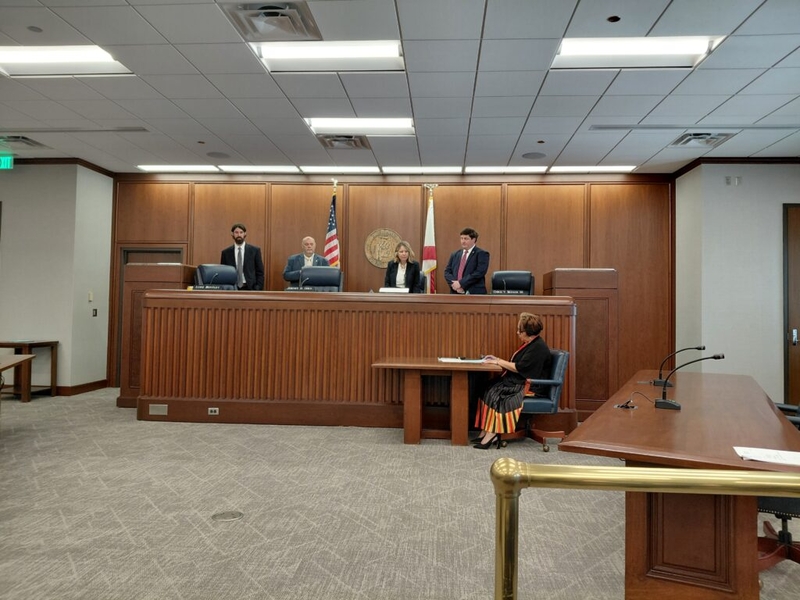
Members of the Alabama Public Service Commission prepare for the regular monthly meeting on Thursday, June 4, 2026. The PSC announces that it will convene a rate case for Spire Inc., a company based in St. Louis with subsidiaries in Alabama, to decide the rate of return it should receive. (Ralph Chapoco/Alabama Reflector)
The Alabama Public Service Commission will hold a rate case for a St. Louis-based natural gas company, the first time the PSC has held one for the company in more than four decades.
PSC Executive Director Luke Bentley IV said at a commission meeting on Thursday that representatives from Spire Alabama Inc., Spire Gulf Inc. and the Alabama Attorney General’s Office could not reach an agreement on customer rates after negotiations that began in January.
“I am excited, honestly, to go through that process for the first time since I have been here, which has been almost a year now,” said Cynthia Almond, president of the PSC, in an interview following the meeting. “I think it is good to do on a regular basis, not all the time, but on a regular basis. And it will be good to get all the information and put it out there for the public.”
Reynolds Anderson, vice president of external affairs of Spire Energy, a subsidiary of Spire Inc., the parent company, said in an interview on Thursday the rate case was “more of a procedural matter” to decide the appropriate rate that the company should charge customers.
“Every couple of years we go through a renewal process,” Anderson said in an interview on Thursday. “Most of the time, we can come to terms on that, but from time to time, that is not the case. You have to begin the process of setting up a procedural schedule and issuing orders. This was not really a surprise to us.”
Anderson declined to state a specific rate the company was seeking approval from the PSC.
“We are very much working through many variables,” he said. “Our ultimate intent is to maintain what we have had in the past and operate under the same umbrella.”
Rate Stabilization and Equalization
The PSC regulates investor-owned utilities and typically uses a process known as Rate Stabilization Equalization, which effectively guarantees utilities a certain rate of profit, affecting whether utilities can raise or lower prices. In a rate case hearing, a utility must justify proposed rate increases in public, citing evidence and using testimony.
“It is going to be like a little trial, with testimony,” Almond said.
She added that “there can be intervenors just like in regular, other formal hearings that we have here, but they have to be a party to the case. I don’t think it is just general submissions from the public. I don’t think that is part of the process.”
Bentley said Spire had been subject to RSE since 1983. It “has been renewed and extended by commission order on nine occasions, most recently in 2022.”
Spire Inc. is expected to receive a return of about 9.84% by September, the end of the fiscal year, according to the PSC, which authorized the company to earn a rate of return between 9.50% to 9.90%.
Spire Gulf Inc. expects to earn a rate of return of about 9.45% by the end of the fiscal year in September, less than the 9.70% to 10.30% return that the PSC allowed for the company.
The company has operated within RSE since 1983, according to Anderson. The PSC ordered Rate Stabilization Equalization for Spire Gulf, a subsidiary of Spire Inc., in 2002 and has been extended and renewed by the SPC three times, most recently in 2021.
New structures
Commissioners approved a rate case weeks after lawmakers passed a bill that dramatically altered the structure of the Public Service Commission.
Gov. Kay Ivey signs bill giving governor more control over PSC
HB 475, sponsored by Mack Butler, R-Rainbow City but heavily altered by legislators, initially required rate hearings every three years for investor-owned electricity companies like Alabama Power.
In the Senate, a committee altered the bill to include the provisions from SB 360, sponsored by Sen. Clyde Chambliss, R-Prattville, which extended a freeze on electricity rates that the PSC, in collaboration with Alabama Power, until 2029.
The bill also created a new secretary of energy, to be appointed by the next governor; expanded the PSC from three members to seven, with four appointed by Gov. Kay Ivey this summer and subject to subsequent elections; and banned rate case hearings on electricity providers like Alabama Power until 2029. The ban does not apply to natural gas companies like Spire.
Alabama has some of the highest residential power rates in the South. According to the U.S. Energy Information Agency, a federal agency, Alabama’s average residential electricity price in March was 17.15 cents per kilowatt hour, higher than Mississippi (16.30 cents), Tennessee (15.08), Georgia (15.01) and Florida (14.86).
In the Republican primaries last month, voters chose Cullman County Sheriff Matt Gentry over PSC Commissioner Jeremy Oden and sent PSC Commissioner Chip Beeker to a June 16 runoff with former Alabama State Auditor Jim Zeigler.
Montgomery