Poll: Concern about AI is growing among New Hampshire residents, but they’re using it more, too
Jun 05, 2026 | 4:50 am ET
Description
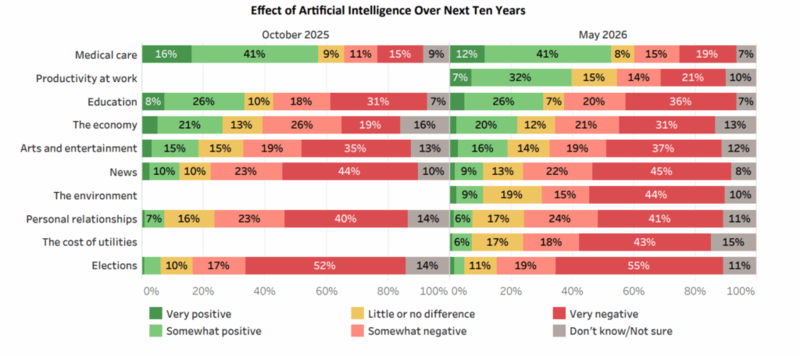
Granite State Poll respondents indicated that AI would have a more negative than positive influence on several areas of life in New Hampshire over the next 10 years. (Graphic courtesy Granite State Poll)
Granite Staters’ hopes are fading that artificial intelligence will have a positive impact on the economy, health care, politics, and more, according to the latest Granite State Poll from the University of New Hampshire Survey Center.
Nearly two-thirds of respondents said the technology would have a negative effect overall on the U.S. over the next decade, according to polling data from late May. That number is up three percentage points from October 2025, when 61% of respondents had a negative view of AI’s future.
At the same time, however, New Hampshire residents are using AI more and more in their work and day-to-day lives. According to the poll, 59% of workers use some form of AI at work. That’s up from 44% in October.
New Hampshire residents see AI as a threat in many spheres
Surveyors asked the 1,198 New Hampshire residents who participated in the poll whether AI would have a positive or negative effect on 10 categories of life in New Hampshire over the next 10 years.
A majority agreed that artificial intelligence would have a net positive effect on only one of those categories: medical care, for which 53% of respondents said AI would have a somewhat or very positive effect over the next decade.
That statistic is, however, down from October, when 57% of respondents answered optimistically.
The only other category in which AI optimism outweighs pessimism in the May survey is productivity at work. Thirty-nine percent of respondents said productivity would be affected positively over the next decade compared to 35% of respondents who said it would be negatively impacted.
For the eight other categories included in the survey, pessimism outweighs optimism. Those categories include education, the economy, arts and entertainment, news, the environment, personal relationships, the cost of utilities, and elections.
Granite Staters are most concerned about the effect of artificial intelligence on elections, according to the survey results. Fifty-five percent of respondents predict that the technology will have a “very negative” effect on elections over the next decade, while an additional 19% said it would have a “somewhat negative” effect.
Seventy-two percent of residents said they believed AI would lead to fewer jobs being available in the future, and about 1 in 5 felt it was likely they would lose their job to the technology in the next t10 years.

AI is a growing part of Granite Staters’ daily lives
Of the 59% of New Hampshire residents who reported using AI to some degree at work, most of those individuals use the technology somewhat sporadically. Only 1 in 4 respondents said they used AI professionally multiple times a week or more, a statistic that has climbed three percentage points from October of last year.
However, the proportion of respondents who work entirely AI-free jobs has fallen by 15 percentage points, from 56% in October to 41% in May.
Meanwhile, in New Hampshire residents’ personal lives, AI is slightly more prevalent.
Two-thirds of respondents said they use the technology in their personal lives. The proportion of respondents who report using AI multiple times a week or more is 28%.
Granite Staters report using AI for a range of purposes in their personal life. The most commonly reported uses were for general information, questions, and research, purposes for which about half of personal-time users reported using AI.
Twenty-seven percent of those who use the tech in their personal life use it to answer medical or health questions, according to the survey; 1 in 5 use it for writing or cooking. Other uses vary widely and include entertainment (16%), home or car repair (18%), organization (9%), financial or life advice (8% and 7%, respectively) and therapy or companionship (4%).
However, whether they use AI for work, school, or personal life, less than half of survey takers said they had a positive experience doing so. Granite Staters’ experience seems to have declined since October, when 55% of users said they had either a very or somewhat positive experience with AI. And more than half of respondents who use AI at work said the technology had made “little or no difference” to their productivity at work, according to the survey.
Data centers spurned
The results also highlight bipartisan opposition to the data centers that house AI-powering computers.
Two-thirds of respondents said they would oppose a data center in their own town. About 1 in 5 said they would support one.
The survey also asked respondents to consider a halt on data center development — a move which the New Hampshire Legislature considered this year, but could not reach consensus on.
Residents were more likely to support a halt than they were to oppose it: While 45% of residents said they would support a pause, 34% were against the idea.
The proportion of respondents who want to see a pause on data centers was similar on both sides of the aisle. About half of Democrats said they would support a pause, compared to 41% of Republicans.
The people most likely to oppose data centers, according to the poll, include those under the age of 50, women, those who self report as socialists, and residents of the North Country, Seacoast, and Connecticut Valley. Conservatives, and those 65 and older, are most likely to support data centers.

Concord, NH