My first Minnesota Republican Convention: Lots of spectacle, little substance
Jun 04, 2026 | 9:51 am ET
Description
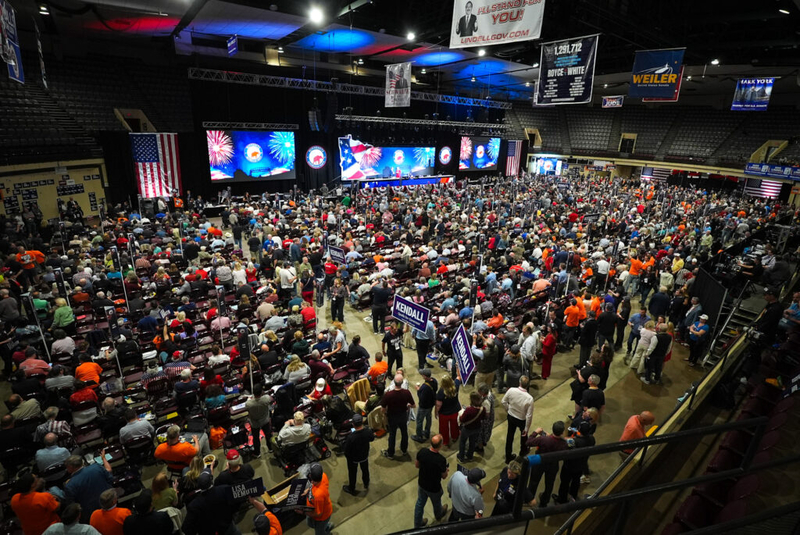
Delegates vote on the floor of the Minnesota Republican Convention in Duluth, Saturday May 30, 2026. (Photo by Glen Stubbe/Minnesota Reformer)
I attended the recent Minnesota Republican convention as a first-time delegate.
People have already asked me if I’ll do it again.
At this point, probably not — unless serious changes are made.
I don’t say that lightly.
Like hundreds of other first-time delegates, I came hopeful. I took time away from my family because I believed this mattered. Truthfully, I never planned on being involved in any of this.
But the past few years changed something. I lived through experiences that made me pay more attention and think differently about safety, community, culture and the future of the state where I am raising my son. I do not want to leave Minnesota. I care what happens here.
And eventually, caring led to participating.
I wanted to better understand the process, hear from candidates, and be part of something serious — people trying to figure out how to actually compete and govern in a state like Minnesota.
Before walking into the convention, protesters stood outside holding signs calling attendees fascists.
I clocked it, shook my head a little, and kept walking. By now, being misunderstood politically feels oddly familiar.
Inside, I walked through security and found myself instinctively scanning the space, quietly thinking through all the ways someone could get in and hurt people.
Political events carry a different feeling than they once did. Safety feels less abstract now.
My first impression of the convention was confusion.
There was no printed agenda. Instead, we were handed a glossy booklet full of candidate photos and campaign materials while the actual schedule lived online somewhere.
As a first-time delegate, it immediately felt oddly insidery — as though everyone else somehow knew the rules while newcomers were expected to figure it out as they went.
Candidate signs covered the walls. Literature piled onto chairs. Vendor booths lined the floor. Candidate lounges offered free drinks and snacks in hopes of winning over delegates. Buses, golf carts, and all manner of swag plastered with names and faces of political hopefuls.
At times, it felt like a county fair crossed with a campaign expo and an oddly tribal endurance contest.
But what discouraged me most was not the atmosphere.
It was the lack of seriousness.
The days stretched to 12 hours. Time disappeared into organizational delays, technology issues, avoidable confusion, and endless procedural motions. Problems with electronic voting left many delegates confused and frustrated, trying to understand what was happening and whether confidence in the process remained intact.

By the end, many delegates — including me — left frustrated, uncertain, and wondering whether the investment of time, energy and sacrifice had mattered at all.
Whether the outcomes were materially affected or not, confidence matters. Especially for a political party that in recent years has placed significant emphasis on confidence in electoral systems.
I was struck by how casually candidates were dismissed as “Republican in Name Only” — RINOs — for being insufficiently conservative. Ideological purity seemed to matter more than electability, even though we’re competing in a blue state, where coalition building and persuasion matter.
At times, delegates continued voting for candidates with little realistic path to endorsement, only later turning to “no endorsement” votes that prolonged already exhausting proceedings. As the hours stretched on, it started to feel like the process favors people whose entire lives revolve around politics, rather than ordinary people with jobs, children and responsibilities who still care deeply about the future of Minnesota.
And then came the fireworks.
Literally.
When endorsements were secured, loud music, lights and patriotically colored smoke filled the room. Speeches were given as though major victories had been won.
But standing there, exhausted, hungry, missing my family and starting to wonder what I was doing there, I remember thinking:
No one has actually won anything yet.
Are we serious or not?
To be fair, I know politics has always involved some degree of spectacle.
Truthfully, I was not expecting — or even wanting — a stuffy, sober, humorless weekend. By hour nine or 10, I was more than ready for a drink and some levity myself. Politics involves personality, community and a little theater. I understand that.
But somewhere between the procedural chaos, loyalty tests, candidate attacks, voting confusion and over-the-top celebrations of endorsements, I found myself wondering what exactly the point was.
As I understood it, the goal was to elect more right-leaning candidates and advance ideas many believed could improve Minnesota.
Too often, that did not feel like the point.

Minnesota is not a state where one faction gets everything it wants. Winning here requires persuading people, tolerating disagreement, and accepting that no candidate will perfectly reflect every preference or strategy.
But at times, it felt as though every disagreement became a morality play and every strategic difference was treated like betrayal.
Do we actually want to win?
Or are we more interested in proving who belongs?
Not every disagreement has to become a loyalty test.
Not every compromise is surrender.
Not every imperfect candidate is a fraud.
I walked into the convention hopeful, believing I was participating in something important. And I found myself wondering how many first-time delegates drove home thinking the same thing:
Nevermind.

Saint Paul, MN