Can we get a right to cool in West Virginia?
Jun 04, 2026 | 5:55 am ET
Description
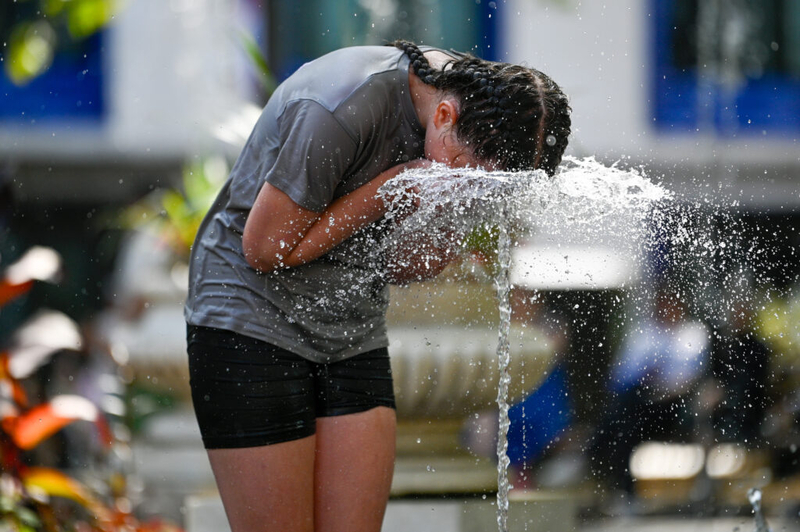
Children play with the water fountains located in Leicester Square during a heatwave on August 12, 2025 in London, England. (Photo by Ben Montgomery/Getty Images)
You may have seen in the news lately that climatologists expect the upcoming El Niño to be one of the strongest ever recorded. For much of the world, high temperatures and droughts are expected. In the United States we’re more likely to see more humidity, rain and storms.
Experts expect this year could still end up being in the top five hottest years ever recorded — 2025 was the third highest, just behind 2023 and 2024. That’s what I’m focusing on today. In West Virginia, we’re seeing higher temperatures and higher humidity, which makes it even harder for our bodies to stay cool.
Two years ago I wrote about heat and how West Virginia — and the United States as a whole — haven’t adjusted to the hotter reality we find ourselves in today. My uncle had just died from a heat stroke while working on a construction site, so my anger at a killer you can’t convict was top of mind. We had also just gotten out of nearly 3 months of 90 degree weather.
I’ll repeat a few things I mentioned in that piece. As temperatures rise, older people, homeless, and people with health conditions are at a high risk of heat illness, even if they’re inside. A heat wave in the Pacific Northwest in 2021 killed hundreds of people. I first learned about the threat heat waves pose to even wealthy nations in graduate school, when a professor discussed the 2003 European heat wave that killed tens of thousands of people.
In West Virginia, many people live in older housing that isn’t adequately insulated, so even if they have air conditioning, it might seep right out of the walls and windows. We lack buildings and outside spaces designed to keep us shady and cool. As much as I love attending events at Slack Plaza and on the riverfront in Charleston, it’s obvious that we need more shade. There are plenty of blocks on my walk from home to downtown that are oppressively hot, devoid of tree cover.
So what can we do about it?
I recently learned of a new-ish name for a movement interested in addressing the perils of heat in our communities: the right to cool.
A recent Heatmap story documents the advocacy movement to protect people from extreme heat. Cities and states around the United States are exploring laws that would set a maximum indoor temperature for rentals or require landlords to provide air conditioning, just like they are required to provide adequate heating in the winter.
The Trump administration has rolled back worker protections, including the outdoor worker heat rule that the Biden administration proposed in 2024. That means that the responsibility to keep workers safe is increasingly falling on cities and states.
Obviously these ideas would impose costs. Landlords would hate extra costs imposed on them. And legislation covering landlords would leave homeowners out of the equation; those families need protection too. Members of our Legislature and state government already think workers have too many rights.
But the conversation has to start somewhere. We can have forward-looking building codes that will ensure future homes are prepared for hotter weather. We can create grant programs and other incentives to help landlords and homeowners upgrade their heating and cooling systems and make their home less leaky. What we can’t do is nothing. Extreme heat is coming, and for some it’s already brought pain.
Charleston, WV