Gov. Kim Reynolds signs final bills from 2026 legislative session
Jun 03, 2026 | 3:27 pm ET
Description
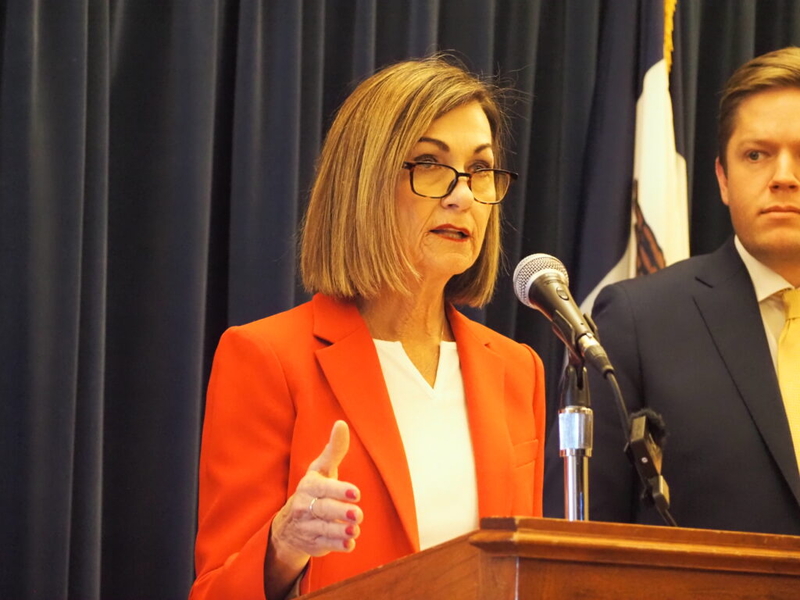
Gov. Kim Reynolds, shown here in a photo from April 16, 2026, signed the final bills of the 2026 legislative session and her final bills as Iowa governor, on June 2, 2026. Photo by Robin Opsahl/Iowa Capital Dispatch)
Republicans were able to enact many of their top goals this year as Gov. Kim Reynolds signed the final bills from the 2026 legislative session into law.
The slate of bills signed into law Tuesday were the final measures to be enacted from the 2026 legislative session — as well as being the final measures Reynolds will sign as Iowa governor, as she is not seeking another term in the 2026 election.
Speaking with reporters Tuesday, Reynolds was emotional as she reflected on what was accomplished in her final year leading the state. She said it was a “bittersweet” period as she prepares to leave the governorship. During her final session, she said she and her team often went from “ecstatic” to “tears.”
“I’m really proud of the last session,” Reynolds said. “Sometimes that is not the way it goes, when it’s your final year and you’re a lame duck. Sometimes it’s kind of irrelevant what the governor wants. And what I experienced for my last legislative session was legislators and leaders in both the House and Senate remained committed to putting Iowans first and getting things done and completed that we promised Iowans we would.”
Reynolds highlighted her work with leaders in both chambers to move forward a law aimed at addressing high property tax costs in Iowa, which she signed into law in May, as well as measures related to charter schools and the state’s Education Savings Account program, and funding for pediatric cancer research through a tax on vapes and alternative nicotine products as among the most important measures that came out of the session.
Alongside these measures, the governor has been working for the past several weeks to sign numerous bills into law sent to her by the Legislature this session. Tuesday was the deadline for signing into law the remaining bills from the year — in the morning, Reynolds held a news conference where she signed three criminal justice measures into law, and went on to sign 46 more measures into law that day, according to a news release.
A majority of those bills were policy proposals, but also included the five remaining appropriations measures that make up the state’s annual budget. In the news release, the governor also shared that she vetoed five policy proposals, alongside issuing line-item vetoes in four budget bills.
Two of the measures Reynolds vetoed, Senate File 2299 and Senate File 2320, were proposals related to concurrent enrollment and sharing programs for public school students participating in classes at community colleges.
She also vetoed Senate File 2453, a proposal that would have required public universities to invest at least 1% of their endowment fund assets in one or more innovation funds established by the state with certain exceptions. Reynolds said she was concerned the measure would create “a statewide investment mandate on university foundation assets without adequately recognizing the independent fiduciary responsibilities of foundation boards and investment professionals based on donor intent, institutional priorities, market conditions, and long-term financial performance,” according to her veto message.
Though there were some bills Reynolds did not accept, many of Republicans leaders’ priorities were signed into law by the June 2 deadline. Here’s a few of the final bills the governor signed Tuesday:
Citizenship checks: Senate File 2218, signed by Reynolds Tuesday, directs the Iowa Board of Educational Examiners to have applicants seeking new and renewing educator licenses to provide the BOEE information about their legal U.S. work authorization. Proof on continued legal work eligibility must be submitted every five years for an educator to remain licensed.
The measure also includes language from an executive order issued by Reynolds in 2025 in response to the immigration arrest of former Des Moines Public Schools superintendent Ian Roberts. This includes several citizenship verification steps for state government jobs and state occupational licenses. When a person is applying for a state government job or a professional and occupational licenses granted by the state, the Iowa government entity must use the federal Systematic Alien Verification for Entitlements (SAVE) database and E-Verify system to verify the individual’s citizenship and legal work status.
The law also makes several other changes to state code related to citizenship checks and immigration law enforcement. It makes the act of providing a false Social Security number to an employer to obtain a job a crime under state law, as well as requires Iowans registering to vote to swear they are a U.S. citizen under penalty of perjury. Additionally, the law will restrict undocumented immigrants from being granted pretrial release — though this provision can be rebutted.
Early Childhood Iowa: Senate File 2488 creates an opt-in, voluntary system for Early Childhood Iowa area boards to choose to move certain funding oversight over to state oversight through the Department of Health and Human Services. ECI boards, which oversee funding for local initiatives and services for pre-kindergarten children, would have the option to move over home visiting contracts through the current “School Ready Fund” in the ECI system to HHS control in order to allow the state to become eligible for more federal funds through the Family First Act. Local boards that choose to make this move would have a portion of the federal matching funds returned to their area, beginning with 25% of funds in FY 2028 and lowering by 10% each subsequent year.
The law signed by Reynolds is significantly different from earlier proposals introduced by HHS officials, which would have repealed the existing ECI program and transfer funding and oversight to a statewide Early Childhood and Family Services (ECFS) system based of the seven “health and human services districts” that currently serve the state’s behavioral health system. The proposal still creates the ECFS system, but does not transfer funding or power from ECI boards outside of the optional change to home visiting contracts. However, it does move some powers and funding oversight for other systems, like that for Decategorization Projects, or Decat, boards to the new ECFS system and gives HHS authority to contract for child abuse preventative services.
Governor’s powers: One of the bills Reynolds signed Tuesday limits her own powers — though the measure is most likely have to have a greater impact on future governors as Reynolds is not seeking reelection.
House File 2694 would bar governor from restricting private businesses’ operations or ordering places of worship to close during disasters and public health emergencies. These were actions taken by Reynolds, alongside governors in many other states, during the COVID-19 pandemic. The law will also state a governor must get legislative approval to make any changes to election laws and regulations.
Though Republican lawmakers said the measure was not related to concerns about a potential future Democratic governor, the law was moved forward in Reynolds’ last year in office and as political forecasters predict Democratic Auditor Rob Sand has a chance of winning the gubernatorial election in 2026, ending more than a decade of GOP control. An attempt by Senate Republicans to add language from Senate File 2388 to the law — which would have prevented state government shutdowns if a governor does not approve a budget before the beginning of the next fiscal year, July 1, through a “continuing appropriations” — was shot down in the House. Democratic lawmakers said this proposal from Senate Republicans was a “power grab” to allow a Republican-controlled Legislature to refuse to negotiate with a Democratic governor.
Affirmative action: State and local entities including the Iowa Departments of Education and Administration, Board of Regents, school districts and area education agencies will no longer have to submit affirmative action plans and reports as Reynolds signed House File 2711 into law. In addition to making changes to affirmative action policies, the bill removes some police training requirements that were enacted in a 2020 law on law enforcement conduct, removing a requirement for law enforcement agencies to conduct annual bias prevention training, as well as removing racial and cultural awareness training requirements at the Iowa Law Enforcement Academy. The measure keeps in place requirements for police to be trained on deescalation techniques.
Des Moines, IA