Advocates challenge the rejection of Oklahoma open primaries initiative petition
Jun 03, 2026 | 3:09 pm ET
Description
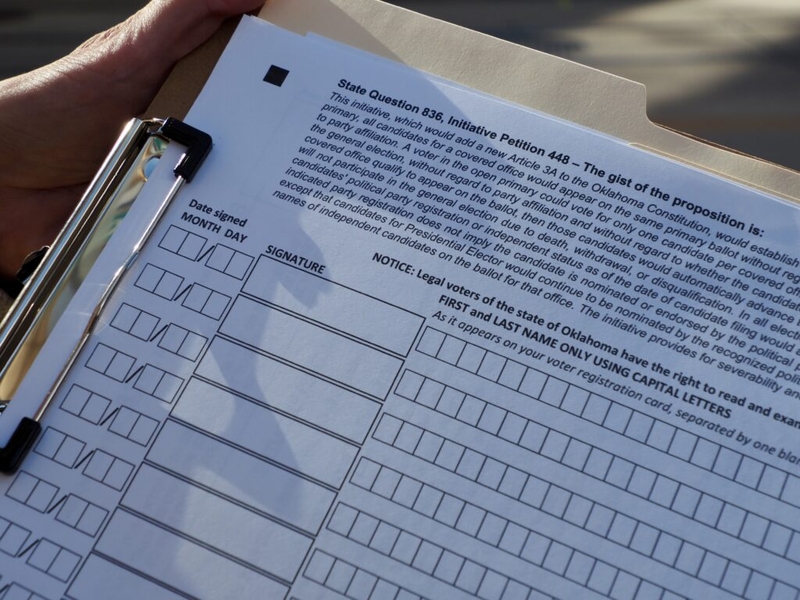
A supporter of State Question 836 to open Oklahoma's primary elections holds a clipboard in downtown Oklahoma City on Oct. 29, 2025, to gather signatures to put the initiative on the ballot. (Photo by Emma Murphy/Oklahoma Voice)
OKLAHOMA CITY — Oklahomans in support of opening the state’s primaries are challenging the state’s rejection of their initiative petition.
Oklahoma Secretary of State Benjamin Lepak rejected the open primaries initiative petition in March and said it fell short of the required number of valid signatures. While supporters submitted over 209,000 signatures, well over the required 172,993, Lepak reported that only 142,567 were valid.
The challenge was filed Monday in the Oklahoma Supreme Court.
It’s “not plausible” that a quarter of those who signed the petition are not legal voters, the challenge reads.
The state has failed to provide transparency and details about why the state believes the signatures are insufficient, according to the objection, filed on behalf of four Oklahomans. The state has provided only the number of signatures that were rejected, according to the challenge.
Lepak said in a statement Wednesday that he commends the employees of his office for their “diligent and thorough work” verifying the signatures.
“Those employees conducted their review in accordance with applicable law, following the same standard protocols and procedures they always do for initiative petitions,” he said. “I stand by the verification we filed with the Oklahoma Supreme Court.”
State Question 836, if approved by voters, would place all candidates in a race on a single primary ballot with their party affiliation listed and voters would be able to select any one candidate. The two top vote getters would advance to the general election.
Oklahoma law currently bars independent voters from voting in partisan primaries unless the party files paperwork to allow it. No party filed the proper paperwork this year, meaning nearly half a million registered Oklahoma voters cannot vote for candidates in the June 16 primary election.
“We all want more faith in our government, but trust is not built by summarily rejecting more than 57,000 signatures without providing a sufficient explanation as to their exclusion,” said Ken Setter, an SQ836 volunteer, in a statement. “We simply want the ability to identify which signatures were excluded so we can evaluate if they should have been counted.”
The advocates’ filing asks the state high court to either rule that the over 200,000 submitted signatures are valid, or to order the secretary of state to provide individual data for rejected signatures and if it’s not provided, that those signatures be considered sufficient.
Advocates argue that the secretary of state’s machine processing of signatures is an “unconstitutional burden” because it could rule out signatures based on things like poor handwriting, misspellings or writing outside of the provided boxes.
“There exists an unlimited myriad of ways a signatory could easily and foreseeably fail to match the many known and unknown requirements of the Secretary’s machine processing,” the filing reads.
Each signature packet voters signed for SQ836 included a disclaimer that it’s a felony to sign with another person’s name, more than once or if they’re not a legal voter, according to the filing.
Oral arguments are set for 10:30 a.m. July 7 at the Oklahoma Judicial Center in front of an Oklahoma Supreme Court referee.
In recent years, lawmakers have put more and more restrictions on the initiative petition process, making it more difficult for people to get issues on the ballot.
A law passed in 2024 requires that at least four of five voter data points be verified for a signature on an initiative petition to be considered valid. Those include legal first name, legal last name, zip code, house number, numerical month and date of birth. Previously, the law had required three of the five data points be present.
Lawmakers passed another measure limiting the initiative petition process which created additional barriers to becoming a petition circulator and forces signature collection in more rural areas in the state rather than focusing on high-population areas like the Oklahoma City and Tulsa metros.
Oklahoma City, OK