Fate of wild horses far from certain
May 14, 2026 | 6:00 am ET
Description
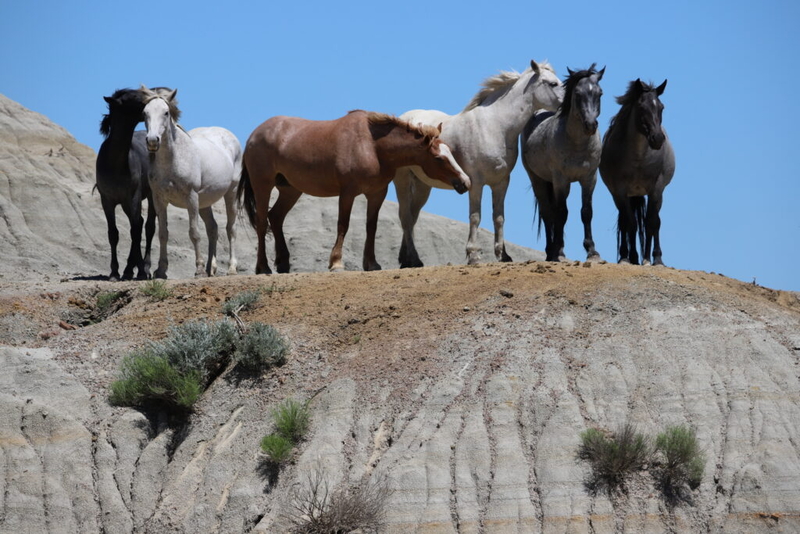
Wild horses gather at Lindbo Flats in the South Unit of Theodore Roosevelt National Park. (Photo courtesy of Patrick Springer)
The saga of the wild horses in North Dakota’s Theodore Roosevelt National Park has been as wild as the horses themselves. Sometimes uplifting, sometimes depressing, the fate of the herd has been uncertain for a long time.
Today, the official story from the National Park Service is that the horses will not be removed from the park, but will be reduced in number over time by administering birth control drugs. It sounds like a reasonable management strategy, but it is not what it appears to be.
The park service has a decades-long record of attempting to remove the horses from the park, where they have thrived since 1947. The horses ranged freely many years before the park was established and fenced. The park service had resisted calls to reverse its policy to eliminate the herd, even after a public outcry, not only from North Dakotans, but also from national advocacy organizations, Native American tribes, historians and wild horse management experts.
That widespread upset translated into political clout when elected officials – Sen. John Hoeven (R-N.D.) and former Gov. Doug Burgum in particular – took up the horses’ cause. Hoeven’s support for preserving and enhancing the herd got the attention of park service managers when he reminded them that he sits on Senate committees that fund the Department of the Interior and the National Park Service. And park service leaders certainly are aware that Burgum is now U.S. secretary of Interior.
Nevertheless, the threat to the future well-being of the horses has taken a sinister turn, which, if not exposed and modified, will mean the slow but certain demise of the beloved herd. Here’s why. In order to meet the public’s demand to keep the horses in the park and maintain a right-sized herd, the park service has been inoculating mares with a birth control drug which will over time reduce fertility and could cause complete sterilization. Already, the reported damage has included fewer foals and more foal mortality. If this intensive regimen (which reportedly includes double dosing) continues, horse advocates believe the herd’s health will be compromised, in part by the loss of the very characteristics that have made the horses uniquely suited to the challenging environment of the Badlands – toughness, intelligence and a robust genetic pool.
The park service’s approach has the feel of perverse natural selection of the weakest. An intended sharp decline in the birth rate will mean the inevitable ruination of the herd. The scheme suggests park managers have not altered their mulish resolve to remove or destroy the horses, and are attempting an end run around a preservation ethic that has nearly unanimous public and official support.
‘Untamed’
Details of the park service’s stealth elimination maneuver, proven preservation alternatives, and the herd’s possible fate are reported in a brilliant new book about the horses. “Untamed: The Story of the Wild Horses in Theodore Roosevelt National Park” by former Fargo Forum newspaper reporter Patrick Springer provides the most detailed and complete story of the horses.
Rolled out recently at a book-signing at the Fargo Public Library, the work is meticulously researched, sourced and endnoted. The accessible writing is clear and concise, as only years of the author having wielded a journalist’s pen could achieve.
But most evident in the text are Springer’s love and respect for his subject, and his deep understanding of the history, heritage, and science of the herd. A compelling theme within the broader narrative is how several genetic lines eventually melded into a Dakota Badlands melting pot that produced the unique horses of the park.
There is no better examination of all aspects of the TR wild horses than Springer’s book. It is available at many North Dakota bookstores and from the publisher, Forum Communications Co.
Bismarck, ND