Rhode Island ramps up homebuilding as affordability crisis lingers, latest state snapshot says
Apr 22, 2026 | 5:03 pm ET
Description
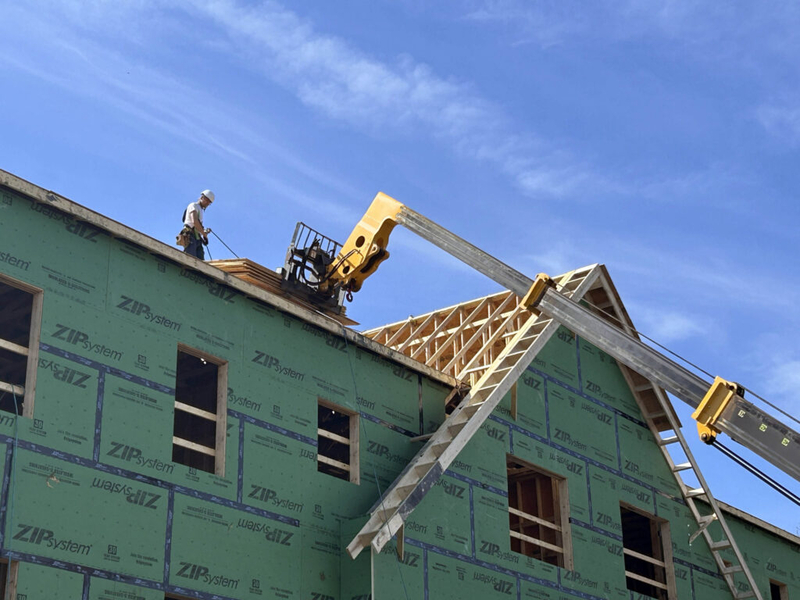
A construction worker retrieves plywood sheets lifted to the roof of the Ade Bethune House, a 54-unit affordable housing complex for seniors under construction on Bristol Ferry Road in Portsmouth on Wednesday, April 23, 2025. (Photo by Janine L. Weisman/Rhode Island Current)
Rhode Island’s push to build new homes has gained traction over the last year, but the affordability of existing housing stock still remains a critical concern for the state.
That’s according to the latest integrated housing report released April 15 by the state’s Executive Office of Housing, which noted 3,778 building permits issued across each of Rhode Island’s municipalities in the last year — the highest level since the 1980s.
“These numbers show consistent, meaningful progress year after year,” Gov. Dan McKee said in a statement accompanying the report’s release. “We’re seeing the results of our efforts with the General Assembly to work with cities and towns, remove barriers to development, and make historic investments in housing.”
But at the same time, the report found nearly 50% of renters and over 20% of homeowners are cost-burdened, meaning that they spend nearly a third of their income on housing costs
“Cost-burdened Rhode Islanders must make difficult decisions on whether to pay for housing, put food on the table, manage their health, or take care of their children and families,” the report notes. “These rates of cost burden are driven by sizable increases in both median gross rents and median home values over the past several years, making housing much less affordable across the income spectrum.”
The cabinet-level department is required to produce the annual snapshot of new homes under the 2022 law that created the cabinet-level housing secretary position.
Rhode Island’s first housing secretary, Joshua Saal, came under scrutiny in his final month on the job after he missed a deadline to submit a required report meant to provide comprehensive data on the state’s housing situation. When it did arrive in early 2023, Rep. June Speakman said it was a snapshot that was “sort of stapled together,” with only census data included.
“That was one of the disappointments about his first year,” Speakman, a Warren Democrat and chair of a legislative panel studying affordable housing, said in an interview with Rhode Island Current. “This report’s much more professional.”
Her only critique is that the report did not make connections between data and concrete policy recommendations.
“But that’s not what the legislation asked them to do,” Speakman said. “It does certainly provide food for thought.”
Along with the total number of building permits issued, the report details the number of vacant properties, units by building type, and what year the average home in any municipality was built.
The report puts the median age of Rhode Island’s housing stock at 1964, making it the third-oldest in the country behind only New York and Washington, D.C.
Only five municipalities — Charlestown, Exeter, Richmond, South Kingstown, and West Greenwich — had homes built, on average, in 1978 or later. Providence had the oldest housing stock in the state, with a median construction year of 1939.
Beyond the permits
House Speaker K. Joseph Shekarchi, a Warwick Democrat who sponsored the legislation mandating the annual snapshot, called the permit data “another validation that the more than 60 housing laws we have passed in recent years have had a significantly positive impact.”
“The overwhelming majority of the growth is private sector housing, not subsidized housing,” he said in a statement to Rhode Island Current. “This major surge in housing production is even more impressive coming at a time when interest rates are historically high.”
Brenda Clement, director of housing policy research group HousingWorks RI, similarly said she was pleased to see the increase in building permits. But the metric that stood out to her was the 2,162 certificates of occupancy issued across Rhode Island’s 39 municipalities last year.
Providence led the way with 727 new units opened for occupancy in 2025. West Warwick came in second with 183 units completed.
“To me that’s the better, truer measure of our progress,” she said in an interview. “Those are actual completed units.”
Clement said there is still room for improvement, particularly in bringing Rhode Island municipalities into compliance with the state’s 10% affordable housing target under set in the 1991 the Low and Moderate Income Housing Act.
Eight of Rhode Island’s 39 municipalities — Burrillville, Central Falls, East Providence, Newport, Pawtucket, Providence, West Warwick, and Woonsocket — met the goal for 2025, according to the state’s report.
That is double what was recorded in the 2024 report, but the increase only came after state lawmakers updated the definition of what constitutes an affordable home. The law added any rental homes where Section 8 federal housing vouchers were accepted, as well as mobile homes, to the group of properties that qualify as legally “affordable.”
State officials have worked to encourage new home construction over the past couple of years by adopting new laws that have eased zoning restrictions, streamlined permitting, and allowed accessory dwelling units.
But not every town wants large-scale developments.
The town of Johnston is battling in court to stop a proposed 252-unit apartment complex after Mayor Joseph Polisena Jr., a Democrat, tried to use eminent domain to seize the site for a public safety complex. The Westerly Planning Board nixed a plan to construct 2,300 homes at Winnapaug Country Club — a decision upheld by a Superior Court judge last September.
A common concern raised by municipalities is that larger developments will bring an influx of students, putting added pressure on local school systems and budgets.
The state allows communities to apply for funds to offset increased municipal costs of educating students who live in a new dwelling unit through its Housing Incentives for Municipalities Program, but the report notes “no school impact offset payments were issued” in 2025.
Housing officials plan to publish a separate report that generally evaluates the impact of new housing construction on municipal finances, including school costs. The Executive Office of Housing has contracted Providence-based engineering consultant AECOM $125,011 to assist with the project, office spokesperson Emily Marshall said in an email to Rhode Island Current.
That contract is valid through May 1, 2026.
For even more homes to be built in the coming years, the report points to the Executive Office of Housing’s 2030 plan as a blueprint lawmakers can follow. Recommendations include establishing production goals for each municipality and strengthening incentives, addressing zoning and regulatory barriers.
Another suggestion is further investment in infrastructure — another common complaint local leaders have when large-scale projects have been proposed in their towns. The state in October opened a new program that provides up to $8 million for municipalities and developers to offset the cost of essential infrastructure such as water and sewer connections.
Projects in seven municipalities won the first set of funds on April 7: Cumberland, Lincoln, North Smithfield, Portsmouth, Providence, South Kingstown, and Westerly.
The State House this year is considering nine new proposals in a package of bills that aim to encourage new home construction including legislation to further cut red tape, redevelop vacant properties, and cap tax rates on newly constructed residential rental units that include set percentages of affordable housing.
Providence, RI