University of Michigan researcher’s death draws scrutiny, diplomatic tension with China
Apr 06, 2026 | 2:25 pm ET
Description
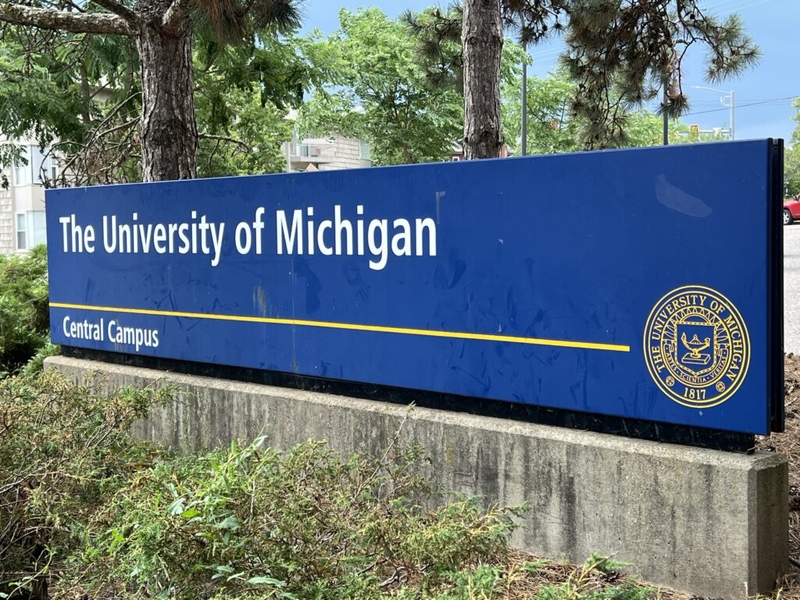
University of Michigan Central Campus sign | Photo by Jon King/Michigan Advance
Chinese officials allege that “hostile questioning” by U.S. federal law enforcement preceded the death of a University of Michigan Electrical and Computer Engineering research assistant on campus last month.
The researcher, Danhao Wang, died March 20 on campus — which Chinese state media has alleged was one day after he was investigated and questioned by law enforcement.
While the U.S. Department of Justice and Department of Education did not respond to requests from Michigan Advance for comment or to confirm if and when Wang had been investigated, the FBI sent a statement that noted its longstanding policy of neither confirming nor denying the “existence of any investigation or investigative activity involving specific individuals.”
In a press conference on March 27, Chinese Foreign Ministry Spokesperson Lin Jian said that the United States has “groundlessly interrogated and harassed Chinese scholars and students.”
“These moves infringe on Chinese citizens’ legitimate and lawful rights and interests, poison the atmosphere of people-to-people and cultural exchanges between China and the U.S., and create a serious chilling effect,” he continued. “China calls on the U.S. to carry out a full investigation, give the family of the victim and the Chinese side a responsible explanation, stop any discriminatory law enforcement targeting Chinese scholars and students in the U.S., and stop imposing wrongful convictions.”

The Chinese Consulate in Chicago similarly stated on X that they have contacted relevant departments of the U.S. government and the university to investigate the incident.
Chinese officials did not name the researcher in their statements.
In a statement from the university, Melissa Overton, the deputy chief of police at the university’s Division of Public Safety & Security, said that university police responded on the evening of March 19 to a report of an individual falling inside the George G. Brown Building, which houses the school’s Department of Mechanical Engineering, who was later pronounced deceased.
Overton noted that the “incident is being investigated as a possible act of self-harm” and is actively being investigated, but that there is no ongoing threat on campus.
Engineering Dean Karen Thole called Wang a “promising and brilliant young mind” in an email to some members of the school’s engineering community on Friday.
“His loss is felt deeply not only by those who knew him here at the University, but also everyone who understands his potential to have contributed to breakthroughs in science that would have positively impacted people around the world,” Thole wrote.
She emphasized his research into wide bandgap III-nitride semiconductor materials and devices, which was published in Nature, uncovering for the first time the switching and charge compensation mechanisms of emerging ferroelectric nitrides.
Wang’s death comes as the Trump administration has repeatedly targeted alleged Chinese influence at higher education institutions. The University of Michigan has come under fire from the administration numerous times — including at least three Chinese nationals with ties to the university who were charged by the FBI with attempting to smuggle biological material into the U.S. last year.
- 5:54 pmThis story has been updated with a statement from the FBI.
Lansing, MI