Habitat protections for Alaska ringed and bearded seals reinstated by appeals court
Mar 25, 2026 | 10:15 pm ET
Description
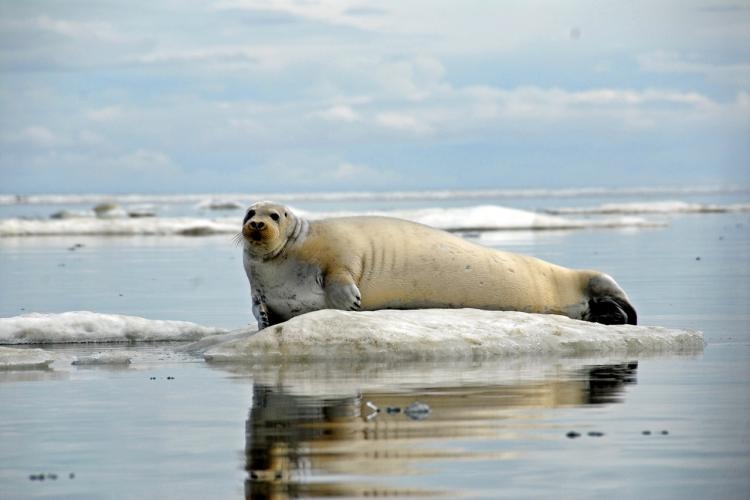
A bearded seal rests on ice in Kotzebue Sound in 2011. Bearded seals were listed in 2012 as threatened under the Endangered Species Act. A federal appeals court on Wednesday reinstated designation of critical habitat for bearded seals and ringed seals, also listed as threatened. (Photo by John Jansen/National Oceanic and Atmospheric Administration)
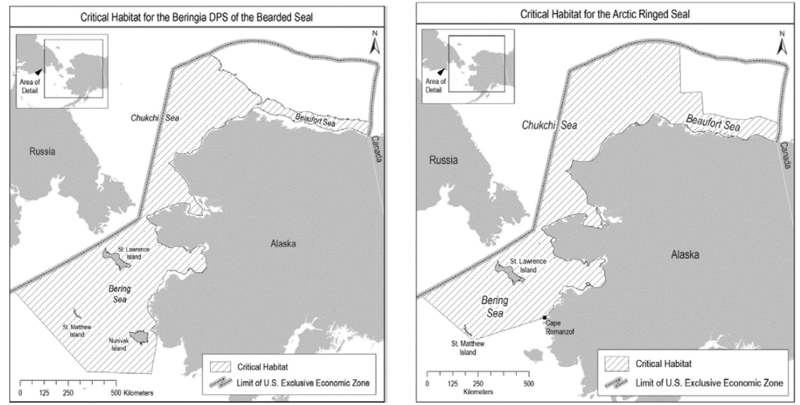
A federal appeals court on Wednesday reinstated protections for Arctic Alaska seals across a coastal and marine region stretching from the Central Bering Sea to the Beaufort Sea off the state’s northern coast.
The 9th Circuit Court of Appeals ruled that federal regulators acted properly in 2022 when they designated nearly 160 million acres as critical habitat for ringed seals and bearded seals. Both species are listed as threatened because of their dependence on Arctic sea ice. Designated critical habitat is required under the Endangered Species Act. It protects listed populations in the places they are most concentrated.
The appeals court ruling reverses a 2024 decision by U.S. District Court Judge Sharon Gleason that struck down the National Oceanic and Atmospheric Administration’s critical habitat designation as overly broad. And Wednesday’s ruling rejects arguments made by the state of Alaska that the critical habitat designated by NOAA’s National Marine Fisheries Service was too vast to justify the negative impacts to oil development and other activities.
NMFS acted properly and in accordance with the law when it designated critical habitat for the seals, making the decisions after weighing impacts to activities like oil development, the ruling said.
The appeals court ruling said that the nearly 160 million acres of designated critical habitat area is large, but size is relative.
“To put that number into perspective, Alaska and its surrounding waters cover nearly half a billion acres—so even a small subset of the state may seem large in the abstract,” it said.
The seal ruling cited one of its earlier decisions, made in 2016, that upheld the designation of 120 million acres of Arctic territory as critical habitat for polar bears, a species listed as threatened in 2008.
“Like the polar bears, the seal species ‘need room to roam,’” Wednesday’s ruling said. “NMFS explained in detail that the seal species rely on resources spread out over a wide area, including sea ice that is ‘dynamic’ by nature. . . . The text of the ESA plainly permits NMFS to designate habitat on that basis.”
Critical habitat designations add a layer of review for any federally permitted activities. Under the Endangered Species Act, permits for activities in critical habitat must undergo an analysis to determine whether listed populations would be harmed.
The Center for Biological Diversity, which filed the lawsuit that prompted the 2022 critical habitat designation and later appealed Gleason’s 2024 ruling, celebrated the ruling.
“This is a great victory for these ice-dependent seals,” Marlee Goska, an Alaska staff attorney for the center, said in a statement. “It’s just common sense that you can’t protect imperiled animals without protecting the places they live, and I’m glad the court agreed. This decision gives these Arctic seals some breathing room, but we still need to stop expanding oil and gas drilling in their habitat to provide these species and so many others a true shot at survival.”
A statement from the Alaska Department of Law said the state continues to object to the designation and “will continue to fight for a commonsense, plain-text reading of the law that achieves the twin goals of conservation and Alaskan success.”
“The State of Alaska is disappointed by today’s Ninth Circuit decision reinstating an unlawful and expansive critical habitat designation. This designation of over 160 million acres of Alaska’s coastline and offshore waters exceeds the authority granted under the Endangered Species Act and sets a troubling precedent unmatched anywhere else in the nation,” the statement said.
“In Alaska, Arctic ringed seals and bearded seals are abundant and healthy. Yet bureaucrats have decided to directly burden responsible resource development, sustainable fisheries, and other vital economic and subsistence activities essential to Alaska through unnecessary habitat designations larger than the state of Texas.”
The 9th circuit ruling is the latest in a long series of litigation over ice-dependent seals in Alaska’s Arctic waters.
The listing was initiated by a 2008 Center for Biological Diversity petition that was followed by a lawsuit filed by the group in 2012. The state, North Slope Borough, Alaska Oil and Gas Association and others filed legal challenges in the past that sought to overturn the threatened listings for each species. Those lawsuits failed, and the U.S. Supreme Court in 2018 declined to take up the state’s case about bearded seals.
The state and North Slope Borough made another attempt in 2022 when they sued NMFS to try to compel the agency to remove ringed seals from the list of threatened species under the Endangered Species Act. The state and borough also lost that case. Last year, the 9th Circuit Court upheld the agency’s decision to maintain the threatened listing.
Juneau