Bill purging affirmative action laws advances, library restrictions stall
Feb 19, 2026 | 8:52 pm ET
Description
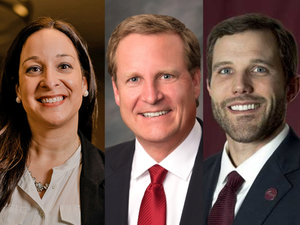
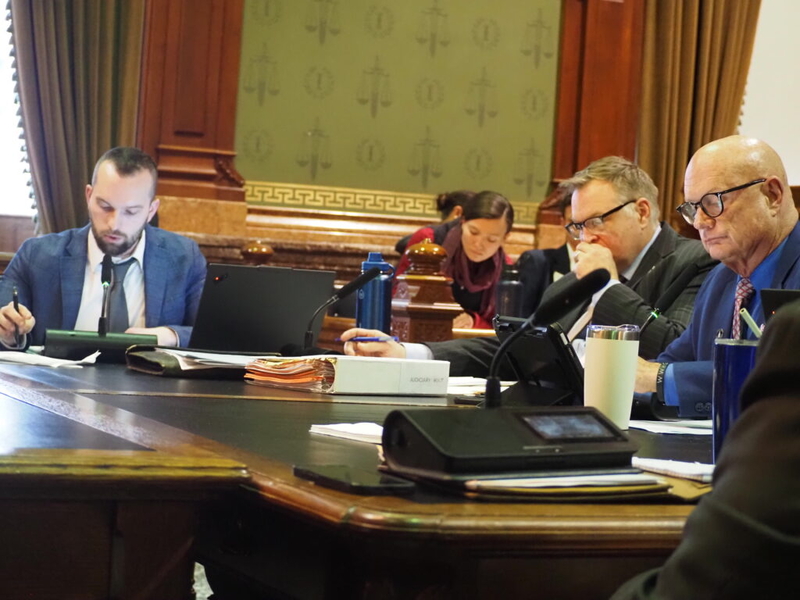
The House Judiciary Committee members including, from left, Reps. Skyler Wheeler, Judd Lawler and Steve Holt, discussed bills at a Feb. 19, 2026 meeting before the first funnel deadline of the legislative session. (Photo by Robin Opsahl/Iowa Capital Dispatch)
A controversial measure to stamp out affirmative action language in Iowa law squeaked past a legislative committee deadline Thursday, while proposals restricting public libraries stalled.
The House Judiciary Committee advanced several bills in its final meeting before the first funnel deadline of the 2026 legislative session, including a measure to restrict gubernatorial powers.
Library obscenity
One of the bills not included on the final agenda for the meeting was House File 2309, a measure restricting “material harmful to minors” from being accessible to Iowans under age 18 without parental consent. The measure was advanced through the subcommittee process earlier in February but was not brought before the House Judiciary Committee.
Several other public library measures also did not survive the deadline, including House File 2270, a bill changing Enrich Iowa program funding requirements for public libraries; Senate File 2177, a measure requiring digital library services offered by public and school libraries to include measures to block minors from accessing obscene and other specified, restricted materials, and Senate File 2119, a bill that would have removed existing exceptions in Iowa’s obscenity laws for libraries and schools.
Though the House Judiciary Committee did not discuss the library legislation, some other bills that received significant pushback during subcommittee meetings moved forward Thursday.
Affirmative action
House Study Bill 668, which was approved in a 14-6 vote, eliminates multiple affirmative action and equal opportunity plans and reporting requirements currently in Iowa law. These initiatives are removed from laws regulating multiple entities, including the Iowa Department of Education, Department of Administration, Board of Regents and judicial branch. These requirements would also be struck for school districts, area education agencies, community colleges and private education institutions.
Many speakers who spoke in opposition to the measure at a subcommittee meeting said these programs ensure marginalized communities receive equal treatment as required under the law. But Republicans and supporters said the bill, alongside other bills restricting diversity, equity and inclusion, or “DEI” efforts, are needed to ensure equity. Rep. Skyler Wheeler, R-Hull, echoed this sentiment at the committee meeting.
“In short, Mr. Chair, the best way to stop discriminating based on race is to stop discriminating based on race,” Wheeler said, quoting U.S. Supreme Court Chief Justice John Roberts.
The measure was amended to remove affirmative action requirements from other areas of Iowa Code, as well as changing reporting requirements for the state to promote minority and women-owned businesses to Iowa-based businesses, Wheeler said.
This amendment simply removes affirmative action in other areas of the code, and changes the requirement that state reports, efforts to promote minority and women owned businesses, and changes that to Iowa-based businesses.
Rep. Megan Srinivas, D-Des Moines, said there are multiple areas of the bill that will discourage immigrants and other Iowans from diverse backgrounds from coming to the state. She said there are sections of the bill that remove current prohibitions on discrimination for licensing based on citizenship status, which she said could deepen workforce shortages in Iowa.
Srinivas said her parents, who are immigrants, came to Iowa because they believed they could “flourish” in the state. Her parents contributed to the Iowa workforce, she said, and raised children who became a doctor and engineer — two professions “we badly have deficits in,” she said.
“By denying people coming here who are filling these vital gaps, you’re denying Iowans the quality of life they deserve,” Srinivas said.
Wheeler said the bill does not create new requirements for U.S. citizenship or bar noncitizens legally in the country from working or obtaining professional licenses.
Another component of the bill that was criticized was removing requirements that law enforcement agencies provide annual training on deescalation techniques and bias prevention, and for the Iowa Law Enforcement Academy to adopt rules on racial and cultural awareness training. These measures were approved unanimously by the Legislature in 2020.
Srinivas said there were several speakers at the subcommittee meeting, including former law enforcement officers, who said “they were concerned about removing racial and bias training, which has become a core part of what they do in the field.”
Restricting gubernatorial authority
The committee also advanced two measures related to gubernatorial authority in disaster situations — primarily restricting certain actions taken in future events similar to the COVID-19 pandemic.
Under current law, a disaster proclamation issued by a governor lasts 30 days, unless terminated or extended by the governor, or if the General Assembly or Legislative Council rescinds the proclamation. Under House Study Bill 726, advanced by the committee in a 14-6 vote, a disaster proclamation would be limited to 15 days, and extensions would have to be approved by the Legislature in 15-day increments. If the General Assembly is not in session, the Legislative Council has the ability to oversee emergency disaster proclamations.
Rep. Samantha Fett, R-Carlisle, said the measure also would put limits on what disaster proclamations can entail, saying it “cannot violate constitutional rights, shut down businesses, alter elections or restrict lawful medical practice,” nor can it restrict religious or family visitations or practices.
It also makes several changes related to public health recommendations — stating the Iowa Department of Health and Human Services can only recommend, not require tests, vaccines or treatment during an emergency, and can only require the quarantine or isolation of individuals infected with a disease to the longest usual period of incubation.
The bill was amended to specify that emergency disaster proclamations issued in order to trigger federal action or gain a federal waiver would not be subject to the timing requirements of the measure.
Rep. Ross Wilburn, D-Ames, said he believed the legislation was “too restrictive for both emergency situations as well as public health emergencies.” He said a 15-day period would not necessarily be long enough for authorities to have an “informed factual assessment of conditions or circumstances” causing the emergency.
“I say this as a former mayor and city council member that had to deal with local disasters — tornadoes, floods — that you know, the executive branch, whether it’s governor or mayor, needs to have some flexibility to manage local circumstances that come up and can be unforeseen,” Wilburn said.
Another measure, House File 2145, restricts the Iowa governor from ordering places of worship to be closed or to restrict their locations or practices, including during emergencies or public health disasters.
House File 2145 comes years after the COVID-19 pandemic. In March 2020, Gov. Kim Reynolds signed a State of Public Health Disaster Emergency executive order which included a prohibition on “social, community, spiritual, religious, recreational, leisure, and sporting gatherings and events of more than 10 people.” The restrictions on religious and spiritual gatherings were lifted in April of that year.
The proposed legislation would prevent future governors from being able to take similar actions in the case of public health crises or other disaster emergency situations. Rep. Beth Wessel-Kroeschell, D-Ames, said during emergencies, “we need to make sure we have all the tools available to protect Iowans and keep them safe.”
“I don’t love the idea of closing down places of worship, and certainly that needs to be a last resort, but in the case of an emergency, I do believe that we need that flexibility in the state,” Wessel-Kroeschell said.
Rep. John Wills, R-Spirit Lake, said the practice of religion is protected under the U.S. and Iowa constitutions. He said “churches have the ability to make the decision whether they should close down or not, individuals have the ability to decide whether they should go to church or not.” The measure was approved in a 16-4 vote.
Des Moines, IA