Law proposed to restrict ICE agents in Montana
Jan 27, 2026 | 10:12 am ET
Description
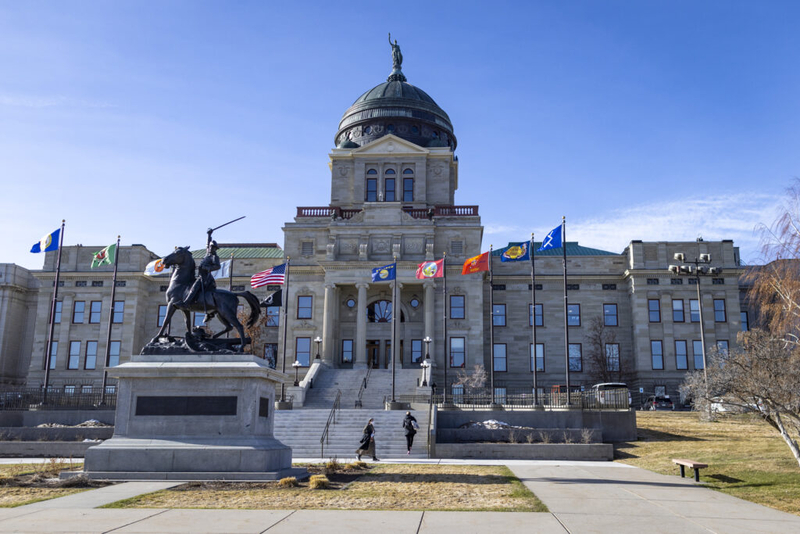
The Montana State Capitol in Helena on Wednesday, April 26, 2023. (Photo by Mike Clark for the Daily Montanan)
In the midst of fatal shootings by federal agents of two U.S. citizens in Minneapolis, a Democratic state senator from Missoula is proposing legislation to limit the way law enforcement officers operate in Montana.
Republican lawmakers are skeptical such legislation will gain traction.
Sen. Ellie Boldman, D-Missoula, said a trio of bills she plans to present would require law enforcement, including federal Immigration and Customs Enforcement officers, to clearly display identification while on the job; limit mask wearing during operations; and protect “privileged places,” such as churches, hospitals, schools and daycares.
Boldman said the bills are aimed at restoring transparency, accountability and constitutional protections in federal enforcement actions. She said they are not about immigration nor are they radical.
“They are about whether armed federal agents should be allowed to operate in secret, without accountability, and in the same neighborhoods where Montanans live, worship, learn and seek medical care,” Boldman said in a statement.“Many of our state and local law enforcement officers already follow these guidelines as common-sense rules that promote public trust. It’s time that those who don’t are held to the same standard.”
Montana’s next legislative session doesn’t start until January 2027, and in an interview, Boldman said she plans to use the months ahead to talk with Montanans about the idea.
She believes it will gain support from faith based groups, Montana law enforcement officers, and more libertarian leaning legislators.
State Sen. Susan Webber, a fellow Democrat and member of the American Indian Caucus, said Native American constituents in particular are concerned about the potential presence of federal agents in Montana this spring as powwow season starts.
Native Americans have been harassed, questioned and detained by federal agents in Minneapolis, New Mexico, Arizona, and elsewhere, according to Source NM and the AZ Mirror, also States Newsroom outlets, and The Red Nation Podcast.
“It’s getting closer to us,” Webber said.
However, other Republican legislators, including Sen. Barry Usher, a former law enforcement officer who has served as chairperson of the Senate Judiciary Committee, said he’s skeptical the state could enforce such legislation on federal authorities.
Usher also said Montanans are largely supportive of law enforcement officers, and the restrictions are unnecessary.
“I think it’s premature, and she’s trying to put out a political statement, which is not needed in the state of Montana,” Usher said of Boldman.
Republican President Donald Trump has focused on mass deportation of illegal immigrants in his second term.
However, federal officers have detained U.S. citizens and other people who are legally in the country as part of their sweeps, and in Minneapolis, immigration officers fatally shot two U.S. citizens this month, including nurse Alex Pretti on Saturday.
The deaths have led to national outcry.
A recent poll from Politico shows most Trump voters, 55%, support the deployment of ICE agents around the country, but a growing number of people are dissatisfied with how Trump is implementing his deportation agenda.
Boldman said the Jan. 7 shooting death of mother and poet Renee Good at the hands of a federal officer in Minneapolis prompted her to propose restrictions on federal law enforcement action in Montana.
Boldman said her interest is not in immigration.
Rather, as a lawyer, Boldman said she is concerned with protecting people’s civil liberties and ensuring law enforcement operates with accountability and not under anonymity.
She said she also recalls times when people on the more conservative end of the political spectrum introduced bills to “get the feds out of our communities,” such as in the aftermath of the Ruby Ridge standoff in 1992.
In that northern Idaho incident, the firefight and standoff between federal agents and family members of a man charged with selling a couple of illegal sawed-off shotguns to an undercover agent left two unarmed people dead, along with a U.S. marshal and a dog. It resulted in criticism of federal law enforcement.
Boldman said the proposed legislation isn’t meant to stop lawful enforcement activity in Montana. However, she said federal authorities don’t have “unchecked authority” in Montana, and the state can place guardrails around their activity.
“I’ve heard from a helluva lot of police officers from our communities that serve and work and live in our communities that do not support what is happening in Minneapolis,” Boldman said.
While Boldman said she anticipates some Republican co-sponsors, Usher won’t be among them.
He said he believes Montana doesn’t have the problems Boldman is attempting to address, and ICE is operating without issues in states besides Minnesota.
He said people understand the work of ICE agents “gets a bad guy out of our hair,” and it means Montanans don’t foot the bill for their detention here.
“We don’t need them raping and killing our people,” Usher said.
Citing multiple national studies, the Migration Policy Institute said immigrants of all legal statuses commit crimes at lower rates than people born in the United States. The institute describes itself as a nonpartisan think tank focused on immigration.
Rep. Neil Duram, also a Republican in law enforcement, said he would resist such legislation, although he said sometimes, people present bills that aren’t intended to become law anyway.
“Sometimes, people bring legislation not to pass, but to further the argument,” said Duram, of Eureka.
He also said if people are wrongly grabbed by ICE, such as if they are citizens who have a right to be in the U.S., they can make their case in court.
Webber, of Browning, said Native Americans in Montana are preparing to encounter ICE agents who assume a person who has dark skin is illegal. She said Native Americans make up just 6% of the population in the state and stand out in Montana.
“That’s always been an issue with us is the racial profiling,” Webber said.
Based on the Blackfeet Indian Reservation, Webber also said people who didn’t worry about traveling to cities such as Missoula in the past have started to think twice about doing so.
Webber said there is fear of encountering ICE, but also there are the facts of the matter.
“You can’t send us anywhere,” Webber said. “This is our land. This is our homeland. We are the first Americans. So we are really having concerns about that.”
Montana legislators to participate in ‘Day of Solidarity’ in Minnesota
As part of an initiative organized by Sen. Cora Neumann, D-Bozeman, more than 100 legislators from 23 states and the District of Columbia will gather in person and virtually in Minnesota on Thursday to stand with their colleagues in the Minnesota Legislature, according to a news release.
The state legislators will show solidarity in confronting increasing federal overreach, the expanding presence of federal agents in American communities, and the escalation of violence in the wake of the killings of Renee Good and Alex Pretti, said the news release from Neumann and Montana Senate Democrats.
In addition to Montana, the 108 state lawmakers from the following states will participate in the Day of Solidarity, either in person or virtually: Colorado, Georgia, Hawaii, Illinois, Kansas, Michigan, Minnesota, Missouri, New Hampshire, New Jersey, New Mexico, New York, North Carolina, North Dakota, Oregon, Pennsylvania, Rhode Island, Tennessee, Utah, Washington State, and Wisconsin; as well as the District of Columbia.
This trip follows Sen. Ellie Boldman filing bill requests for legislation that would improve transparency and accountability for federal immigration and law enforcement agencies operating in Montana.
In addition to Neumann and Boldman, other Democratic legislators who will be attending Day of Action in person are the following:
Senate Minority Leader Pat Flowers (Bozeman)
Senate Democratic Whip Shane Morigeau (Missoula)
Sen. Chris Pope (Bozeman)
Rep. Josh Seckinger (Bozeman)
Rep. Shelly Fyant (Arlee)
Other Montana Legislators will be attending virtually.
The Day of Solidarity events are planned in partnership with State Futures, a national nonprofit that organizes legislators and other state policymakers.
Editor’s note: This story has been corrected to note the 55% support for ICE deployment in a Politico poll reflects Trump voters.
Helena, MT