Cuts to property and income taxes for some SC residents advance in Senate
Jan 20, 2026 | 8:57 pm ET
Description
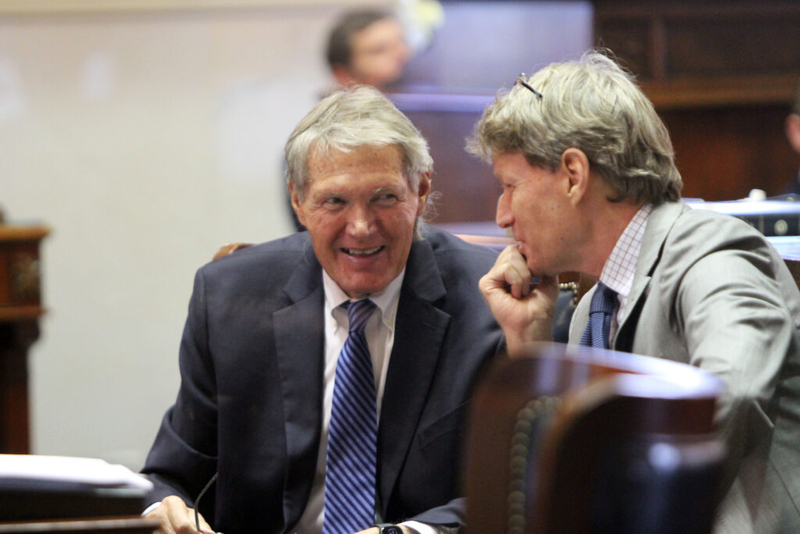
Senate Finance Chairman Harvey Peeler, R-Gaffney, pictured talking with Senate Judiciary Chairman Luke Rankin, R-Myrtle Beach, in Senate chambers on Thursday, Jan. 11, 2024, proposed a property tax cut to go along with the House's proposed income tax cut. (File/Mary Ann Chastain/Special to the SC Daily Gazette)
COLUMBIA — Income and property taxes could both go down for some South Carolina residents next year under dual bills advanced out of a Senate committee Tuesday.
The Senate Finance Committee made no changes to a bill the House passed last year slicing the state’s income tax for some residents, with the goal of eventually doing away with the tax altogether. Senators saw the House’s proposal and raised them another tax cut, this time to the property taxes of people 65 and older who’ve lived in their home for at least five years.
“You can’t out-cut Harvey Peeler,” Peeler, the Senate’s head budget writer, told reporters soon after the vote, repeating his common catchphrase.
Senators agree with the House’s plan to eventually take the state’s income tax rate down to 0%, but property taxes have been a bigger complaint, especially from older homeowners, Peeler said.
“That’s what we’ve heard so much from our constituents,” the Gaffney Republican said. “All of it’s too high, but the property tax is unfair.”
Altogether, the bills would reduce state revenue by about $378 million for the fiscal year starting July 1. In both cases, the main opposition the bills faced Tuesday came from concerns they didn’t go far enough.
The state’s fiscal advisers expect economic growth to provide an additional $734 million in the fiscal year starting July 1, according to their latest predictions. Any tax-cutting plan would reduce that amount. Legislators also have a $1.7 billion surplus available on top of that from above-expected tax collections and unspent reserves in prior years, but that’s meant for one-time expenses.
State agencies and colleges are collectively seeking far more than the combined $2.5 billion. Peeler didn’t give any hints on which requests for the additional dollars might not get funded.
“I’m ready to go to work,” Peeler said. “That’s all I can say.”
Property tax cut
Property taxes don’t go to the state. They’re collected by counties for local government services. The proposal requires the state to reimburse counties an estimated $259 million additional for what’s called the Homestead Exemption.
Since 2000, homeowners who are 65 and older, blind, or are permanently disabled haven’t paid property taxes on the first $50,000 of their home’s value.
The bill advanced to the Senate floor would triple that tax break to $150,000 while also increasing the residency requirement. To qualify, homeowners must have lived in their house for five years, up from one.
The additional time is meant to ensure people don’t move into the state just to take advantage of the tax break, said Sen. Greg Hembree of fast-growing Horry County.
People are “moving in from out of state, and day one, they get the benefit of this exemption without having to put the first cent toward the building up of our communities,” the Little River Republican said. “They’re benefiting from those that have been here for many, many years paying these fees.”
However, homeowners who already qualify for the tax break under the one-year requirement would continue to get it under the proposal.
Initially, the bill lowered the qualifying age threshold to 60 and doubled the break to $100,000. Senators opted to maintain the age requirement in state law and instead increase the non-taxed value of a home. Hembree, who proposed the change, said that would help homeowners who most need it.
Sen. Tom Corbin disagreed. Even though many people aged 60 to 65 are still working, they need the help just as much, if not more, than their older counterparts, Corbin said. A lower amount combined with a lower age limit could help more people, said the Greenville County Republican.
“We’re giving more breaks to the people who we’ve already been giving a break to,” Corbin said.
Corbin was one of two senators to vote against the bill. Sen. Sean Bennett, R-Summerville, was the other. The other 19 senators at the meeting voted in favor.
Income tax cut
A bill that would immediately cut income taxes for nearly 40% of residents and make the state’s income tax appear more appealing to people moving from out of state also advanced Tuesday.
South Carolina’s top marginal income tax rate of 6% is the highest in the Southeast. But the effective rate — what people actually pay on average — is about half that. Still, Republicans in the House contended the state needed to decrease that top tax bracket to keep attracting companies and their executives.
The House approved the bill at the end of the legislative session last year, following an initial version that would have raised taxes for about 60% of filers. Under the bill senators advanced Tuesday, about 27% of people would pay more, and 35% would pay the same.
Sen. Wes Climer, a Rock Hill Republican, criticized the plan for not going far enough. No one’s taxes should go up as a result of what is advertised as a tax cut, said Climer, who is also running for Congress.
That’s not possible, said Bennett, a financial planner. Many of the people who will see their taxes increase under the bill were paying no income tax at all, so any change will inherently raise their taxes, Bennett said.
About 45% of tax filers pay zero state income taxes, according to the state Revenue and Fiscal Affairs Office.
“The truth is, a lot of taxpayers for a long, long time have been getting a pretty sweetheart deal while others in our communities have been covering for them,” Bennett said.
In its first year, the bill would reduce state revenues by about $119 million, according to an updated financial analysis.
The income tax would continue to decrease incrementally until it hit 0%, as long as state revenues from other taxes grow enough to hit the triggers defined in the bill. The same triggers would continue collapsing the state’s tax rates — from three to two, and then to a single flat rate — before eventual elimination.
Along with reducing taxes overall, the bill decouples the state’s income tax code from the federal system. South Carolina is one of just five states to base state income taxes off “federal taxable income,” rather than adjusted gross income. That’s why South Carolina’s tax rate looks so out of whack compared to others in the Southeast.
Legislators say South Carolina should set its own tax rules instead of staying beholden to any changes Congress makes.
“That’s a significant issue, because it does allow South Carolina to create its own tax policy, which I think is critically important to the future of South Carolina,” Bennett said.
Decoupling means the federal income tax reductions in the massive tax package signed by President Donald Trump last July won’t extend to state income taxes.
Sen. Ronnie Sabb was the only senator to vote against the bill. He didn’t oppose the idea of a tax cut but felt the specifics of the bill needed more discussion, he said after the vote, without giving details on what he wanted to see change.
“This is more window-dressing than something substantive that needs to take place,” said the Greeleyville Democrat.
Columbia