Lawsuit: BLM wants to burn thousands of acres, but won’t say where, when or how
Jan 15, 2026 | 7:15 pm ET
Description
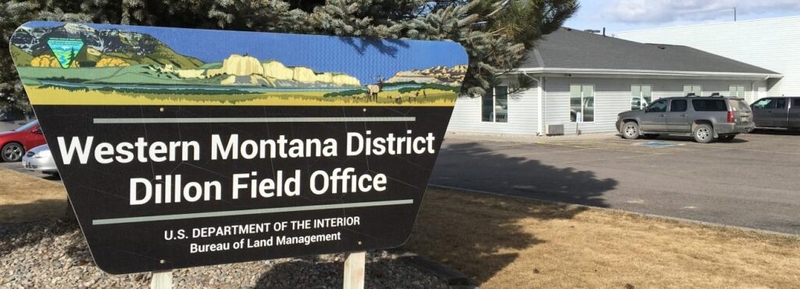
The Dillon Field Office of the Bureau of Land Management located in Dillon, Montana (Photo via BLM).
A lawsuit filed this week challenges a decision by the Bureau of Land Management and the Dillon Field Office to use prescribed burns and other conservation techniques on tens of thousands of acres of land, but fails to say when, where and how those will be applied, as well as cuts out any public comment and review.
Alliance for the Wild Rockies, Native Ecosystems Council, the Council Wildlife and Fish as well as the Western Watersheds project have filed suit in the Butte division of the federal court system, asking the court to halt the project because it falls short of federal law, and includes so little detail that it’s impossible to understand the plan. The groups also raised concerns about several species that reside in the area, including the sage grouse, pygmy rabbits and pinyon jays.
The Bureau of Land Management has a standing policy of not commenting on pending litigation.
The “vegetation management treatments” could span across multiple mountain ranges in southwestern Montana and include prescribed burns. That area encompasses 905,000 acres of land.
“BLM authorized the project without determining where and when which activities will take place,” the lawsuit said. “The precise location, timing and scope of these land-disturbing activities will be decided at the implementation stage … without any further opportunity for public comment. In some cases, those decisions will be made without additional review of the underlying environmental analysis, even though the analysis of baseline conditions is more than a decade old and missing key baseline information.”
Instead, the lawsuit said that the BLM will then “backfill” data only after the project is approved and even then, that information will not be subject to public comment.
The suit claims that the federal agency has planned this “in a way that undermines informed decision-making and meaningful public participation,” which the groups allege is a violation of the National Environmental Policy Act and the Federal Land Policy Management Act.
The lawsuit also says that the scope of this proposed project is so large and so wide that it is impossible to evaluate the impact on “special status species” — those endangered or protected by federal law.
It also claims that the BLM is failing to take into account why some of the land has been degraded — because of livestock grazing.
“The assessment report have identified livestock grazing as a significant causal factor for certain watersheds not meeting rangeland health standards,” the lawsuit said. “For instance, in one area of the Grasshopper Watershed, the riparian health and water quality standards were not met because livestock has caused a wetland area to dry out.”
The organizations told the court that because they have not taken into account grazing or even established a baseline, it will be impossible to tell what role the grazing has on the rest of the ecosystem.
The groups offer opinions from the U.S. Ninth Circuit Court, which oversees Montana’s federal courts, including a 2016 decision that says without establishing the baseline conditions before a project begins, there’s no way to comply with federal policy. The lawsuit also said federal law requires data, explanations and conclusions that are subject to both public review and a court review before beginning action.
The plan calls for “deforestation” of conifers including Douglas fir and Rocky Mountain Juniper from historically non-forested areas, and authorizes 10,000 acres per year for prescribed burns or mechanical removal, including cutting or mulching trees.
“The available scientific evidence — as well as BLM’s own planning materials — indicates a high potential for harm from mechanical conifer removal and prescribed fire,” the lawsuit said. “For instance, one of the most common outcomes of mechanical junior and sagebrush removal is an increase in invasive annual grasses, which in turn increase fire risk and degrade native ecosystems.”
The lawsuit also faults the BLM for not explaining how it will achieve these plans, and any of the steps the agency will take to protect habitat, especially for sage grouse, pinyon jays and pygmy rabbits, the smallest wild rabbits in the world.
The conservation organizations also describe populations of wildlife that are falling in the Dillon Field Office area. It includes a sage group population that has shrunk 30% since 2021 and has been cut in half since 2002 in Montana. Pygmy rabbit populations have crashed in the past 50 years, with half of the numbers declining due to habitat loss, according to the lawsuit.
Pinyon Jays, small to medium sized blue jays that live in the West, have also seen their numbers reduced by 80% because of changes to the environment, including elimination of juniper habitats, which the birds depend upon for seed caching, foraging and nesting.
It also calls into question whether whitebark pine, a species on the Endangered Species List, is going to be affected.
“Without such surveys, the BLM cannot know the baseline status of the species, (and) cannot seriously analyze the impacts of the project on whitebark pine,” the lawsuit states.
The lawsuit asks that court to halt the decision, require the BLM to complete an environmental impact statement for the project, or at least supplement an environmental analysis that addresses the deficiencies.
“This area contains some of the best habitat for sage grouse in Montana and the Northern Rockies,” said Mike Garrity, the executive director for the Alliance for the Wild Rockies. “Yet the BLM wants to burn down sagebrush to promote even more widespread grazing.”
Helena, MT