Summit to tell story behind the deal to restart SC’s failed nuclear reactors
Dec 04, 2025 | 3:15 pm ET
Description
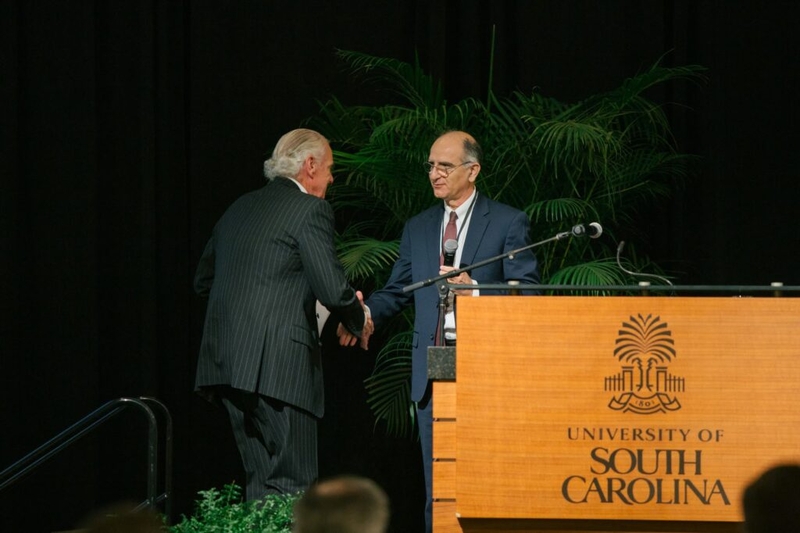
Hossein Haj-Hariri, the dean of the University of South Carolina's engineering and computing school, right, shakes hands with Gov. Henry McMaster at the state's inaugural nuclear summit. (Photo courtesy of USC)
COLUMBIA — State utility executives, legislators and the lead investor in the reboot of South Carolina’s abandoned nuclear reactors will tell the story behind the multibillion-dollar deal during a nuclear-focused conference in Columbia next week.
The state’s second annual nuclear summit will feature a panel conversation with Santee Cooper CEO Jimmy Staton, president of the utility’s governing board Peter McCoy, House Speaker Murrell Smith, R-Sumter, and state Sen. Tom Davis, R-Beaufort.
Separately, attendees will hear from the executives of Brookfield Asset Management, the New York investment firm in negotiations with Santee Cooper for the purchase of two partially built reactors at the V.C. Summer nuclear station in Fairfield County.
The event is something of a celebration of actions taken over the past year and a half, according to Ethel Bunch, the founder of a nuclear advocacy group — the Palmetto Nuclear Coalition — made up of large energy-using companies and nuclear-related firms that is co-hosting the conference alongside the University of South Carolina.
After all, it was during the state’s inaugural nuclear summit in August 2024 that Davis, one of the project’s most vocal cheerleader in the Legislature, publicly broached the idea of a V.C. Summer restart.
“He came out on the stage after the breakout sessions and said, ‘We’re all talking around this opportunity. We need to talk about this opportunity,’” Bunch said.
Those remarks set into motion a chain of events: a scouting trip by a state advisory group to see the condition of the unfinished reactors, Santee Cooper putting them on the market, Gov. Henry McMaster’s calls for a “nuclear renaissance,” legislation supporting the effort, and now a pending deal for the sale.
A nuclear history
Whispers about rebooting V.C. Summer’s expansion had begun a year earlier, Bunch said, as tech giants and major manufacturers looked for sources of low-to-no carbon power. Nuclear became the answer.
South Carolina’s four nuclear power plants already supply 55% of the state’s total electricity and the state is the third-largest producer of nuclear power in the nation, according to the U.S. Energy Information Administration.
The state also is home to nuclear fuel-maker Westinghouse’s U.S. facility. And the Savannah River Site, which once produced weapons-grade plutonium and tritium for the U.S. nuclear arsenal during the decades-long Cold War, now recycles the radioactive materials for reuse.
SC’s state utility enters negotiations on deal to restart failed nuclear project
Now state leaders want to double-down and make South Carolina a nuclear stronghold.
The V.C. Summer expansion, fraught with fraud and cost overruns, continues to be a black mark on the state that has left power customers footing the bill for the reactors that have never produced a megawatt.
But in the past year, restarting construction has gone from a far-fetched idea to one politicians and industry executives are championing.
At the conference Tuesday, Santee Cooper leadership is expected to talk in depth about the closed-door meetings where the decisions were made.
Executives from Brookfield will then take the stage to talk about their interest in the South Carolina power plant and other national trends. Brookfield now also owns Westinghouse, the company that designed the V.C. Summer reactors, having bought it when the nuclear debacle sent it spiraling into bankruptcy.
What’s next
In October, Brookfield, its subsidiary Westinghouse and Canada-based Cameco inked a partnership deal valued at $80 billion, with the U.S. government. The companies will build 10 reactors identical to those at V.C. Summer.
Under the agreement, the federal government will help secure financing and permits for the reactors. In return, the government could take a 20% share of any profits after Brookfield and Cameco take a $17.5 billion share.
If Westinghouse’s value surpasses $30 billion by 2029, the government could turn those profits into a 20% equity stake in the company.
Final executive punished for VC Summer failure to spend at least 10 months in prison
South Carolina’s reactors would be the first and second on the list, with construction starting by 2030.
“When you’re an engineer, all problems become opportunities,” said Hossein Haj-Hariri, the dean of USC’s engineering and computing school. “V.C. Summer was a major egg on the face of the state. But we have (the reactors.) They’re sitting there. They are partly done.”
The project still has a long way to go, Haj-Hariri acknowledges, but USC also wants to be part of the solution.
The state’s largest university system is offering up its technological expertise.
“The thing that has made nuclear struggle is not the design of the reactor. It’s how do you put it together so that you come in on time and on budget?” Haj-Hariri said.
His suggestions: use modern tools, such as artificial intelligence and sensors, to gather data and learn as you build; make use of new, more advanced building materials; and use drones to manage the construction site.
“We are going to develop construction engineering with a focus on nuclear so that we can help the eventual builder of V.C. Summer,” Haj-Hariri said. “We are not just building two reactors. We are building the infrastructure that helps build future reactors. We come up with processes.”
To ensure the plans will work, USC has the technology to create virtual simulations to test them out before building begins, something the school has been doing for years at its McNair Aerospace Center, alongside Columbia-based Integer Technologies, on contracts for the U.S. Department of Defense.
Other opportunities
In addition to the Trump administration’s push for 10 new, large-scale reactors, Haj-Hariri sees opportunity in another of the president’s executive orders.
That order calls for small-scale, micro reactors at nine U.S. Army bases by 2028: Fort Benning in Georgia, Fort Bragg in North Carolina, Fort Campbell in Kentucky, Fort Drum in New York, Fort Hood in Texas, Fort Wainwright in Alaska, Holston Army Ammunition Plant in Tennessee, Joint Base Lewis-McChord in Washington, and Redstone Arsenal in Alabama.
Smaller nuclear reactors spark renewed interest in a once-shunned energy source
USC already has a head start. The college has worked on micro reactor projects in the past, Haj-Hariri said.
The Army previously explored them as a way to replace the need for diesel generators used to power battlefield outposts for deployed troops. The school also was developing mini reactors for fueling naval ships until the Trump administration defunded the project in its DOGE-led purge of clean energy grants, Haj-Hariri said.
USC hopes to channel this momentum around nuclear into a new innovation center planned for the south end of campus. The five-story building would house reactor-related research on three floors while renting out the remaining space to industry partners.
And more nuclear in the state could spell more jobs of USC engineering graduates.
Of the 1,700 South Carolina college students who graduated in 2021 with a bachelor’s degree in engineering, only 54% were working in the state a year after graduation, according to data from the state employment agency.
“It’s not because our graduates don’t want to stay here,” he said. “But if there are no jobs, then where do they go? They go to North Carolina, Georgia, somewhere else.”
Columbia