Sheep Creek mine exploration in Bitterroot draws opposition
Dec 02, 2025 | 11:06 am ET
Description
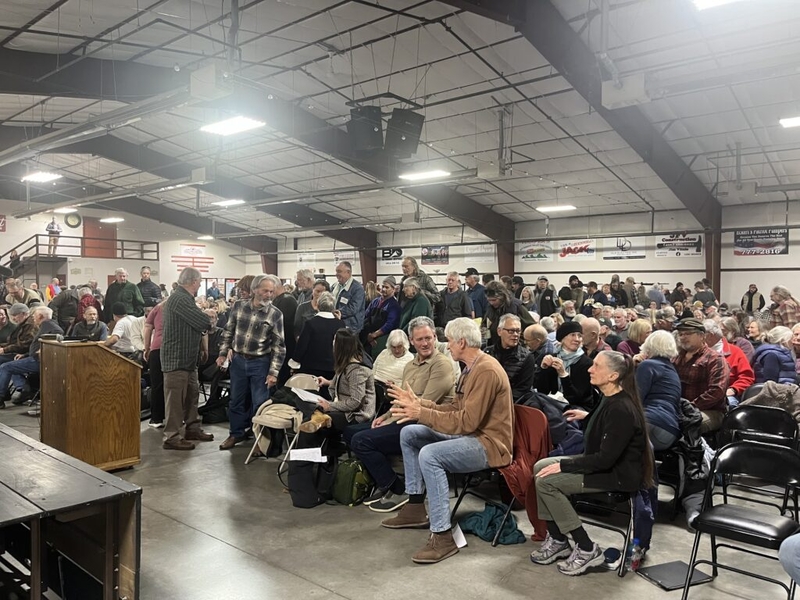
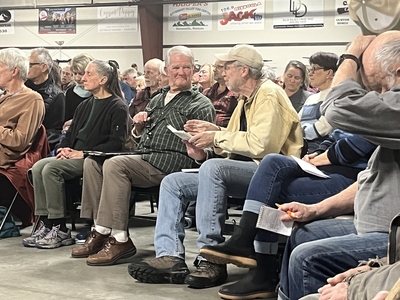
Some 36 people testified about the Sheep Creek mine exploration project, but no one spoke in favor of it, according to a count from the Ravalli County Commissioner's Office. (Keila Szpaller/The Daily Montanan)
HAMILTON — With overwhelming support, Ravalli County Commissioners voted unanimously Monday to oppose the placement of the Sheep Creek mining “exploration” project on a federal track designed to improve permitting efficiency.
More than 500 members of the Bitterroot Valley turned up at the Ravalli County Fairgrounds Event Center for the midday meeting, and no member of the public expressed support for the project, to conduct preliminary gallium and heavy “rare earth element” mining to see if a full-scale operation is feasible.
The materials are used in everyday items such as automobiles and cellphones.
The project would take place near the headwaters of the Bitterroot River and in an area with elk, wolverines, Canada lynx, sometimes grizzly bears, and native fish, including westslope cutthroat trout, listed by Fish, Wildlife and Parks as a “fish of special concern.”
Some members of the public asked commissioners to oppose the project altogether.
On behalf of U.S. Critical Materials, Scott Osterman told commissioners and members of the public the work was important to national security and ensuring China didn’t have a stranglehold on material needed for U.S. defense.
Osterman, former head of the Department of Commerce, and another mine representative said the project would use new methods and be environmentally “benign,” although Osterman disputed the area was “pristine.” He apologized for staying mum about the project for so long.
However, members of the public said the headwaters of the Bitterroot River in a closed basin where water is already overallocated is no place for a mine, no place for the substantial truck traffic, and no place for experimenting with new mining technology.
They also raised questions about the corporate structure of U.S. Critical Minerals and its relationship with “shell companies,” as did Commissioner Greg Chilcott, who said shell games make him nervous.
“I don’t want to pick the wrong walnut shell,” Chilcott said.
During public comment, Tom Powers, who described himself as one of the sole surviving members of the original class action suit brought in Libby over asbestos poisoning, said he never worked in the mine there, but he has asbestosis.
Powers said he worked in public buildings, and he worked on the Kootenai River when trucks pulled asbestos across the top of the river, unbeknownst to him.
Powers and many community members were diagnosed with a chronic lung disease, one with symptoms that often don’t appear for years after exposure, and Powers asked commissioners to consider the aftermath of a mine.
“Don’t let this happen here,” Powers said.
Tuesday, commissioners plan to sign a letter to the Congressional delegation and Gov. Greg Gianforte announcing their opposition to the placement of the Sheep Creek project on the federal FAST-41 permitting list.
FAST stands for Fixing America’s Surface Transportation Act, and Osterman said the acronym incorrectly implies projects are on a “fast track.”
The federal website that describes the FAST-41 permitting council, created under Title 41 of the Act, said it aims to “improve the efficiency of the permitting process for critical infrastructure projects.”
Commission Chairman Dan Huls said he wasn’t sure how the project landed on that list, but the commission learned about it a couple of weeks earlier, he believes from a member of the Congressional delegation.
Commissioner Chilcott said he generally appreciates the idea the federal government could move more quickly, especially when it comes to forest projects in the area, but he does not want a process that cuts out local participation.
After the presentation from U.S. Critical Materials, Commissioner Jeff Burrows grilled the mine representatives, and he said they not only kept the community in the dark, they also didn’t reach out to Ravalli County Commissioners in a timely fashion.
Commissioners are responsible for public safety and health, including roads, he said, but roads already are in disrepair, and Ravalli County does not have a budget to accommodate the significant infrastructure demands of the project.
“If you start talking somewhere between 30 and 5,000 trucks per week coming out of the West Fork, we can’t afford that,” Burrows said. “ … I’m a little disappointed that we haven’t been reached out to earlier, (and) that now, we’re looking at going on the ‘fast track’ program.”
The mine representatives gave varying estimates for truck traffic during the exploratory phase, from “maybe” one to three two-ton trucks a day, “relatively minimal” during the first year, to “potentially more” the second year.
They said the project would ramp up, all under the permitting process, although it was hard to estimate a truck count at full-scale production, should that take place. Osterman said the company would help build roads and bridges if it moved into that phase.
He said even in the early stages, the project would bring 40 to 50 jobs to the Darby area, and average salaries for mining jobs are $85,000 to $135,000 a year, which he described as “significant” economic development.
Members of the public, however, said tourism is the new economy, and the mine posed a risk to tourism, recreation, even property values, and they pointed to different values.
Katelynn Rennaker, who owns the Bitterrooter, a vintage clothing boutique in Stevensville, opted to keep her shop closed on Monday, to lose money, in order to attend the meeting and ask commissioners to withdraw all support for the mine, especially “fast tracking” it.
“This felt way, way more important,” Rennaker said.
Phil Ramsey, general manager with MPG Ranch, and Heather Barber, director of the Bitterroot Water Partnership, gave rebuttal testimony to the mine company’s presentation, and Barber said she had never seen as many people in attendance at the fairgrounds before.
Ramsey said the companies interested in mining in the Bitterroot had been prospecting the headwaters since 2022, but they had opened no local office, offered no regular briefing, and made no full data releases.
“Trust is earned through documents and relationships, not slogans,” Ramsey said.
He said if the company was serious about earning the community’s trust, it would remove itself from the FAST-41 list, although Osterman declined to do so when a commissioner asked. Ramsey also said the company representatives told one story to the public about the scope of the mine, but another to potential investors, with “major discrepancies.”
Barber too said she had seen no meaningful engagement from the mine representatives, despite an executive recently stating permits were expected in time for production in 2026. She said the valley already faces mounting pressures from more water users and hotter summers, and the mine proposal puts the river and local economy at risk.
Tourists spent $7.5 million on guiding services alone in the Bitterroot Valley in 2023, the fishery and tourism economy bring $67 million a year to the valley, and the tourism economy is growing, Barber said.
“It’s a significantly larger portion of the economy than 40 to 50 jobs may create,” Barber said.
She said the mine representatives see a geographic anomaly in the Bitterroot that could be lucrative, but the Bitterroot is a home, and one not worth risking to people who value public lands, healthy rivers, hunting, fishing, floating, bird watching, farming, ranching, and local businesses and families.
“We’re lucky to live, work and play here, and people from around the world visit to see something that is increasingly rare, a vibrant valley sustained by a healthy river running through its heart,” Barber said.
Helena, MT