University of Alabama freshman draws state’s court-ordered Senate map
Nov 21, 2025 | 8:01 am ET
Description
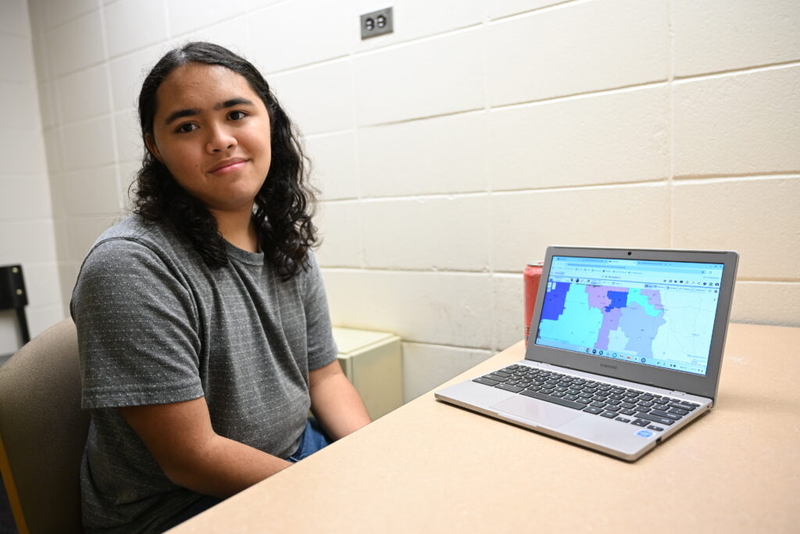
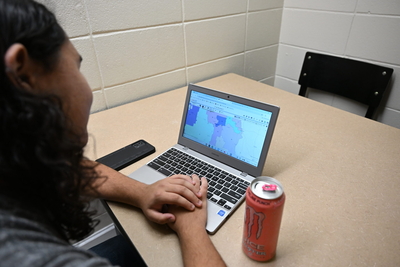
Daniel DiDonato, an 18-year-old student at the University of Alabama, working on a state Senate district map in a common study area in Martha Parham Hall in Tuscaloosa, Alabama, on Nov. 20, 2025. DiDonato created the map that a federal judge ordered to be implemented for Alabama's 2026 and 2030 elections after ruling that the Montgomery-area districts violated Section 2 of the Voting Rights Act. (Anna Barrett/Alabama Reflector)
TUSCALOOSA — Daniel DiDonato says he’s been passionate about elections since he was a young child. He remembers watching the 2016 presidential election as a fourth grader.
That’s why DiDonato, an 18-year-old political science major at the University of Alabama, worked late at night and used a free redistricting app to draw six new Alabama Senate district maps, and submitted them, unsolicited, to a federal court in a lawsuit over potential Voting Rights Act violations in Alabama’s state Senate districts.
On Monday, U.S. District Judge Anna Manasco ordered that one of DiDonato’s maps be implemented in the case.
“You can be the change you want to see in policy. You can be the change you want to see in government. Literally, you can do anything you set your mind to,” DiDonato said in an interview in Tuscaloosa on Thursday. “It’s extraordinarily cliche, but I did that.”
Whether the map remains in place is uncertain. Richard Allen, a special master charged with overseeing the new maps; Alabama Secretary of State Wes Allen, and attorneys for a group of plaintiffs who challenged the original Senate districts as racially discriminatory have all leveled criticisms of the map. The state may appeal Manasco’s order, though no appeal had been filed as of Thursday afternoon.
DiDonato identifies as a Democrat but said his affiliation did not influence his decisions. He said he was not familiar with the racial or partisan makeup of Montgomery and did not “turn on” the partisan and race filters on the software until he finished the maps.
“I don’t possess more than a passer-byer’s familiarity with the area. My understanding is limited to that,” he said.
The case
Manasco, a Trump appointee, ruled in August that Alabama’s Senate maps violate Section 2 of the Voting Rights Act. That provision prohibits voting laws or procedures that purposefully discriminate on the basis of race, color or membership in a language minority group.
Manasco ordered new district lines to be drawn in Senate Districts 25 and 26, currently represented by Sens. Will Barfoot, R-Pike Road, and Kirk Hatcher, D-Montgomery, respectively. She ordered a second district in Montgomery that had a 50% Black voting age population, or something close to it.
Gov. Kay Ivey said in September that she would not call a special session to redraw the map, citing a pending decision in the U.S. Supreme Court, Callais v. Louisiana, in which the justices are considering whether majority-minority districts are constitutional. A ruling is expected by next summer.
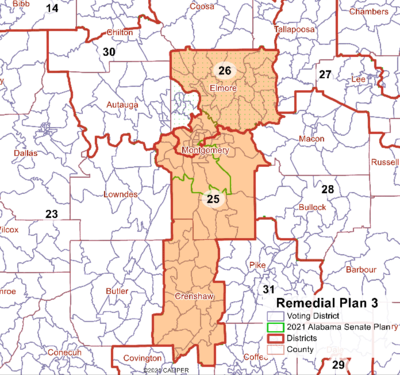
Manasco then appointed the same team that redrew the state’s congressional districts in 2023 to remedy the state Senate issue. Richard Allen, the special master, submitted three maps, with two being what he thought was best to remedy the VRA violation. The special master only submitted Remedial Plan 3, DiDonato’s map, to strengthen his case for Remedial Plans 1 and 2.
“The special master puts forward Remedial Plan 3 because, while it weakly remedies the Section Two violation, the comparison of Remedial Plan 3 to Remedial Plans 1 and 2 demonstrates the impact of modifying a third district (District 30) on the effectiveness of the remedy,” Allen wrote in an October court filing. “Additionally, given the small region in which the remedy is being effected, the special master lacked a third remedial plan that would modify only three districts, would more adequately remedy the Section Two violation, and would materially differ from Remedial Plans 1 and 2.”
Remedial Plan 3 extends Senate District 25 into southern Montgomery and extends Senate District 26 into Elmore County, which is currently in District 25.
It changes the Black voting-age population from 29% to 51.1% in Senate District 25 and 66.1% to 43.9% in Senate District 26.
DiDonato’s process
DiDonato said he used Dave’s Redistricting, a free online app, to create the maps. All of his work was done late at night either in his dorm room or in a common study area in Martha Parham Hall East, a male community-style residence hall located near Bryant-Denny Stadium.
He often worked over the course of a few days until 3 a.m., snacking on Trolli sour gummy worms or Starburst, but absolutely no caffeine.
“No caffeine late at night. That’s my policy,” he said.
In the redistricting software, DiDonato was able to hide partisan and racial information, allowing him to draw the districts without intentional gerrymandering. His goal was to create population equality between the districts. In the end, the districts differ by two people.
“The legal standard is that with state legislative districts, plus or minus 5% is acceptable,” he said. “They try to keep the population deviation between districts as low as possible. One thing that my plan did is I did my best to achieve exact population equality.”
According to correspondence between DiDonato, the special master and Manasco’s staff, DiDonato submitted his plans to the team on Oct. 1. He was later invited to a hearing on the maps by Charles Singleton, a clerk at the Northern District of Alabama Federal Court, on Oct. 27. DiDonato could not attend due to lack of transportation.
Messages seeking comment from Manasco’s staff were left Thursday afternoon, but no response had been received by publication time.
Secretary Allen objected to all three of the plans the special master submitted, but said Plan 3 was “the least bad of several bad options.”
“I guess the state was right,” DiDonato said. “They claim mine was the least objectionable, because it achieved the required remedy in a way that left more of the current plan intact relative to the special master’s Remedial Plans 1 and 2.”
The plaintiffs in the case said that the map was the “weakest remedy” to Manasco’s August ruling and requested Remedial Plan 2 to be implemented because it gave Black voters a near-guarantee to elect a candidate of their choosing.
Messages seeking comment were left with Allen on Thursday. Davin Rosborough, an attorney representing the plaintiffs, did not comment Thursday afternoon.
Manasco told the plaintiffs in her Monday ruling that a guarantee is not required to remedy the Section 2 violation. DiDonato argued the same.
“I found the assertion that my plan didn’t provide two districts in which African-American voters had an opportunity to elect a candidate of their choice … I found it a bit rockheaded,” DiDonato said. “The court found that the plaintiffs weren’t entitled to two districts in which Black voters would elect a candidate of choice, only that they have an equal opportunity to do so.”
DiDonato does not expect any financial compensation. The special master and his team will bill for their work and legal costs. In 2023, the special master billed the state for more than $500,000 for the redrawing of the state’s congressional districts.
“The best I can get is a thank you,” he said. “They are going to bill hundreds of thousands of dollars, and this time, one of their maps wasn’t picked. I find that deeply hilarious.”
Political implications
DiDonato’s plan does not favor either Hatcher or Barfoot should they run for re-election in 2026. Using votes from the 2024 Presidential election, Senate District 25, which is currently held by Barfoot, becomes solidly Democratic.
According to the redistricting software, DiDonato said Senate District 25 would have elected Democratic nominee Kamala Harris by double digits. In reality, 64% of the district chose President Donald Trump.
“It goes from being a safe red district to a reliably blue district,” he said.
A message seeking comment from Barfoot was left Thursday afternoon.
The same principle applies to Senate District 26, held by Hatcher. The software showed the district turning in Republican candidates’ favor by about four percentage points. In 2024, 75% of the district chose Harris.
“This is a district that was invincibly blue, like, 75% Democratic at the last election. Now it voted for Trump,” DiDonato said. “Neither incumbent is favored in a vacuum to win re-election. And I’m like, ‘Oops, I did that.’ I guess this was an unintended partisan impact.”
Hatcher declined to comment on the changes in a text message Thursday afternoon.
These political implications is why DiDonato chose to be anonymous in court documents, since the age of majority in Alabama is 19.
“I wanted to proceed with discretion, with privacy,” he said. “While the process was playing out, I didn’t want it to get tainted by games from outside forces, if you will.”
‘Your passions mean something’
As a 2024 graduate of Russell County High School in eastern Alabama, DiDonato said he would not have the confidence to pursue his dream without his teachers and guidance counselor.
“In the most literal sense, they were the ones who pushed me to be where I am now. I’m eternally grateful to be a Russell County High School Warrior,” he said.
DiDonato’s father Anthony said in an interview Wednesday that he was shocked his son’s map was selected, but proud.
“When he gets into politics, he’s in his own little world. That’s his thing,” DiDonato’s father said.
DiDonato turned 18 after the 2024 Presidential election, so he has not had the chance to vote yet. But that did not stop him from trying to make an impact on his government.
“There will be the things you are passionate about that have meaning,” he said. “I want this to be a reminder that you can change things for the better. Even if you’re just some person who has a passing interest in something. It is important somewhere to someone for something.
Montgomery