Supreme Court seems open to limiting key voting protections in Louisiana redistricting case
Oct 15, 2025 | 4:51 pm ET
Description
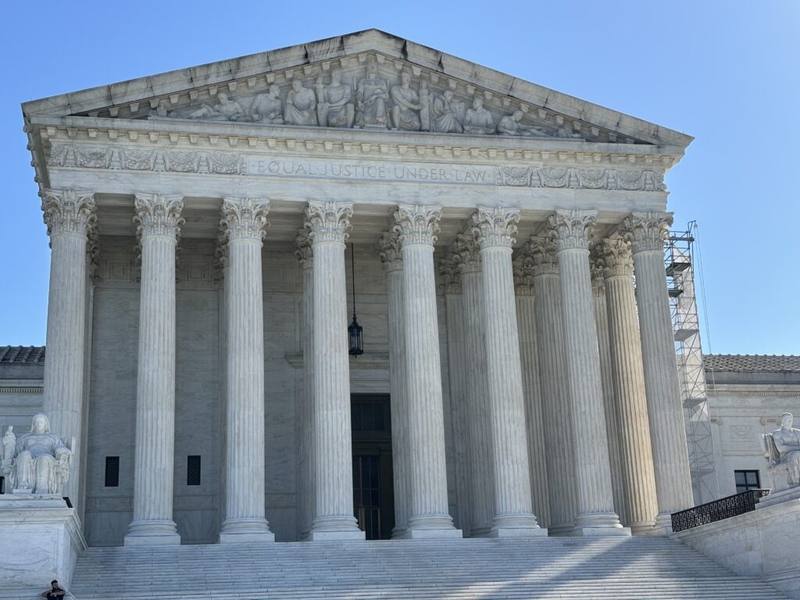
The Supreme Court on Oct. 9, 2024. (Photo by Jane Norman/States Newsroom)
During arguments in a Louisiana case, U.S. Supreme Court justices seemed open to limiting the consideration of race in the redistricting process, a move that would undermine a key provision of the Voting Rights Act.
Conservative justices, who make up the court’s majority, seemed sympathetic to arguments made by Louisiana Solicitor General Benjamin Aguiñaga and President Donald Trump’s administration. They argued the consideration of race in the redistricting process violates Constitutional requirements that people are treated equally regardless of race.
The case in question, Callais v. Louisiana, challenges the legality of a second majority-Black congressional district Republicans state lawmakers drew in 2024 in response to a federal court finding a 2022 version of the state’s congressional maps was unconstitutional. Louisiana has six seats in the U.S. House of Representatives, but just one favored a Black candidate before the redistricting process in a state where nearly a third of the population is Black.
How we got here: Louisiana’s redistricting case puts the Voting Rights Act on trial
The case has since been shaped into a test of Section 2 of the Voting Rights Act of 1965, a landmark federal law that prohibits racial discrimination in elections. Section 2 prohibits voting laws or procedures that purposefully discriminate on the basis of race, color or membership in a language minority group.
The outcome of the case could have nationwide implications, as it could determine the degree to which race can be considered when drawing election maps after each decennial census.
The Callais case is also notable because justices were originally supposed to rule on the case earlier this year. But in a rare move, they punted a decision to their next term.
They also posed new questions for parties to answer: Did the Louisiana Legislature’s creation of a second majority-Black district violate the 14th or 15th amendments to the U.S. Constitution?
The 14th Amendment, in part, covers representation in Congress, and the 15th Amendment prevents citizens from being denied the right to vote based on their race.
Voting Rights Act supporters rally outside Supreme Court as justices hear Louisiana case
The case is being carefully watched, as any ruling that cuts back on Section 2 would likely lead to states redrawing their congressional maps to eliminate majority minority districts.
Fair Fight Action, a progressive voting rights organization, predicts that if the Supreme Court sides with conservatives and hollows out Section 2, states could redraw up to 19 majority Black districts to make them competitive or safe seats for Republicans.
Though Louisiana Attorney General Liz Murrill originally defended the map challenged by Callais, her short-lived alliance with Black voters ended in September when Republicans and groups supporting Black voters filed opposing briefs.
Attorneys representing the state, the Trump administration and the white voter plaintiffs in Callais argued the framework for proving a Section 2 violation should be modified. The so-called Gingles test, which arose from a 1986 Supreme Court ruling, set the standards for determining whether election districts meet federal standards.
The Gingles test
Created by the U.S. Supreme Court in the 1986 case Thornburg v. Gingles, plaintiffs must show the existence of three preconditions to prove racial vote dilution:
- The racial or language minority group “sufficiently large and geographically compact to constitute a majority in a single-member district”
- The minority group is politically cohesive
- The majority votes sufficiently as a block to usually defeat the minority’s candidate of choice
Chief Justice John Roberts and Associate Justice Brett Kavanaugh voted to uphold the constitutionality of Section 2 just two years ago in Allen v. Milligan, an Alabama case that required the addition of a majority-Black congressional district. Both asked questions during Callais arguments, indicating their openness to revisiting the recent precedent.
“This court’s cases in a variety of contexts have said that race-based remedies are permissible for a period of time, sometimes for a long period of time, decades, in some cases,” Kavanaugh said, “but that they should not be indefinite and should have an end point.”
Voting rights advocates note that the Gingles test provides a time limit unique to each situation.
“Section 2, by itself, automatically sunsets as conditions on the ground get better,” Michael Li, senior counsel for the Brennan Center for Justice, a progressive organization that follows redistricting issues throughout the country, said in an interview earlier this year.
Kavanaugh also seemed sympathetic to U.S. Solicitor General John Sauer’s proposal that plaintiffs seeking judicial relief from a violation of Section 2 should be required to take a state’s political motivations into consideration when offering alternative districts. For example, this could include drawing a district to not just keep an incumbent in their district but to ensure the incumbent’s victory.
“That suggestion would swallow Section 2 whole,” NAACP Legal Defense Fund attorney Janai Nelson said. “Party cannot trump the responsibility of states to ensure that all voters have an equally open electoral process.”
Nelson, representing Black voters, argued the Voting Rights Act is the sole reason there is Black representation in Louisiana.
Until the Voting Rights Act was enacted, many promises of Reconstruction-era amendments to the Constitution were largely unfulfilled as Black voters were suppressed under racially oppressive Jim Crow laws.
“[Section 2] is an intervention that has been crucial to diversifying leadership and providing an ability of minority voters to have an equal opportunity to participate in the process,” Nelson said. “But it also isn’t a permanent remedy. It corrects itself over time, and it’s only triggered when those extreme conditions exist.”
Liberal justices on the court sharply questioned Aguiñaga and U.S. Principal Deputy Solicitor General Hashim Mooppan about their proposed changes to the Gingles framework.
“The bottom line is, just get rid of Section 2,” Justice Sonia Sotomayor said of the pair’s arguments.
Though conservatives advocate for an end to race-conscious redistricting under Section 2, Aguiñaga said other applications for the statute are “fair game.” Most Section 2 cases are about discrimination at the local government level, primarily challenges to at-large districts that critics say dilute minority voting strength.
Black voters react
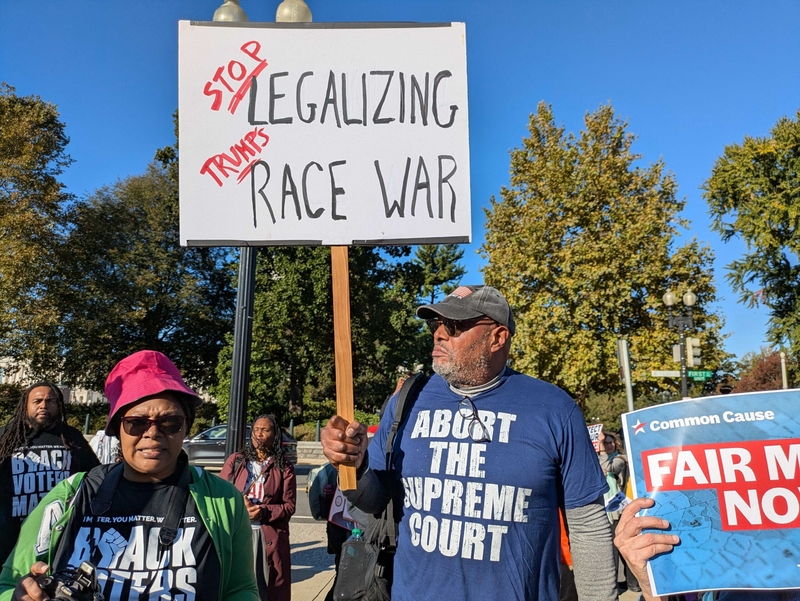
As oral arguments were underway, hundreds gathered outside the court. Nearly two dozen advocacy organizations, including the NAACP, the League of Women Voters and the National Urban League, led a “Fight for Fair Maps” rally.
The Rev. Shavon Arline-Bradley, president and CEO of the National Council of Negro Women, told the crowd that as a descendent of slaves in Florida and South Carolina, “I come with blood of resilience in my veins.”
“Every time you face opposition, just look at it and say, ‘No weapon against us shall prosper.’ Section 2 will be intact after they do their work inside that Supreme Court,” Arline-Bradley said. “And I stand on my 10 toes, ready to fight until justice is won.”
Fletcher Johnson of Baltimore stood among the rallygoers and said he’s concerned about voter suppression in next year’s congressional midterm election.
“We’re losing the country really fast, and we got to fight for every inch of it,” Johnson, 68, said. “So this, this decision here, is going to be critical to our voting rights, and they’re trying to dismantle everything that we’ve worked for.”
Potential outcomes
There is no set date for when justices will rule on Callais, but it is likely to be next spring before the end of June.
Justices could uphold Louisiana’s challenged 6th Congressional District, which Rep. Cleo Fields, D-Baton Rouge, currently holds. This outcome would lead to few or no changes nationally.
If justices overturn Fields’ district and remand the case to the state without addressing the constitutional questions, Louisiana would be required to adopt a new map that maintains two majority Black districts. State lawmakers would likely have to do so by picking a map preferred by Black voters, likely one with a district anchored in Northeast Louisiana that complies with more traditional redistricting principles than the one Republicans chose last year.
This would also likely allow Fields to keep his seat.
Or justices could overturn Fields’ district and set new precedent scaling back Section 2. That could give Republicans in Louisiana the opportunity to draw a map with one or even no majority Black districts, giving Republicans an opportunity to win Fields’ seat and the 2nd Congressional District, currently held by U.S. Rep. Troy Carter, D-New Orleans.
“For decades, the court’s conservative majority has chipped away at this landmark civil rights law,” Carter said at a news conference after the arguments. “Now section two, which prohibits voting practices that discriminate based on race, is on the chopping block.”
“If struck down, Louisiana could lose its two majority Black congressional districts, silencing Black voters,” Carter added.
With the Trump administration leaning on states to carve out extra seats ahead of the 2026 midterms, other Republican-controlled states with majority minority districts could follow suit.
In anticipation of the ruling, the Louisiana Legislature is considering a special session in the coming weeks to push back the qualification deadline for next year’s congressional elections. Doing so would give lawmakers enough time next year to adopt a new redistricting plan.
In August, Gov. Landry directed lawmakers to set aside dates for another redistricting special session, but legislative leaders expressed reluctance to do so before justices made a decision in the Callais case.
Whether a decision will come in time to influence midterm election results will vary by state.
Ashley Murray contributed to this report from Washington, D.C.
Baton Rouge, LA