Salem mayor leads effort to expand local ability to sweep homeless encampments
Oct 21, 2025 | 1:55 pm ET
Description
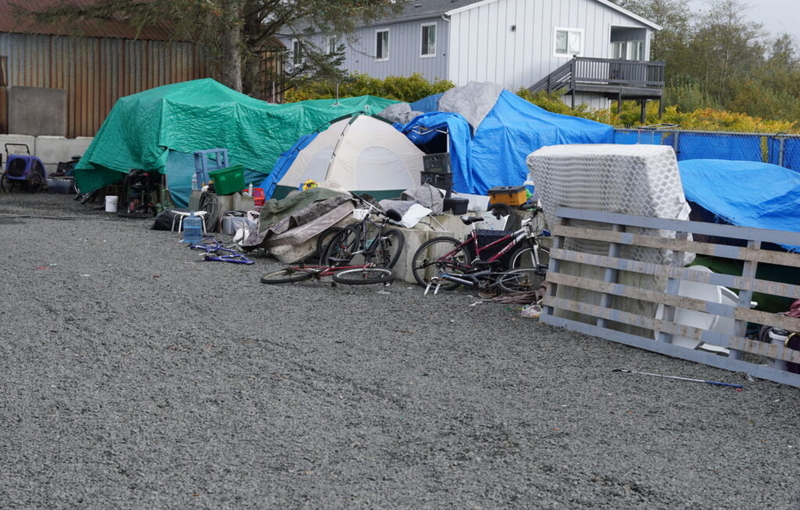
A city-designated site for homeless camping in Seaside on Oct. 8, 2024. Clatsop County started a deflection program to help people in addiction enter recovery services. (Photo by Ben Botkin/Oregon Capital Chronicle)
This article originally appeared in Salem Reporter.
Salem Mayor Julie Hoy has joined a coalition of the state’s largest employers seeking to make it easier for cities and counties to remove homeless people and their belongings from public spaces.
Hoy and two other chief petitioners filed an initiative Oct. 15 with the Oregon Secretary of State’s office titled “The Local Control & Safety Act.”
It seeks to repeal a 2021 state law that requires cities to justify whether removing someone from the public place they’re sitting, lying or sleeping is “objectively reasonable as to time, place and manner.” They’re hoping to gather enough signatures to put the measure to Oregon voters in the November 2026 election.
“Homelessness continues to be the issue the people of Salem care most about solving. We need more tools to be able to deliver, and this would offer another tool,” Hoy said in a Monday text to Salem Reporter.
Within current state laws, the city of Salem already bans camping in areas including near building entrances and encampments that block sidewalks. The state requires that cities give people a 72-hour notice before clearing an encampment. That’s in a separate statute which the initiative petition doesn’t address.
Hoy declined to share further information about her intentions and motivations for leading the initiative petition after the news publication denied her request to send written questions in advance. She referred further questions to Oregon Business & Industry.
She did not use her mayoral title when filing the petition.
“Mayor Julie Hoy filed the petition as an individual resident. The city has no response on the petition. Mayor Hoy said she will not comment to you about this,” said city spokeswoman Erin Neff in a Tuesday email to Salem Reporter.
The initiative effort is led by Preston Mann, director of external affairs for Oregon Business & Industry and Portland lawyer and policy advocate John DiLorenzo, alongside Hoy. Oregon Business & Industry is the statewide chamber of commerce, which in 2023 led a successful effort to put the city’s payroll tax on the ballot, an issue that propelled Hoy’s mayoral campaign.
The mayor has made public safety and homelessness major focuses of her time in office, including directing Police Chief Trevor Womack in June to develop a plan to increase police presence downtown in response to calls from business owners to address homelessness, safety and cleanliness. After a series of public forums throughout the summer, the city council unanimously approved a plan last week to expand police and cleaning crews, and to stand up a new crisis response team through the fire department.
Hoy’s involvement in the petition shows an apparent break from longstanding city approaches toward homelessness. Local homeless service providers say the petition’s goals would further criminalize homelessness and harm both local governments and homeless people.
The petition will need to gather at least 117,173 valid signatures by the end of next summer in order to be added to the November 2026 ballot for voters’ consideration.
The petition states that “homelessness and unsanctioned public camping represent a clear and present danger to unhoused Oregonians and community safety,” and that encampments in public spaces negatively impact tourism and economic growth.
The effort comes amid a nationwide shift away from housing-first policies at many levels of government, as the Trump administration pushes to expand states’ abilities to jail and institutionalize homeless people. For decades, federal government policies and funding have supported the proven-effective approach of ending homelessness by giving someone a place to stay where they can have more stability to address other challenges in their lives, rather than requiring that they be sober or work in order to get housing assistance.
Experts say that when encampments are cleared by law enforcement with little notice, or when homeless people are arrested for trespassing, it typically will only displace someone and make it harder for them to use services and get housed.
In Salem, the city already has the ability to remove encampments on public property if they post a notice asking its residents to leave within 72 hours. It has typically enforced this in areas where encampments block sidewalks or put campers in harm’s way of traffic. Large encampments like the one at Salem’s Wallace Marine Park have remained for years.
Some common Salem encampment spots, such as the Market Street underpass, are under the Oregon Department of Transportation’s jurisdiction.
Police can already fine homeless people for camping, though the Salem Police Department rarely does so, instead opting to have officers talk to people about available resources. The city issued two citations under its camping ordinance in 2023 and none in 2024. They issued one warning and one citation so far in 2025, Neff said.
Mann, in an emailed statement to Salem Reporter, said that “Local control over unsanctioned public camping is essential to promoting public health and safety. Yet, under existing, outdated law, our cities’ and counties’ hands are tied.”
Mann said that, beyond his statement, he did not have time to address specific questions from Salem Reporter about points within the filing or Hoy’s involvement ahead of the publication’s deadline.
News of Hoy’s involvement in the initiative drew concern from local homeless advocates and providers in several local Facebook groups.
Jimmy Jones, the executive director of the Mid-Willamette Valley Community Action Agency which oversees much of the region’s homeless services, said he is not surprised about Hoy or the others’ involvement in the initiative.
“Mayor Hoy has expressed repeated concern about the damage done to public safety, public health and the economic development of the community at the hands of homeless communities,” he said in an email. “We do hope, however, that the community as a whole takes the time to understand this complicated issue. Criminalization is a failed strategy.”
Jones said, should the initiative succeed, it would increase workloads for local police and governments while failing to address the root causes of homelessness.
“It’s going to make the homeless problem in Oregon much worse than it is. But it’s also a bad idea for cities and counties, who are only going to see their cost increase considerably when they become this instrument for pushing poor people from one part of the state to the next,” he said in an interview.
Jones said the claim that the cities and counties don’t have enough tools to address homelessness is “patently false.”
“There are plenty of justifications in the law as it currently exists to be able to remove homeless camps. That is absolutely, demonstrably false if anybody’s claiming that they just need more tools here,” he said. “This is another step down the path to criminalizing the homeless condition, and it would make it a far worse place than what we have right now.”
Changes in the laws
Efforts to restrict homeless encampments on public property gained momentum in Oregon after the Supreme Court’s June 2024 ruling that cities can ban homeless people from sleeping outside, even if they have nowhere else to go. That case arose from the city of Grants Pass’ efforts to remove homeless encampments despite limited and inaccessible shelter space.
Several bills trying to repeal the state’s law regulating camps on public property were introduced, but failed to progress, in the most recent legislative session.
Oregon Business & Industry’s petition asks that the state update its laws to align with the Supreme Court’s ruling.
“Despite the U.S. Supreme Court’s decision in the city of Grants Pass v. Johnson, which made clear that local governments can enforce camping regulations, Oregon communities are restricted from doing so under state law,” the petition states. “(State law) continues to interfere with local communities’ ability to protect parks and open spaces for the enjoyment and use by Oregon families.”
The existing state law, HB 3115, was created through a collaborative effort which included the League of Oregon Cities, Association of Oregon Counties and nonprofits, Jones said. His agency was among dozens supporting the bill.
“We don’t want law enforcement just showing up, telling people ‘You’ve got 5 minutes to pack whatever you can pack and then leave.’ We want to avoid that when we possibly can because it scatters homeless populations and relationships have to be rebuilt. Enormous trauma is created in those moments, a lot of good case work that’s taken place is set back. We lose access to people because we can’t find them anymore,” he said.
Jones said he’s known people that died homeless despite having a housing voucher ready with their name on it, because they were moved and outreach workers couldn’t find them again.
Jones said the bill sought to allow cities the ability to regulate camping when sites become a public health or safety issue.
“There has to be a certain standard or reasonableness attached about it, and there has to be notice,” he said. “There is a process that goes along with it, and that process has made it safer for everybody involved.”
The petition also states that Oregon’s laws are “confusing and undefined,” putting local governments at risk of lawsuits.
Jones said that prior to the state laws, cities and counties were “getting sued hand over fist” for violating existing time, place and manners standards. Having a single state law prevents those suits, he said, saving cities and counties money.
Becky Straus, managing attorney with the Oregon Law Center which originally filed the Grants Pass lawsuit on behalf of the city’s unsheltered residents, said in an email to Salem Reporter that the organization opposes Oregon Business and Industry’s petition.
“Oregon’s camping law maintains a balance between cities’ need to manage public space and protecting the civil rights of our most vulnerable neighbors. The law merely requires that limits on camping are reasonable. This misguided petition carelessly sends cities back to the drawing board and risks a harmful descent into unchecked, punitive approaches to homelessness,” she said.
The petition also implies that the law requiring “objectively reasonable as to time, place and manner” has contributed to a statewide increase in homelessness, despite increasing shelter capacity.
“Oregon’s homeless population has increased dramatically since ORS 195.530 was enacted, demonstrating its ineffectiveness,” the petition states.
Jones said that’s false.
“The real cause of the growth of homelessness over the last 20 years in Oregon is simply the lack of affordable housing, and the significant increase in cost of living,” Jones said. “The public should just sit back and ask themselves: am I paying more to rent now than I was eight years ago? Am I paying more for gasoline? Am I paying more for health care? Am I paying more for food? Am I paying more to keep the lights on? And the answer to that for almost everybody is: ‘yes.’”
Mann said that repealing the state law would be a critical step into helping local leaders address their community’s needs.
“Oregonians want solutions and our sincere hope is that the Legislature will repeal this law during the 2026 session, and we will work closely with lawmakers to help make that a reality. However, we believe it’s necessary to file this initiative to preserve the opportunity for Oregonians to act on this commonsense policy change if the Legislature doesn’t,” he said.
A political action committee formed to support the initiative had no financial contributions or expenses listed as of Monday.
UPDATE: This story was updated Tuesday morning to include comments from city spokeswoman Erin Neff and the number of camping citations the Salem Police Department issued in 2025. Neff initially told Salem Reporter there had been zero citations, but later said they had issued one warning and one citation.

Salem, OR