Arizona families fear financial ruin, homelessness, as new disability care restrictions loom
Sep 11, 2025 | 12:31 pm ET
Description
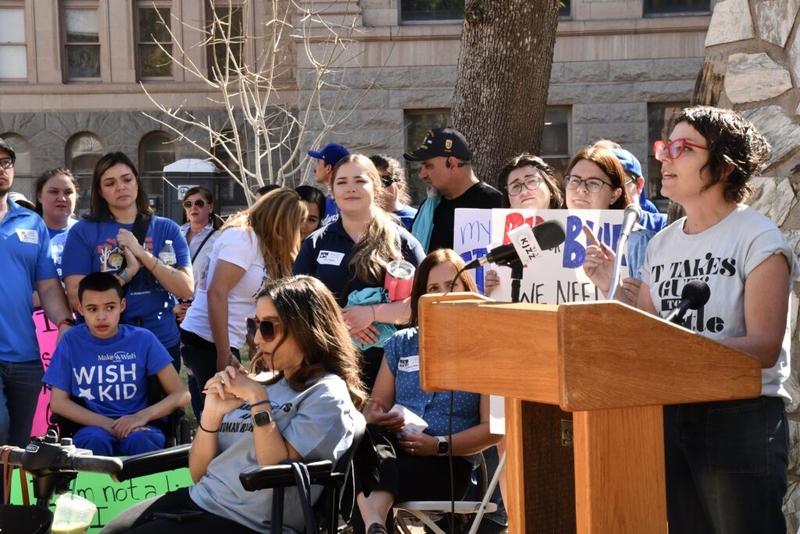
Kathleen Muldoon, who relies on Division of Disability services to help care for her son, pushes for funding alongside other members of the developmentally disabled community on Feb. 26 at the Arizona Capitol in Phoenix. Photo by Caitlin Sievers | Arizona Mirror
Advocates for and members of Arizona’s developmentally disabled community were already exhausted when they were hit last week with new restrictions on care covered by state programs.
Some say those restrictions leave them in fear of financial ruin and possibly even homelessness.
It was less than six months ago that these same advocates won a hard-fought battle at the state Capitol that they thought secured funding for critical programs that, for many, are a lifeline. After months of protests and lobbying, they convinced lawmakers to pass a supplemental funding bill for the Division of Developmental Disabilities to prevent insolvency and to ensure people who depend on its programs continued to get the care they need.
But Republican lawmakers only agreed to the $122 million in supplemental funding — ensuring that 65,000 Arizonans with disabilities kept access to vital services — because it was paired with guardrails for the Parents as Paid Caregivers Program, which was a major contributor to the funding shortfall.
The PPCG pays parents to provide in-home care to their own children, but only if they require “extraordinary care” above and beyond typical parenting tasks. That might include assisting a teenager who has cerebral palsy, autism or cognitive disabilities with tasks like bathing, dressing and eating.
The program has roughly doubled over the last year from 3,000 participants to around 6,000, which came with substantial cost increases. Initially, the program was entirely federally funded, but as of earlier this year, the state is on the hook to fund around 35% of its cost. PPCG was created in 2020 during the COVID-19 pandemic as a temporary response to a widespread caregiver shortage, but it got approval from the federal government in 2024 to continue permanently.
House Bill 2945, which contained the new limits for the PPCG program, passed with bipartisan support in April. But the Arizona Healthcare Cost Containment System, the state’s Medicaid program which is better known as AHCCCS, along with the Division of Developmental Disabilities, were charged with creating rules based on that legislation. Those new rules were posted for public comment in May and were revised based on those comments, with the final versions shared in a DDD public forum Sept. 4.
But even parents who are involved in advocacy for the community, including some who are on the Member Advisory Council for DDD, said they weren’t aware of strict age-based restrictions on services that essentially bar payments for care of young children until that Sept. 4 meeting, less than a month before the rules are set to take effect on Oct. 1.
This has left parents who rely on the Parents as Paid Caregivers program panicking and scrambling to figure out what to do moving forward, Michele Thorne, co-founder of Care 4 the Caregivers, told the Arizona Mirror.
We have families who are really, truly believing that they are going to end up homeless because of this.
“We have families who are really, truly believing that they are going to end up homeless because of this,” Thorne said. “Because the hard age limits were kind of hidden from the public view and only presented when the policy document was finalized, that’s what really threw everybody.”
In a review of the documents posted for public comment, the Mirror could not locate any reference to specific age limits for care reimbursements, though it was in the presentation made on Sept. 4.
Those age limits include bans on paid hours to help children with specific tasks. As of Oct. 1, there will be no reimbursement to help a child younger than six with toileting or to assist a child younger than eight with bathing, for example.
Some of the rules are based on language in HB2945, which says “a parent caregiver may not bill for attendant care services for housekeeping, laundry or meal preparation that would ordinarily be performed by a parent of a minor child who does not have a disability.”
But other rules go beyond any requirements set by the state legislature, and they apply to all services provided through DDD, not just the ones provided by parents.
The rules put a strict ban on payment for what is called attendant care supervision services for children younger than 10 years old. That might make sense to people outside of the disability community since supervision of a child younger than 10 seems like an everyday parenting task for a kid without disabilities.
But Brianna Falsetti, a Yavapai County mother of six children between the ages of nine to 19 who rely on DDD services, told the Mirror that the level of supervision needed for many of the children younger than 10 is above and beyond what other children might require.
“You have to have line of sight,” she said.
Some of these parents quit their jobs because they couldn’t find someone else to care for their child and will soon be stuck without pay or childcare.
Many day cares aren’t equipped to care for children who need constant one-on-one supervision. And some of the children who rely on DDD are nonverbal, which makes parents reluctant to trust others to care for them, since the child can’t tell them if something neglectful or inappropriate were to happen in another person’s care.
This problem is especially true for parents of children with disabilities in rural areas of the state, like Falsetti, where there might not be any daycare facilities that have the capacity to care for a child with special needs.
The new rules also put strict limits on the number of hours of habilitation care — or training in skills to prepare them for independent living, to improve sensory-motor development, mobility and behavior intervention or physical, occupational or speech therapies.
After Oct. 1, children two or younger will not have access to any habilitation services paid by Medicaid and limits will be imposed based on age range for older children, with a five-hour weekly limit for kids ages three to five.
With the federal government slashing Medicaid and stripping health care from hundreds of thousands of Arizonans, the state must work to prepare for billions of dollars in lost funding and costly new red tape forced on it by Washington politicians to sustain life-saving health care services.
Thorne said she struggled to understand those limits, especially after she witnessed how the habilitation services provided to her nonverbal autistic son have helped him.
“We benefited greatly from having habilitation when he was younger, because it really helped to have him fill in those gaps and different therapies that he wasn’t getting in other places,” she said. “We know that early intervention is really what helps these children thrive.”
Thorne added that the disability community “would like just a little more transparency regarding how these decisions are being made.”
Although she had hoped that she could get some answers during a Sept. 10 DDD Member Advisory Council meeting, Thorne told the Mirror that she walked away from it with scant new information.
“Why weren’t we alerted and why wasn’t there more transparency around (the new limits on care hours)?” Thorne asked. “We’re talking about real world impacts to service hours for our kids.”
The public information office for AHCCCS said Wednesday that it was in the process of researching the Mirror’s questions about when the age limits for care were first released to the public.
Back in February, some Republican lawmakers, led by Rep. David Livingston of Peoria, called for significant cuts to the PPCG program due to skyrocketing costs. Livingston and other Republicans blamed Democratic Gov. Katie Hobbs for continuing the program after the GOP-controlled legislature refused to specifically allocate funding to it in the 2025 budget.
The Hobbs administration played a key role in negotiating the terms of the supplemental funding bill and the stipulations that came with it. Christian Slater, a spokesman for Hobbs, defended the legislation in a statement to the Mirror, pointing out that, even after the rule changes, Arizona is still one of the “most generous” states when it comes to providing DDD services and paying parents as caregivers.
“Governor Hobbs proudly signed legislation into law that protects healthcare for over 60,000 Arizonans with developmental disabilities after extremist Republicans threatened to slash the program by 50%,” Slater said.
He added that, without Hobbs on their side, families who rely on DDD services would have seen devastating cuts and the complete elimination of the PPCG program.
Slater said that, while changes to DDD services are not a direct response to deep Medicaid cuts that are coming thanks to President Donald Trump’s “One Big Beautiful Bill,” they are related. Many of those services are not required by federal law, and are the first to be cut any time that funds are tight.
“In order to maintain continued success delivering critical services to disabled Arizonans, the Governor worked with families and bipartisan legislators to enact guardrails that protect taxpayer dollars, curb spending and limit covered services for minors to those that are clinically appropriate for kids,” Slater said in his statement.
Both care hours and cost of DDD attendant care and habilitation services have risen dramatically since 2019, according to information provided by the Governor’s Office.
Annual spending for attendant care in Arizona increased from $17 million in fiscal year 2019 to $318 million in 2025. Spending on habilitation services increased from $60 million to $295 million in the same time period.
While the presentation from DDD last week blamed the changes in covered care on the new state law and the terms of the federal Medicaid waiver that allows the PPCG to continue permanently, Thorne said she doesn’t totally buy that.
“I think, at some level, you know that federal budget cuts are going to hit Arizona hard,” she said. “They’re not coming out and saying it, but I think that has to be our assumption.”
It’s expected that Arizona will lose an estimated $34 billion in federal Medicaid funding over 10 years, and the state has to deal with those cuts somehow.
Slater on Wednesday confirmed Thorne’s suspicions.
“With the federal government slashing Medicaid and stripping health care from hundreds of thousands of Arizonans, the state must work to prepare for billions of dollars in lost funding and costly new red tape forced on it by Washington politicians to sustain life-saving health care services,” he said.
***CORRECTION: This story has been corrected to show that Brianna Falsetti lives in Yavapai County.
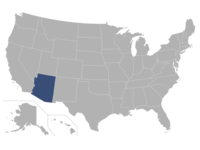
Phoenix, AZ