Butterfly stampede: More than 22,000 sign up for ID logo alerting to hidden disabilities
Jun 10, 2026 | 2:19 am ET

Description
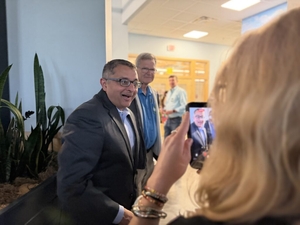
Linda Carpenter-Grantham and her son Eric pose for a picture June 1 at a campaign event in Silver Spring hosted by Montgomery County Executive Democratic candidate Will Jawando. (Photo by William J. Ford/Maryland Matters)
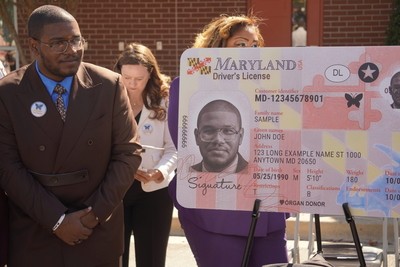
When Eric Carpenter-Grantham became the first person in Maryland to get a new state-issued identification card last fall with a special butterfly logo to identify his hidden disability, he encouraged others to follow him. That was Oct. 1.
As of last week, more than 22,000 Marylanders had done just that, asking the Motor Vehicle Administration for the logo that was made possible under what became known as “Eric’s ID Law.”
“It shows it is really needed for people who cannot speak for themselves,” Carpenter-Grantham, 21, said during a recent interview.
The Montgomery County resident has high-functioning autism, and the logo is designed to alert police and other emergency responders to the developmental or intellectual disabilities that are not immediately noticeable with Eric, and others like him. The decal can be placed not only on driver’s licenses but on MVA-issued identification cards and even moped operator permits.
The law also requires that the state Police Training and Standards Commission, in consultation with the State Police and other stakeholders, “implement training concerning interactions with individuals who have a nonapparent disability.”
Kimberly Boddie of Prince George’s County, who has an hidden disability and the butterfly logo on her ID, said police training is sorely needed.
“If a police officer is talking to me and I turn my head, a police officer may think I’m being rude. I’m sensitive to light,” Boddie, 49, said Friday. “Training helps officers and just makes things better.”
Boddie said she doesn’t drive due to a trifecta of ailments – lupus, Raynaud’s disease and Sjogren’s syndrome.
Lupus is an autoimmune disease that can cause joint pain and inflammation in various parts of the body. Sjogren’s is another autoimmune disease that creates dry eyes and lack of moisture in the mouth. The disease can trigger Raynaud’s, a disorder that restricts blood flow that Boddie said can make her “hands turn blue and makes me immobile. I’m an autoimmune warrior.”
Boddie was officially diagnosed with all three in 2020, then noted jokingly, “But I never got COVID.”
‘Remarkable young man’
The Carpenter-Grantham family has not just been sitting at home and relishing its success since getting a state law passed.
They have traveled to other states to lobby for passage of legislation like Eric’s ID Law, in states such as Delaware and New York. Linda Carpenter-Grantham, Eric’s mom, said they are already planning to return to Georgia next year to work on a bill that did not win passage during this year’s legislative session.
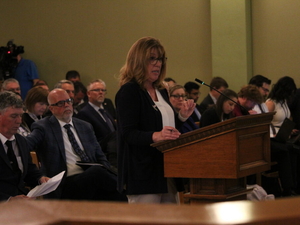
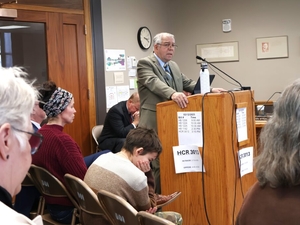
The mother-and-son duo traveled across the border into Washington, D.C., and testified Thursday before the D.C. City Council’s Committee on Transportation and the Environment on the “Eric’s ID Amendment Act of 2026.” The bill would allow applicants for a license, permit, or identification card to have the applicant’s nonapparent disability noted on the credential.
“As a person with autism, I understand how it feels to be misunderstood sometimes. People with autism and other invisible disabilities communicate differently, need extra time to process information, or react differently in stressful situations,” Eric said in his testimony to the committee.
“Unfortunately, those differences can sometimes be failures to follow rules, or change of behavior, instead of being recognized as a disability. This is why this legislation matters,” he said.
Several other Marylanders joined the family to testify in support of the D.C. measure, including Boddie, Laurel City Councilmember Kyla Clark and Prince George’s County Dels. Kym Taylor and Karen Toles, both Democrats. Taylor, who has an adult son with an invisible disability, was a co-sponsor of the Eric’s ID bill when the General Assembly passed it into law last year.
Taylor summarized how the Maryland law and the D.C. bill are both strictly voluntary.
“This bill does not require anyone to disclose a disability. It does not create a registry. It does not require medical documentation. It does not impose additional fees,” she said. “Instead, it empowers individuals and families with a voluntary tool that can facilitate understanding during critical interactions.”
Meanwhile, the Carpenter-Granthams may return to Annapolis next year with a proposal for an Eric’s ID amendment to produce butterfly stickers and have them placed on vehicle windows to inform police officers someone with a non-apparent disability is inside.
The Worcester County Sheriff’s Office has already promoted not only stickers, but also buttons with informational cards. Representatives from the office will hand them out during the Ocean City Air Show on the weekend of June 13. The Carpenter-Grantham family plan to be there, too, to talk about the law.
“I want to celebrate this for Eric because he’s a remarkable young man to have this vision,” said Worcester County Sheriff Matt Crisafulli. “This [will] help first responders – law enforcement, paramedics, firefighter personnel. Think about the benefits this will have for everyone. This is just huge for our residents and visitors who have those hidden disabilities.”
Linda Carpenter-Grantham hopes other sheriffs will follow Crisafulli’s lead.
“The sheriff was just so excited to follow up with Eric’s ID Law. It’s good to see,” she said. “This is something we need to get done.”
Annapolis, MD