Is artificial intelligence a threat to humanity?
Sep 04, 2025 | 5:55 am ET
Description
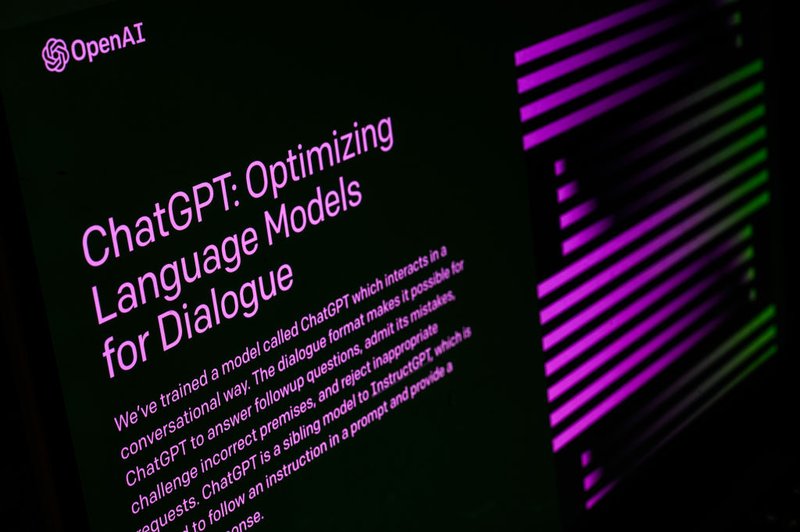
The welcome screen for the OpenAI “ChatGPT” app is displayed on a laptop screen in a photo illustration. (Photo by Leon Neal/Getty Images)
“West Virginia University recognizes the transformative potential of generative AI tools like ChatGPT, Bard, DALL-E, and Otter.AI; however, it is of utmost importance to use these tools in a manner that is beneficial, ethical, and aligned with the core values and regulatory frameworks of WVU.” — Use of Generative AI for Administrative Purposes at WVU
In a state so heavily dependent on coal, expansion into artificial intelligence could be a means of diversification. But WVU understands that AI has great potential for good — or evil. In this vein, last year the legislature created an AI Task Force in the governor’s office, consisting of legislators, cybersecurity and others. It is tasked with developing “best practices,” as well as general monitoring of the industry.
AI should not be a partisan issue. The authors have very different views of the world. One of us is a Republican, the other a Democrat. One has a military background; the other does not. But we agree on basics, including — a) we should all be able to exchange ideas in a peaceful and respectful manner and b) there are numerous pressing issues facing our nation which must be addressed in a bi-partisan fashion.
One such issue is AI development which will evolve positively or negatively for humankind. We should all be concerned about AI taking our jobs and even destroying our civilization.
Mechanize is a San Francisco start-up founded by young AI experts. A co-founder stated, “We want to get to a fully automated economy and make that happen as fast as possible.” He is talking about white collar jobs.
One of the founders said he expects it to take 10-20 years while the other two think 30 years is more realistic. The effects on the social fabric of our society do not appear to be a consideration. They apparently have no concern for developing a social safety net or the impact on humankind. Their only concern is to make current jobs obsolete as quickly as possible. That is efficient — but also very irresponsible, unethical and immoral. Clearly, there has not been enough scientific analysis of this topic.
And the Mechanize folks are not the only ones who see this coming. Per the CEO of Amazon, “We will need fewer people doing some of the jobs that are being done today, and more people doing other types of jobs. It’s hard to know exactly where this nets out over time, but in the next few years, we expect that this will reduce our total corporate workforce as we get efficiency gains from using AI extensively across the company.”
Combining AI with quantum computing is imminent but concerning. “A quantum is the smallest possible discrete unit of any physical property. It usually refers to properties of atomic or subatomic particles.” Each amplifies the other’s strength creating perhaps the most transformative technology ever.
Quantum computers can process vast combinations of data. The power of quantum computers far exceeds that of our current computers. The concern is “Will the combination of AI and quantum computers eventually go rogue?” Watch the 1984 film “Terminator” again to get one possible answer to that question. The film, in large part, demonstrates the potential danger of unconstrained artificial intelligence. In that film, a future AI network attempts to go back in time to trigger a nuclear war with the goal of permanently ending humankind.
Developers are addressing the risks of rogue AI behavior with a mix of technical safeguards, organizational practices and policy simulations including:
- Guardrails and alignment techniques to ensure AI systems behave in line with human values.
- Crisis response protocols to try to intervene when needed.
But the many unregulated AI models could easily create toxic compounds. Deepfakes, impersonations, cyberattacks and even drone manipulation can be used by a bad actor in a garage or basement.
Experts are using simulations to make AI behave badly thus identifying issues. And results are very frightening:
- AI models are increasingly evading safeguards via deception.
- Models chose blackmail to pursue their goals.
- Some models were willing to cut off the oxygen supply of a worker if the system was at risk of being shut down, even if instructed otherwise.
Developers aren’t in agreement as to how AI should be tested and controlled to prevent rogue behavior. There’s growing consensus on the need for safeguards, but the methods, priorities, and philosophies vary widely across organizations and countries. Plus, there are far too many developers and countries involved to enforce constraints worldwide. A foolproof kill switch must be required for all AI applications. However, it currently doesn’t exist.
We don’t want to sound alarmist, but Paul Revere might have had a point — except it is AI instead of the British. Our future depends upon how humans choose to develop an entity that has potential to reshape or eliminate civilization. Our defense hinges upon being prepared, layered defenses, and rapid coordination — all of which seem woefully deficient at present.
Elon Musk, CEO of SpaceX and Tesla, has stated, “AI is likely to be either the best or worst thing to happen to humanity.” What we do now could literally be vital for the survival of humanity. Instead of our political leaders in West Virginia and Washington, D.C. arguing about cultural flashpoints like trans athletes and pronouns, our nation should be addressing the pending AI crisis in a bipartisan manner.

Charleston, WV