How did Trump do in the most recent U.S. Supreme Court term?
Jul 17, 2026 | 6:45 am ET
Description
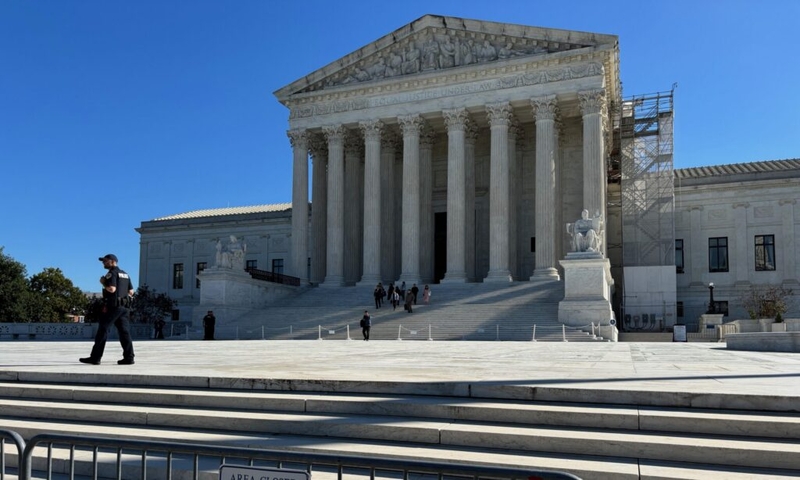
The U.S. Supreme Court sided with President Donald Trump in many of its decisions this term, with a few high-profile exceptions. (Photo by Jane Norman/States Newsroom)
In her analysis of the most recent U.S. Supreme Court term, Amy Howe of SCOTUSblog pondered whether it was “the Trump term?” after mixed results for President Donald Trump on the cases involving his agenda.
So, how did Trump do?
The court checked Trump with high profile decisions against him on tariffs, birthright citizenship, and his desire to fire Lisa Cook at the Federal Reserve Board without cause. In the Trump losses, Howe has described Trump as “swinging for the fences.”
Those adverse results were largely expected.
The closeness of the 5-4 vote on the constitutionality of birthright citizenship may have been the biggest surprise. If you add in Justice Brett Kavanaugh’s vote under a federal statute, the vote was 6-3. The provocative Kavanaugh concurrence would have allowed Congress to rewrite the exceptions to birthright citizenship under the Fourteenth Amendment. But that’s not how the Constitution works.
The court gave Trump expansive new authority under its unitary executive theory.
Under this theory, the court gave Trump the power (1) to fire board members of the former independent regulatory agencies without cause, and (2) to enforce his immigration policy of mass deportations. Trump’s Department of Homeland Security was allowed to terminate the temporary protected status of Haitians and Syrians, largely without judicial review.
Writing for the court, Justice Samuel Alito did not consider President Trump’s false statement about Haitians in Ohio eating pets to be “overtly racial.” And the court allowed Homeland Security to use a process called “metering” to bar applicants from seeking asylum before the aliens crossed the border.
These were all 6-3 decisions issued by the conservative majority. The destruction of the independence of the regulatory agencies may turn out to be the most far-reaching court decision of this term.
From a purely partisan standpoint, the court gave Trump’s Republican Party major victories in the campaign finance and voting rights cases.
The court gutted the Voting Rights Act with its Callais decision. Writing for the majority, Alito created a new “updated” Section 2 test for discriminatory intent that will be virtually impossible for plaintiffs to satisfy. Again, the campaign finance and voting rights cases were 6-3 decisions.
But by a narrow 5-4 vote, the court did allow Mississippi to count mail-in ballots received shortly after the date of the election. Justice Amy Coney Barrett wrote the majority opinion.
In a series of non-merits cases, the court repeatedly sided with the Trump administration in its emergency docket. The Brennan Center for Justice reports the court ruled in favor of the Trump administration about 80% of the time in emergency docket applications over a one-year period.
The court thus blocked more than 20 preliminary injunctions or TROs issued by lower courts that would have prevented the Trump administration from engaging in unlawful actions pending full plenary review. This emergency docket pattern began in the last term and continued in the 2025-26 term.
So, it’s been sort of a mixed bag. But the results were mostly very favorable to Trump and his agenda. If you were hoping the Supreme Court would serve as a significant check on the abuse of executive power, you would be deeply disappointed.
What does all this say about the individual justices and their approach to Trump? In my view, the court this term has divided itself into three distinct camps.
The most consistent Trump loyalists are Justices Alito, Clarence Thomas, and Neil Gorsuch. Of this conservative cohort, Alito and Thomas seemed most willing to adopt even extreme administration arguments. On major cases, Gorsuch only strayed from Trump on tariffs. .
Justices Elena Kagan, Sonia Sotomayor, and Ketanji Brown Jackson voted consistently against the Trump administration. They dissented together in almost one quarter of the total cases this term. The liberal justices were adamant in their opposition to what they see as judicial and executive overreach.
As a group, Chief Justice John Roberts, Barrett and Kavanaugh were the most willing to cross the line and vote with the liberals in a few selected cases.
The best examples for Roberts and Barrett were the cases on birthright citizenship and mail-in ballots. Roberts and Kavanaugh crossed the line in the Lisa Cook appeal. And Kavanaugh had his own peculiar view on birthright citizenship. But for the most part, Roberts, Barrett and Kavanaugh stuck with the conservative majority. That’s why so many of the most controversial cases this term were decided by 6-3 votes.
SCOTUSblog reports that 28.8 percent of the cases this term were decided by 6-3 votes, and 22.7 percent of the cases were ideological 6-3 splits.
These percentages are considerably higher than they were in the last term. Only nine percent of the cases in the 2024-25 term were decided by ideological 6-3 splits.
The ideological polarization of the Court is hardening and not getting better. I don’t believe this term will instill greater public confidence.

Jefferson City, MO