Court Temporarily Reverses Prison Agency’s Suspension of Solitary Confinement Law
Jul 02, 2025 | 11:36 am ET
Description
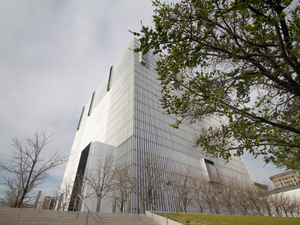
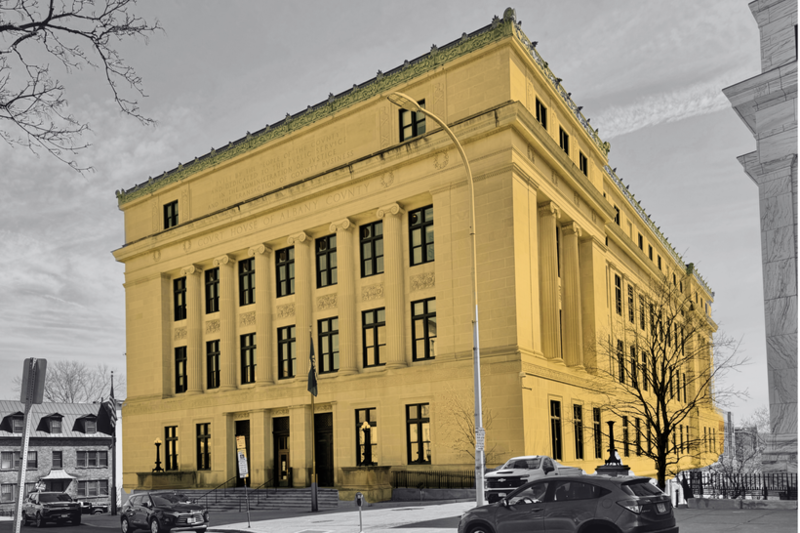
The Albany County Courthouse. | Photo: Warren Lamay via Flickr | Illustration: New York Focus.
A state court will temporarily overturn a New York prison agency policy that indefinitely suspended a solitary confinement reform law across its facilities.
The Department of Corrections and Community Supervision “wholly failed to demonstrate” that keeping the policy in place “has a basis in rational fact,” the judge wrote.
DOCCS stopped following parts of the law, which placed strict restrictions on prisons’ and jails’ use of isolation, after thousands of corrections officers and sergeants launched a wildcat strike in February. The officers said they staged the action over workplace safety and understaffing issues, specifically calling for the repeal of the Humane Alternatives to Long-Term Solitary Confinement Act, or HALT, which they allege has led to increased violence.
As part of its negotiations with the officers, DOCCS suspended its compliance with HALT — which it has never fully implemented — for 90 days, using a provision that allows for leeway in the case of “facility-wide emergencies.” The department kept the suspension in place past the 90 days, promising that it would restore HALT requirements on a “facility-by-facility” basis as post-strike staffing levels improved.
In April, roughly a month after the end of the strike, the Legal Aid Society filed a class action lawsuit in state court arguing that DOCCS was abusing its emergency authority to permanently gut HALT. Whereas HALT mandates a minimum of seven hours of out-of-cell time, incarcerated people across the prison system had been languishing in their cells for between 21 and 24 hours a day, the lawsuit alleged. It asked the court to issue a preliminary injunction overturning the suspension. The court heard oral arguments last week and granted the injunction on Tuesday.
Judge Daniel Lynch wrote that DOCCS has abused the leeway HALT gave the department to deal with emergencies. The law allows the prison commissioner to suspend aspects of HALT on a facility-by-facility basis, but he blew past that limit and suspended the law in all of DOCCS’s facilities, and for an indefinite period — “essentially permitting the exception to swallow the rule,” Lynch wrote.
DOCCS issued its suspension order “without any specific findings of fact related to the conditions in each facility,” the judge explained.
Lynch will not overturn the HALT suspension until July 11. At that point, DOCCS can only suspend the law at certain facilities if it submits new, legally compliant emergency declarations with explanations of why solitary confinement regulations would exacerbate the emergencies. DOCCS must file those emergency declarations publicly with the court, the judge ordered. For the next week, the suspension can remain in place.
The injunction is a positive sign for the Legal Aid Society’s case, which seeks to compel DOCCS to justify and limit its suspension of HALT’s mandates for out-of-cell time, recreation and educational programming, and due process for disciplinary proceedings.
“This decision reaffirms that no agency — regardless of political pressure — can unilaterally disregard laws enacted to protect human rights,” said Antony Gemmell, supervising attorney with the Legal Aid Society’s Prisoners’ Rights Project.
DOCCS did not respond to requests for comment before publication.

Albany